
I. Bad Omens (1 Kings 3:1-4)
In introducing the books of 1 and 2 Kings earlier, we noted that Deuteronomy served as the de facto constitution for ancient Israel and thus was the foundation which the historical and prophetic books hearken back to. As such, it is worth beginning this lesson by looking at what Deuteronomy 17:14-20 says about the requirements upon kings, as that sets the stage for what we will see in Kings:
14 When thou art come unto the land which the LORD thy God giveth thee, and shalt possess it, and shalt dwell therein, and shalt say, I will set a king over me, like as all the nations that are about me; 15 Thou shalt in any wise set him king over thee, whom the LORD thy God shall choose: one from among thy brethren shalt thou set king over thee: thou mayest not set a stranger over thee, which is not thy brother. 16 But he shall not multiply horses to himself, nor cause the people to return to Egypt, to the end that he should multiply horses: forasmuch as the LORD hath said unto you, Ye shall henceforth return no more that way. 17 Neither shall he multiply wives to himself, that his heart turn not away: neither shall he greatly multiply to himself silver and gold. 18 And it shall be, when he sitteth upon the throne of his kingdom, that he shall write him a copy of this law in a book out of that which is before the priests the Levites: 19 And it shall be with him, and he shall read therein all the days of his life: that he may learn to fear the LORD his God, to keep all the words of this law and these statutes, to do them: 20 That his heart be not lifted up above his brethren, and that he turn not aside from the commandment, to the right hand, or to the left: to the end that he may prolong his days in his kingdom, he, and his children, in the midst of Israel.
And a few other passages as well:
“Only thy holy things which thou hast, and thy vows, thou shalt take, and go unto the place which the LORD shall choose” (Deut. 12:26).
“Thou mayest not sacrifice the Passover within any of thy gates, which the LORD thy God giveth thee: but at the place which the LORD thy God shall choose to place his name in, there thou shalt sacrifice the Passover at even, at the going down of the sun, at the season that thou camest forth out of Egypt” (Deut. 16:6-7).
With this as the backdrop, let’s turn now to the beginning of Solomon’s reign in 1 Kings 3:1-4.
1 And Solomon made affinity with Pharaoh king of Egypt, and took Pharaoh’s daughter, and brought her into the city of David, until he had made an end of building his own house, and the house of the LORD, and the wall of Jerusalem round about. 2 Only the people sacrificed in high places, because there was no house built unto the name of the LORD, until those days. 3 And Solomon loved the LORD, walking in the statutes of David his father: only he sacrificed and burnt incense in high places. 4 And the king went to Gibeon to sacrifice there; for that was the great high place: a thousand burnt offerings did Solomon offer upon that altar.
Certainly, the things that stand out as problematic are Solomon marrying Pharaoh’s daughter and the sacrifices offered in the “high places.”
The fact that Solomon was able to marry Pharaoh’s daughter shows the relative influence the Solomon and his kingdom had at the time, since the Egypt court typically viewed all countries as inferior to itself. Politically, it made sense for Solomon because an alliance or affiliation would have secured his western border, especially as part of the dowry included Gezer (1 Kings 9:16), which was near two trade routes. Israel was prohibited from marrying Canaanites (Deut. 7:3-4), but not necessarily foreigners (recall, for example, Ruth the Moabitess). Presumably a condition of the marriage would have been that his wife would accept the worship of Israel’s God. This probably happened, since in the first part of Solomon’s reign he seems to have been faithful to God; it was in his latter years that his subsequent wives led him into false worship.
The high places would continually become a thorn in the side of Israel’s kings and faithful worship within the nation. At this point in Israel’s history, the Temple had not yet been built, and the people would have followed Solomon’s example. Worshiping at the high places would have been attractive to the people for several reasons. First, it was convenient. There were all sorts of places around the country that would have fit the bill. Even after the Temple was built, it would have been more convenient than having to trek to Jerusalem three times a year or more. Second, it gives a transcendent feeling. And, lastly, people would have been freer to “customize” their worship, rather than having to follow biblical strictures. For these reasons, the high places were problematic.
II. A King Most Wise (1 Kings 3:5-28)
Let us turn now to a key character trait of Solomon that became instrumental to his rule. Read 1 Kings 3:5-15:
5 In Gibeon the LORD appeared to Solomon in a dream by night: and God said, Ask what I shall give thee. 6 And Solomon said, Thou hast shewed unto thy servant David my father great mercy, according as he walked before thee in truth, and in righteousness, and in uprightness of heart with thee; and thou hast kept for him this great kindness, that thou hast given him a son to sit on his throne, as it is this day. 7 And now, O LORD my God, thou hast made thy servant king instead of David my father: and I am but a little child: I know not how to go out or come in. 8 And thy servant is in the midst of thy people which thou hast chosen, a great people, that cannot be numbered nor counted for multitude. 9 Give therefore thy servant an understanding heart to judge thy people, that I may discern between good and bad: for who is able to judge this thy so great a people? 10 And the speech pleased the Lord, that Solomon had asked this thing. 11 And God said unto him, Because thou hast asked this thing, and hast not asked for thyself long life; neither hast asked riches for thyself, nor hast asked the life of thine enemies; but hast asked for thyself understanding to discern judgment; 12 Behold, I have done according to thy words: lo, I have given thee a wise and an understanding heart; so that there was none like thee before thee, neither after thee shall any arise like unto thee. 13 And I have also given thee that which thou hast not asked, both riches, and honour: so that there shall not be any among the kings like unto thee all thy days. 14 And if thou wilt walk in my ways, to keep my statutes and my commandments, as thy father David did walk, then I will lengthen thy days. 15 And Solomon awoke; and, behold, it was a dream. And he came to Jerusalem, and stood before the ark of the covenant of the LORD, and offered up burnt offerings, and offered peace offerings, and made a feast to all his servants.
Solomon recognized that the nation had a multitude of people and the task of ruling them would be daunting. Wisely, he asks for wisdom in ruling, for which God was pleased. The reference to the people being a multitude has covenantal echoes, in terms of what God originally promised to Abraham (Gen. 12:1-3) and how that was fulfilled at the time of the Exodus. Solomon’s request pertained to how to rule justly, which would have greatly reflected on the character of God. God effectively renewed the Davidic Covenant with Solomon and stipulates that he “walk in my ways, to keep my statutes and my commandments, as thy father David did walk, then I will lengthen thy days.” (1 Kings 3:14). The narrative illustrates God’s gift of wisdom to Solomon with an example, that of the case of the two harlots.
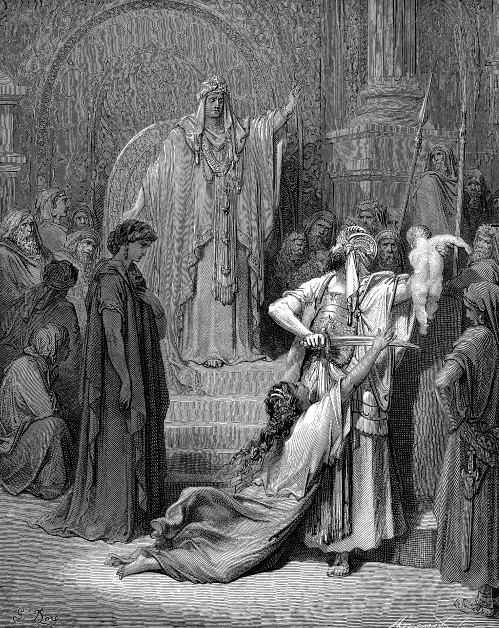
16 Then came there two women, that were harlots, unto the king, and stood before him. 17 And the one woman said, O my lord, I and this woman dwell in one house; and I was delivered of a child with her in the house. 18 And it came to pass the third day after that I was delivered, that this woman was delivered also: and we were together; there was no stranger with us in the house, save we two in the house. 19 And this woman’s child died in the night; because she overlaid it. 20 And she arose at midnight, and took my son from beside me, while thine handmaid slept, and laid it in her bosom, and laid her dead child in my bosom. 21 And when I rose in the morning to give my child suck, behold, it was dead: but when I had considered it in the morning, behold, it was not my son, which I did bear. 22 And the other woman said, Nay; but the living is my son, and the dead is thy son. And this said, No; but the dead is thy son, and the living is my son. Thus they spake before the king. 23 Then said the king, The one saith, This is my son that liveth, and thy son is the dead: and the other saith, Nay; but thy son is the dead, and my son is the living. 24 And the king said, Bring me a sword. And they brought a sword before the king. 25 And the king said, Divide the living child in two, and give half to the one, and half to the other. 26 Then spake the woman whose the living child was unto the king, for her bowels yearned upon her son, and she said, O my lord, give her the living child, and in no wise slay it. But the other said, Let it be neither mine nor thine, but divide it. 27 Then the king answered and said, Give her the living child, and in no wise slay it: she is the mother thereof. 28 And all Israel heard of the judgment which the king had judged; and they feared the king: for they saw that the wisdom of God was in him, to do judgment.
This is the case that proverbially has become known as “splitting the baby.” In the way that the justic system worked in ancient Israel, particularly hard cases would have been brought to the king. What was difficult about it this case was the fact that there were no other witnesses (Deuteronomic law required at least two witnesses) and the credibility of the witnesses involved was questionable (both were prostitutes). Solomon’s response is wise not only in his understanding of the law, but in understanding human psychology in such a way as to elicit information upon which to make a more definitive judgement. In the popular mind of Israelites, Solomon’s wisdom was attributed to God and was thus glorifying to God.
III. Solomon’s Administration (1 Kings 4:1-19)
With chapter 3 laying out the character of Solomon as a ruler, chapter 4 describes the nature of the kingdom over which he ruled. The first thing that is described is the administration Solomon set up to supply the royal household.
1 So king Solomon was king over all Israel. 2 And these were the princes which he had; Azariah the son of Zadok the priest, 3 Elihoreph and Ahiah, the sons of Shisha, scribes; Jehoshaphat the son of Ahilud, the recorder. 4 And Benaiah the son of Jehoiada was over the host: and Zadok and Abiathar were the priests: 5 And Azariah the son of Nathan was over the officers: and Zabud the son of Nathan was principal officer, and the king’s friend: 6 And Ahishar was over the household: and Adoniram the son of Abda was over the tribute. 7 And Solomon had twelve officers over all Israel, which provided victuals for the king and his household: each man his month in a year made provision. 8 And these are their names: The son of Hur, in mount Ephraim: 9 The son of Dekar, in Makaz, and in Shaalbim, and Bethshemesh, and Elonbethhanan: 10 The son of Hesed, in Aruboth; to him pertained Sochoh, and all the land of Hepher: 11 The son of Abinadab, in all the region of Dor; which had Taphath the daughter of Solomon to wife: 12 Baana the son of Ahilud; to him pertained Taanach and Megiddo, and all Bethshean, which is by Zartanah beneath Jezreel, from Bethshean to Abelmeholah, even unto the place that is beyond Jokneam: 13 The son of Geber, in Ramothgilead; to him pertained the towns of Jair the son of Manasseh, which are in Gilead; to him also pertained the region of Argob, which is in Bashan, threescore great cities with walls and brasen bars: 14 Ahinadab the son of Iddo had Mahanaim: 15 Ahimaaz was in Naphtali; he also took Basmath the daughter of Solomon to wife: 16 Baanah the son of Hushai was in Asher and in Aloth: 17 Jehoshaphat the son of Paruah, in Issachar: 18 Shimei the son of Elah, in Benjamin: 19 Geber the son of Uri was in the country of Gilead, in the country of Sihon king of the Amorites, and of Og king of Bashan; and he was the only officer which was in the land.
There are a couple of things to note about this list. First, while there were twelve officers over all of Israel tasked with collecting the support requirements for the royal court, these individuals were not neatly aligned with the tribal allotments. That reflects a particularly centralized administration which may have been aimed at lessening tribal frictions that had challenged David’s rule in his early years as king. Second, the support requirements were significant, as seen in verse 22-23:
22 And Solomon’s provision for one day was thirty measures of fine flour, and threescore measures of meal, 23 Ten fat oxen, and twenty oxen out of the pastures, and an hundred sheep, beside harts, and roebucks, and fallowdeer, and fatted fowl.
Compare this with Samuel’s warning about what a kingship would entail when the people demanded a king who would rule over them like all the nations (1 Sam. 8:10-20).
10 And Samuel told all the words of the LORD unto the people that asked of him a king. 11 And he said, This will be the manner of the king that shall reign over you: He will take your sons, and appoint them for himself, for his chariots, and to be his horsemen; and some shall run before his chariots. 12 And he will appoint him captains over thousands, and captains over fifties; and will set them to ear his ground, and to reap his harvest, and to make his instruments of war, and instruments of his chariots. 13 And he will take your daughters to be confectionaries, and to be cooks, and to be bakers. 14 And he will take your fields, and your vineyards, and your oliveyards, even the best of them, and give them to his servants. 15 And he will take the tenth of your seed, and of your vineyards, and give to his officers, and to his servants. 16 And he will take your menservants, and your maidservants, and your goodliest young men, and your asses, and put them to his work. 17 He will take the tenth of your sheep: and ye shall be his servants. 18 And ye shall cry out in that day because of your king which ye shall have chosen you; and the LORD will not hear you in that day. 19 Nevertheless the people refused to obey the voice of Samuel; and they said, Nay; but we will have a king over us; 20 That we also may be like all the nations; and that our king may judge us, and go out before us, and fight our battles.
The LORD allowed the people to have a king over them like the kings that other nations had, but that was a double-edged sword.
IV. The Glory of Solomon’s Reign (1 Kings 4:20-38)
Finally, we come to a summary of Solomon’s reign (at least in the early years) in 1 Kings 4:20-34:
20 Judah and Israel were many, as the sand which is by the sea in multitude, eating and drinking, and making merry. 21 And Solomon reigned over all kingdoms from the river unto the land of the Philistines, and unto the border of Egypt: they brought presents, and served Solomon all the days of his life… 24 For he had dominion over all the region on this side the river, from Tiphsah even to Azzah, over all the kings on this side the river: and he had peace on all sides round about him. 25 And Judah and Israel dwelt safely, every man under his vine and under his fig tree, from Dan even to Beersheba, all the days of Solomon. 26 And Solomon had forty thousand stalls of horses for his chariots, and twelve thousand horsemen. 27 And those officers provided victual for king Solomon, and for all that came unto king Solomon’s table, every man in his month: they lacked nothing. 28 Barley also and straw for the horses and dromedaries brought they unto the place where the officers were, every man according to his charge.
29 And God gave Solomon wisdom and understanding exceeding much, and largeness of heart, even as the sand that is on the sea shore. 30 And Solomon’s wisdom excelled the wisdom of all the children of the east country, and all the wisdom of Egypt. 31 For he was wiser than all men; than Ethan the Ezrahite, and Heman, and Chalcol, and Darda, the sons of Mahol: and his fame was in all nations round about. 32 And he spake three thousand proverbs: and his songs were a thousand and five. 33 And he spake of trees, from the cedar tree that is in Lebanon even unto the hyssop that springeth out of the wall: he spake also of beasts, and of fowl, and of creeping things, and of fishes. 34 And there came of all people to hear the wisdom of Solomon, from all kings of the earth, which had heard of his wisdom.
Jeremiah achieves a complex effect with this summary.
On the one hand, this is a picture of a prosperous reign, with people flourishing. Certainly that is not a bad thing. Indeed, this influence would have been extended throughout the region, given Israel’s geographic position. Israel sat upon the nexus of the east-west/north-south trade and invasion routes and so a prosperous, united Israel would have been the keystone to peace and prosperity within the region. This presents a kind of fulfillment of God’s covenantal promise of blessing to Abraham; the nations would be blessed through Abraham’s descendants.
On the other hand, this was good as it was going to get for Israel. Like Edward Gibbon would do centuries later in his magisterial, Decline and Fall of the Roman Empire, this provides the backdrop on the decline that would follow, and comparing this with the passages we looked at from Deuteronomy and Samuel, there is a foreshadowing of the problems to come. As (probably) Solomon himself said in Proverbs 16:18, “Pride goeth before destruction, and an haughty spirit before a fall.”
 Covenantide
Leave a comment