
I. Preparations for Constructing the Temple (1 Kings ch. 5)
Previously, we looked at the early character of Solomon’s reign, and in particular, at how God granted Solomon’s request for wisdom in governing. Wisdom for executing justice is an important virtue in a ruler. We now turn to another attribute of kings, namely their ability to carry out massive building projects. In addition to the character of their rule, ancient Near Eastern kings would typically obtain glory through warfare or building projects, and often both. David left Solomon a favorable situation politically, with Israel domestically united, prosperous, and dominating the surrounding states. Solomon himself recognized this in 1 Kings 5:2-5:
And Solomon sent to Hiram, saying, 3Thou knowest how that David my father could not build an house unto the name of the Lord his God for the wars which were about him on every side, until the Lord put them under the soles of his feet. 4 But now the Lord my God hath given me rest on every side, so that there is neither adversary nor evil occurrent. 5 And, behold, I purpose to build an house unto the name of the Lord my God, as the Lord spake unto David my father, saying, Thy son, whom I will set upon thy throne in thy room, he shall build an house unto my name.
In looking at the construction of the Temple, let us start by asking the question, what did Solomon need in order to build the Temple and how extensive was the effort he sought to undertook?
- Peace and Time. He needed peace within the country and surrounding it, since wars and instability would have necessitated taking resources and energy away from construction. These projects would also take time; construction of the Temple alone lasted seven years (1 Kings 6:38) and of his own palace and other projects another 13 years.
- Cooperative Relations with Other Countries. He needed cooperative relations with countries who could supply the materials, and he had that in the person of Hiram of Tyre. Tyre was a major trading country, and as such, had extensive commercial connections across the region. In 1 Kings 5:12 we see that Solomon and Hiram had a formalized partnership to that effect. The Hebrew word used here for treaty (NKJV, ESV) or league (AV) is the term that elsewhere in the Old Testament is translated covenant.
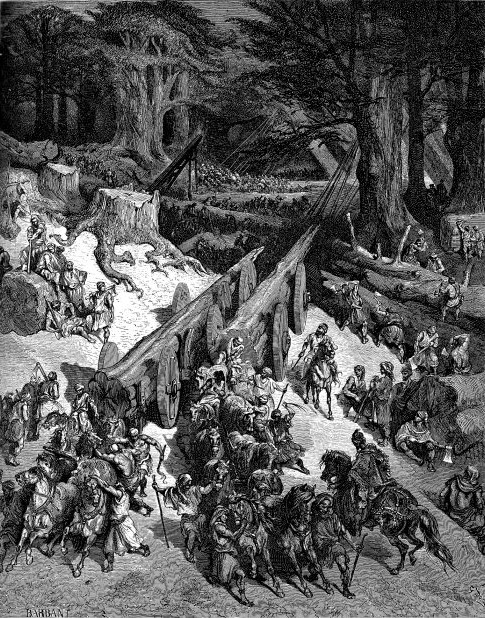
- Resources. He needed resources in terms of materials and people. With regard to the former, he needed not only materials specifically for the Temple and other buildings, but also to trade for the services of Hiram’s nation. Israel is not a heavily forested place, and so he would need cedar, fir, and other wood from what is modern day Lebanon, as well as quarried stones that would be suitable for such monumental architecture. His payment to Hiram consisted of about 100,000 gallons of wheat and 100 gallons of pure oil a year for each year of construction (1 Kings 5:11). The pure oil may not sound like much, but olive presses would produce multiple batches of oil of varying quality. The first press would be the pure oil; subsequent presses would extract further oil, but of decreasing quality. Thus, the 100 gallons would have been of the topmost quality, used for special and not everyday purchases. In terms of personnel, Israel provided forced and conscripted labor of at least 153,600 individuals (2 Chronicles 2:17-18), including 30,000 men to help in harvesting trees (divided into three cadre, each working three-month rotations), 70,000 men involved in material transport; 80,000 stone cutters; and 3,300 supervisors (1 Kings 5:13-18). No expense was being spared for these projects.
II. Constructing the Temple (1 Kings chs. 6-7)
In chapters 6 and 7, we get a detailed description of the Temple itself. The dimensions of the Temple are about double those of the Tabernacle (cf. Exod. 25:15-25, 34:36). It was about 87.5 ft. long, 29.1 ft wide, and 43.75 ft. high. By way of comparison, the Temple could just about fit inside the Lincoln Memorial. That said, the Temple was made entirely of stone and wood, with hand carved ornamentation and pure gold inlay completely in the interior. The ornateness would have been a contrast to the simplicity of the Tabernacle. It would not have been secured by concrete, steel or metal fasteners, so the stone cutting had to be precise before the blocks were brought onsite, and Solomon hired a master metalsmith experienced in working with brass to do the ornamentation, as well as to supervise the construction of the external basins (1 Kings 7:13-14). Given the dimensions, each basin could hold 230 gallons of water. This was a sophisticated building project. Construction on the Temple began in Solomon’s fourth regnal year, 966 BC, a date which we can conclusively establish based on the correlation of biblical and extra-biblical sources.
The text of chapters 5-7 goes into extensive detail about the preparations for and construction of the Temple. This raises the question as to why Jeremiah thought that would be especially important to the original audience for whom he was writing? At least three reasons are likely:
- First, it preserved a memory of the Temple for those in exile. Jeremiah had prophesied that the Exile would last seventy years (Jer. 29:10), so by the end of the exile, most of the remnant would have no personal recollection of Solomon’s Temple.
- Second, it highlighted the glory of God. A building this ornate is needed for a God as great as Israel’s God. By providing such extensive detail on the ornateness of the Temple, Jeremiah was indirectly highlighting the greatness of Israel’s LORD.
- Third, it highlighted what Israel had lost. The Temple was not simply a piece of monumental architecture; it was the focal point for the presence of God amidst His people. With the destruction of the Temple, the remnant had to come to grips with the reality that they broke the covenant with their God. By providing extensive detail of the Temple and elaborating on the necessary conditions for constructing it meant that it would highly unlikely that it would ever be replicated on the same level, as it would be too costly. As a result, the faithful remnant had no other recourse but to return in repentance and trust in the LORD’s grace and mercy.
Such an understanding illuminates the word of the LORD that came to Solomon in the midst of the Temple’s construction:
6:11 And the word of the Lord came to Solomon, saying, 12 Concerning this house which thou art in building, if thou wilt walk in my statutes, and execute my judgments, and keep all my commandments to walk in them; then will I perform my word with thee, which I spake unto David thy father:13 And I will dwell among the children of Israel, and will not forsake my people Israel. (1 Kings 6:12-13)
This is the second occasion when God speaks directly to Solomon. Recall that when God granted Solomon wisdom to rule, He said, “3:14 And if thou wilt walk in my ways, to keep my statutes and my commandments, as thy father David did walk, then I will lengthen thy days” (1 Kings 3:14). Compare this, as well, with David’s guidance to Solomon on his deathbed:
2:3And keep the charge of the LORD thy God, to walk in his ways, to keep his statutes, and his commandments, and his judgments, and his testimonies, as it is written in the law of Moses, that thou mayest prosper in all that thou doest, and whithersoever thou turnest thyself: 4that the LORD may continue his word which he spake concerning me, saying, If thy children take heed to their way, to walk before me in truth with all their heart and with all their soul, there shall not fail thee (said he) a man on the throne of Israel. (1 Kings 2:3-4)
The common theme in these three passages is that Solomon (and, by extension, the people) are to walk in the ways of the LORD and keep His statutes and commandments, and if they do that, then the LORD will not forsake His people, will lengthen Solomon’s days, and preserve the throne of David. This is the baseline requirement for keeping the covenant; Solomon, the kings after him, and the people failed to do this. Israel’s subsequent history is an extended indictment for this failure.
In the next post, we will look at Solomon’s dedication of the Temple.
 Covenantide
Leave a comment