
This lesson was taught by Kyle Simmons
Jeroboam’s Sin (1 Kings 12:25-13:34)
I. Jeroboam Introduces Idolatry
25 Then Jeroboam built Shechem in the mountains of Ephraim, and dwelt there. Also he went out from there and built Penuel. 26 And Jeroboam said in his heart, “Now the kingdom may return to the house of David: 27 If these people go up to offer sacrifices in the house of the Lord at Jerusalem, then the heart of this people will turn back to their lord, Rehoboam king of Judah, and they will kill me and go back to Rehoboam king of Judah.” (1 Kings 12:25-27)
Jeroboam fortified Shechem and made it his capital, but he quickly realized its easier said than done to separate Israel from Judah. They have had 120 years of continuous monarchy. The last 80 years saw their government and worship centralized under a single figure and religious location of Jerusalem. While the culture remained largely tribal, it was still very much tied to Jerusalem and Temple where God had made his dwelling place among His people. Jeroboam was therefore afraid that Israel, by continually making pilgrimages to worship at the Temple, would develop a love for Judah and its king, and thereby return eventually to Judah.
In the eyes of Jeroboam, the religion of God’s people was becoming a national security threat to the state in general and him specifically. This isn’t without modern parallels. Roman Catholicism claimed the same thing about the Reformers. A closer example to today would be Ukraine’s efforts to ban the Russian-affiliated Orthodox Church in Ukraine, and seizing its churches because Russia uses it to project influence into Ukraine. So, to avoid this security threat, Jeroboam “asked advice.” Scripture does not say he prayed to God for wisdom, nor did he trust in God’s promises that he would be made into a great house if he continued in faithfulness. After he was blessed by God, he forgot about God’s promises. Rather, Jeroboam “asked advice” of someone unspecified. Whoever they were, they gave bad advice. As noted in the previous lesson regarding Rehoboam and the wisdom of choosing wise counselors, and we see again that choosing foolish counselors results in foolish counsel. Jeroboam here sets religious faithfulness aside to pursue what is politically expedient and self-enriching.
28 Therefore the king asked advice, made two calves of gold, and said to the people, “It is too much for you to go up to Jerusalem. Here are your gods, O Israel, which brought you up from the land of Egypt!” 29 And he set up one in Bethel, and the other he put in Dan. 30 Now this thing became a sin, for the people went to worship before the one as far as Dan. 31 He made shrines on the high places, and made priests from every class of people, who were not of the sons of Levi. 32 Jeroboam ordained a feast on the fifteenth day of the eighth month, like the feast that was in Judah, and offered sacrifices on the altar. So he did at Bethel, sacrificing to the calves that he had made. And at Bethel he installed the priests of the high places which he had made. 33 So he made offerings on the altar which he had made at Bethel on the fifteenth day of the eighth month, in the month which he had devised in his own heart. And he ordained a feast for the children of Israel, and offered sacrifices on the altar and burned incense. (1 Kings 12:28-33)
How did Jeroboam violate God’s commandments for worship? There are four ways: (1) He established new religious centers and high places; (2) He build idols; (3) He made priests of anyone who paid enough for it, including himself; and (4) He established a false feast.
- Establishment of new religious centers and building up high places
Once more we see the high places make an appearance. We saw them in Solomon’s time before this, and we will see them appear in greater numbers in Judah. When Israel left Judah, they did not leave the paganism there. Quite the opposite. Jeroboam established new religious centers in violation of Deuteronomy 12:1-7, which commands (among other things) that worship be held at the place that God will choose to dwell (The Temple), and in the way God has proscribed.
The issue is not merely the centers of worship, but where they were located. Bethel is in southern Israel, which before the split was central Israel. It was where God appeared to Jacob and told him that his name would be Israel. It therefore in a way can be considered the birthplace of Israel. Bethel also was a stop on the main north-south road between Israel and Judah. To get to Jerusalem, you have to pass through Bethel. It can be assumed that this site was chosen as a last ditch effort to lure pilgrims away from Jerusalem and towards this new worship. The other center was at Dan in the north, which unlike Bethel does not share a rich and faithful history- it has a history of idolatry, sin, and unmitigated paganism. It was established by the tribe of Dan, the tribe that was prophesied by Jacob to be a “serpent by the road, an adder in the path that bites the heels of the horse and causes the rider to stumble.”
When the men of Dan first conquered it in Judges 18, they set up silver idols in the city, and installed priests of the sons of the grandson of Moses, who was not a Levite. These priests continued unabated until Israel was removed from the land in 722 BC. Jeroboam may well have set up here because of the pre-existing priesthood he could co-opt for his own purposes. Jeroboam defends this decision in his announcement, that he is doing this for Israel. “It is too much for you to go up to Jerusalem, so here, I have made things easier with these golden calves. Your new gods!” Jeroboam is making the assertion that ease and comfort trump God’s Word on this issue. “God said to do this thing, but that is simply too difficult, so I have made an easier version.” For Jeroboam, the small gate and narrow road that leads to life is simply too difficult, so he starts changing the road by his own standards. He ignores that one of the purposes of the Law of Moses is to be difficult, to show us that no one can follow the laws perfectly and be justified by his own works of righteousness. (Romans 3:20)
There are times when doing what is right, doing what is commanded by God, is definitely difficult. In most circumstances, the people of God are promised difficult roads, long roads, roads of persecution, and isolation. But if they turn aside to Bethel, they’ll never see that Holy City of Jerusalem. That’s true for us as well as them. Israel, however, takes Jeroboam up on his new offer, and worshipped at both Bethel and Dan.
- Creation of Idols
That was Violation 1. Violation 2 was that he created idols- two golden calves. Zero originality here. If this were a movie, it would be like a sequel-reboot, where the character of the golden calf has the same story as the original but is not the original. It is like the Force Awakens of idolatrous moves. Jeroboam even announces their debut with the same phrase as Aaron did back in Exodus 32:4: “This is your god, O Israel, that brought you out of the land of Egypt!” These images are not made because Jeroboam thinks God is literally in the form of a golden bull, but because it is an attempt to control God’s power. The bull represents strength, fertility, and power—it is the reason someone built a massive bronze statue of it in front of our New York Stock Exchange to represent the economy. Jeroboam sees that as a parallel to God’s power, and so it is a way to extract those aspects and direct them towards his own gains.
Jeroboam also builds shrines on the high places, just like Solomon did. He follows directly in the path of his predecessor, doing the same evil that led to his predecessor’s eviction and his installment as king. Indeed, Jeroboam is doing everything he can to split Israel away from Judah, and that includes its God, and its history. This connection to the Exodus narrative, with himself playing the part of Aaron the high priest, tries to “restart” Israel’s history, to begin again, fresh.
- Creation of a New Priesthood
So, Violation 2 was the manufacture of idols. In Violation 3 Jeroboam made priests from every class of people who were not the sons of Levi, including himself. We mentioned in the previous lesson that the tribe of Levi was a special case in the tribes of Israel, in that they held no land, but were a priestly caste. The Levites were not all priests, but all priests were Levites. They were in charge of teaching the Law, offering sacrifices, officiating religious ceremonies, maintaining the Tabernacle and Temple, and judging disputes. God had specifically set aside this tribe as the tribe who would officiate worship. Denying this in favor of making priests from “every class of people” was another rejection of God. And it is not specified that this is only the Israelites, which means it may have included even Canaanites who were still in the land.
The Levites did not take kindly to this move, or to the other violations of Jeroboam. The Levites actually have a history with golden calves specifically- it was they who rallied to Moses’s side, and stormed through the camp of the Israelites in Exodus 32, killing all the idolaters. The Levites take proper worship very seriously. As such, the tribe of Levi, en mass, left Israel and joined Judah, strengthening Rehoboam for those first few good years of Rehoboam’s reign
(2 Chronicles 11:13-17). Israel was left largely bereft of the godly, and only the pretenders remained. This is a lasting problem for Israel throughout its future. While Judah occasionally sees priests instigate revivals, specifically through kings, Israel has no such priests to do so.
When Israel was being corrupted by false priests, should the Levites have stayed and tried to reform it from the inside? Or were they right to leave, to preserve right worship of God elsewhere? How should it inform our decisions to stay or go? As if that was not bad enough, Jeroboam also instantiated himself as a new priest of this religion. Just at the most basic level, you cannot make yourself a priest. As Hebrews 5:4 says- “And no man takes this honor to himself, but he who is called by God, just as Aaron was.” In the united kingdom of Israel, the office of king and priest were kept separate. Those offices were not to be mixed, though at times God made exceptions for David and Solomon, as they were members of the Messianic line. Jeroboam ignores this—he makes himself a new high priest, a King-priest. This is a usurpation of the office of King-priest of Christ, after the order of Melchizedek.
- Creation of a False Feast
In the fourth violation, Jeroboam instituted a Faux Feast Day. The Feast of Booths/Tabernacles/Succoth was an eight-day long feast at the end of harvest time, halfway through the seventh month. It is called the Feast of Booths because for seven days, all Israel gathered branches of all kinds of trees and builds temporary shelters, and lives in them. It was designed to remember the wilderness journey taken by the Israelites during the Exodus, when they dwelled for 40 years in temporary lodgings. It was also aimed to the idea for the Israelites to remember that they are still strangers here on Earth, that this is a temporary lodging, and not to indulge in pride after a full harvest. It was during one of these Feast Days that the Temple was dedicated by Solomon.
Jeroboam instituted his own version of this feast, one month afterwards. His feast day is only said to last one day, so one would not have to live a week inside a hut one built. The booths are not actually mentioned here—only the feasting and sacrifices. As for the change in date, the passage is clear this comes solely from Jeroboam’s own heart. It is theorized by some scholars that since harvest came a little later to the northern parts of Israel, that at times the Feast of Booths overlapped with the end of harvest, meaning they would have to push themselves really hard to gather all the crops before the Feast. With Jeroboam’s delayed Feast, this is another way to make things more convenient.
So, there we have the 4 violations of Jeroboam. All of them focus on changing the worship of God and making things more convenient for Israel in general, and Jeroboam specifically. Are you ever tempted to violate God’s commandments to make things “easier”?
II. The Message to Jeroboam
God is not mocked, and it was not long before he sent a prophet to Jeroboam to warn him of his crimes.
And behold, a man of God went from Judah to Bethel by the word of the Lord, and Jeroboam stood by the altar to burn incense. 2 Then he cried out against the altar by the word of the Lord, and said, “O altar, altar! Thus says the Lord: ‘Behold, a child, Josiah by name, shall be born to the house of David; and on you he shall sacrifice the priests of the high places who burn incense on you, and men’s bones shall be burned on you.’ ” 3 And he gave a sign the same day, saying, “This is the sign which the Lord has spoken: Surely the altar shall split apart, and the ashes on it shall be poured out.”
4 So it came to pass when King Jeroboam heard the saying of the man of God, who cried out against the altar in Bethel, that he stretched out his hand from the altar, saying, “Arrest him!” Then his hand, which he stretched out toward him, withered, so that he could not pull it back to himself. 5 The altar also was split apart, and the ashes poured out from the altar, according to the sign which the man of God had given by the word of the Lord. 6 Then the king answered and said to the man of God, “Please entreat the favor of the Lord your God, and pray for me, that my hand may be restored to me.”
So the man of God entreated the Lord, and the king’s hand was restored to him, and became as before. 7 Then the king said to the man of God, “Come home with me and refresh yourself, and I will give you a reward.”
8 But the man of God said to the king, “If you were to give me half your house, I would not go in with you; nor would I eat bread nor drink water in this place. 9 For so it was commanded me by the word of the Lord, saying, ‘You shall not eat bread, nor drink water, nor return by the same way you came.’ ” 10 So he went another way and did not return by the way he came to Bethel. (1 Kings 13:1-10)
God sent a prophet up from Judah to speak to Jeroboam of his crimes, and to promise him that a child of the House of David, Josiah, will destroy Jeroboam’s priests, and that God will destroy his altar. This prophet is never named, so we will simply refer to him as “the man of God”, like the text does.
We ought to admire the man of God here, who travels North from Judah into what is now hostile territory, which not long ago was threatening to go to war with Judah. He walks right into this pagan altar, stands before the King making his sacrifices to a pagan God, and proclaims the Word of the Lord to that assembly, prophesying judgment on the people there, the king and priests (the ones in power) foremost among them. Jeroboam stretches forth his hand against God’s prophet, calling for his arrest. And yet to protect his prophet, God caused Jeroboam’s arm to wither and seize up, and Jeroboam could not pull it back. He remains there frozen, his strained, withered, inhuman looking arm pointing accusingly at the man of God. The altar splits in two, and the ashes poured from it, just as was prophesied. The hand that offered sacrifices to idols, and the hand that meted out judgement is no longer able to do so. God has stopped Jeroboam dead in his tracks. All Jeroboam can do now is beg, and that he does. In an act of contrition, the king asked the prophet to ask God to heal his arm, and the man did so. God saw fit to heal Jeroboam.
Jeroboam probably did not genuinely understand what had just occurred. Despite kneeling before the prophet, begging for healing for the man who has interrupted his ceremony, he does not change his ways, does not ask how to make things right with God. He does not pray or do anything other than neglect such a great salvation. He merely accepts that this punishment is on its way. He has the same attitude towards God of many people online—that when they hear “the lifestyle you live leads to death, your sins need to be forgiven or else you will go to Hell”, their reaction is a spiteful joy. They are glad to be going where God is not. And in same way, Jeroboam, while forced by reality to respect the power of God, refuses to undertake the task of addressing the root of the problem, and becoming right with God. He does not speak to God, he speaks next to the unnamed prophet, asking him to come with him, inviting him into his home, promising a reward for what God had done. There is no doubt that Jeroboam’s aim was to corrupt the man of God, subvert him to work under Jeroboam.
The unnamed prophet, however, insisted that he must not eat, drink, or go back the way he came to Bethel, for God had said he must not. As one commentary puts it, “Have no fellowship with the works of darkness.” Even if Jeroboam gave him half his house, he would not go with him. This is akin to when Christ was tested in the Wilderness and said “Man does not live by Bread alone, but by every word that comes out of the mouth of God.” The unnamed prophet therefore departed from Bethel, taking another road out of Israel.
III. Death of the Man of God
Unfortunately, there is another prophet in our story: an old prophet who lived in Bethel.
11 Now an old prophet dwelt in Bethel, and his [c]sons came and told him all the works that the man of God had done that day in Bethel; they also told their father the words which he had spoken to the king. 12 And their father said to them, “Which way did he go?” For his sons had seen which way the man of God went who came from Judah. 13 Then he said to his sons, “Saddle the donkey for me.” So they saddled the donkey for him; and he rode on it, 14 and went after the man of God, and found him sitting under an oak. Then he said to him, “Are you the man of God who came from Judah?”
And he said, “I am.”
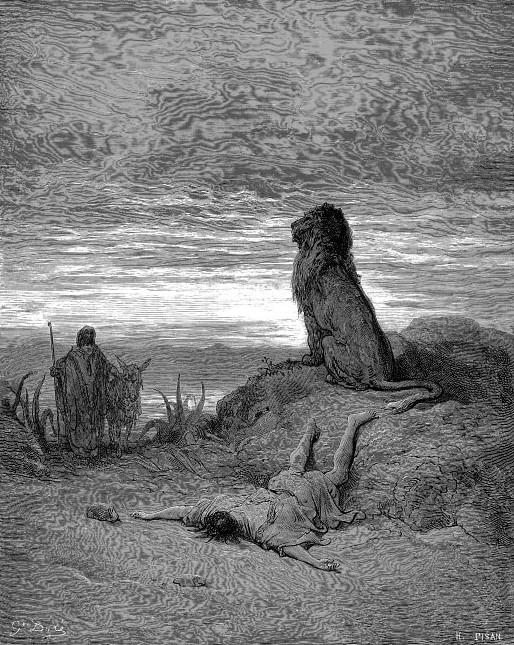
15 Then he said to him, “Come home with me and eat bread.” 16 And he said, “I cannot return with you nor go in with you; neither can I eat bread nor drink water with you in this place. 17 For I have been told by the word of the Lord, ‘You shall not eat bread nor drink water there, nor return by going the way you came.’ ” 18 He said to him, “I too am a prophet as you are, and an angel spoke to me by the word of the Lord, saying, ‘Bring him back with you to your house, that he may eat bread and drink water.’ ” (He was lying to him.) 19 So he went back with him, and ate bread in his house, and drank water. 20 Now it happened, as they sat at the table, that the word of the Lord came to the prophet who had brought him back; 21 and he cried out to the man of God who came from Judah, saying, “Thus says the Lord: ‘Because you have disobeyed the word of the Lord, and have not kept the commandment which the Lord your God commanded you, 22 but you came back, ate bread, and drank water in the place of which the Lord said to you, “Eat no bread and drink no water,” your corpse shall not come to the tomb of your fathers.’ ” 23 So it was, after he had eaten bread and after he had drunk, that he saddled the donkey for him, the prophet whom he had brought back. 24 When he was gone, a lion met him on the road and killed him. And his corpse was thrown on the road, and the donkey stood by it. The lion also stood by the corpse.
25 And there, men passed by and saw the corpse thrown on the road, and the lion standing by the corpse. Then they went and told it in the city where the old prophet dwelt. 26 Now when the prophet who had brought him back from the way heard it, he said, “It is the man of God who was disobedient to the word of the Lord. Therefore the Lord has delivered him to the lion, which has torn him and killed him, according to the word of the Lord which He spoke to him.” 27 And he spoke to his sons, saying, “Saddle the donkey for me.” So they saddled it. 28 Then he went and found his corpse thrown on the road, and the donkey and the lion standing by the corpse. The lion had not eaten the corpse nor torn the donkey. 29 And the prophet took up the corpse of the man of God, laid it on the donkey, and brought it back. So the old prophet came to the city to mourn, and to bury him. 30 Then he laid the corpse in his own tomb; and they mourned over him, saying, “Alas, my brother!” 31 So it was, after he had buried him, that he spoke to his sons, saying, “When I am dead, then bury me in the tomb where the man of God is buried; lay my bones beside his bones. 32 For the saying which he cried out by the word of the Lord against the altar in Bethel, and against all the shrines on the high places which are in the cities of Samaria, will surely come to pass.”
33 After this event Jeroboam did not turn from his evil way, but again he made priests from every class of people for the high places; whoever wished, he consecrated him, and he became one of the priests of the high places. 34 And this thing was the sin of the house of Jeroboam, so as to exterminate and destroy it from the face of the earth.
So, the old prophet heard from his sons of the works and words of the unnamed prophet and saddled up his donkey to go find the man of God. When he found him on the side of the road, he asked him to come back with him the way he had come, to eat bread with him. The man of God was initially resistant, telling the old prophet the same thing he told Jeroboam. However, the old prophet told the man of God that he was also a prophet and had been told by an angel that he was to bring the man back to his home and feed and water him. Nothing but lies. But the man of God believed the old prophet, and accompanied him home, ate bread, and drank water. And so, the Holy Spirit came to the old prophet, and he proclaimed that because the unnamed prophet disobeyed God, so he would die soon, and his body would not rest in the tombs of his forebears. The old prophet saddled the man on his own donkey and sent him on his way. A lion met him on the road and killed him, spared the donkey, and stood guard over the corpse. The old prophet rode to retrieve the corpse, and brought it back, laying it in his own tomb, and he made his sons promise to one day bury him in it with him, perhaps out of guilt, perhaps out of self-interest. The old prophet seemed to recognize that after the words of God he had spoken had come true, that the words the younger prophet had spoken, that men’s bones would be burned on that altar. And as he did not want his bones to be burned on that pagan altar, he asked that his bones be buried with the man of God, that they might be spared.
What do we make of this character? What were his intentions towards the unnamed prophet? If he was truly a man in whom the Spirit dwelt, why did he disregard the Word of God so recklessly? We do not know fully what to make of the man, but he does not seem malicious towards the man of God in the same way Jeroboam is. I think we see in the old prophet what I will term a member of the old guard. He does not have a proper respect for God, nor God’s words, else he would not have proved himself a false prophet with his lies. But I think he desired the outcomes of a righteous nation without necessarily understanding the heart of the matter. He wanted the man of God to remain in Bethel, for at least a short time. Perhaps he hoped to convince him to stay permanently, as he saw this man as an ally against the idols which he hated, though the old prophet could not give a proper explanation of why they were wrong. He calls the unnamed prophet “brother,” and wishes to be buried with him.
I have multiple guesses. Maybe the unnamed prophet is a believer who went astray in his desperation to keep the man of God around. Or maybe he was an unbeliever who nevertheless God had blessed with sufficient wisdom to despise those evils God has named. There are many in the latter category I can think of today, who through God’s common grace and restraint can reason sufficiently clear to some evils must be opposed. Or maybe he was merely trying to get the man of God to lift the curse that had been place on the land.
As for the unnamed prophet, he was guarded against those who he recognized as his enemies. So, when tempted by them, he resisted. However, when tempted by his friends, he let his guard down and paid with his life. He took the old prophet at his word and did not test his words against that which he had received, which was his true folly. No matter if the revelation comes from friend or foe, all must be tested against the Word of God. God’s unchanging nature means he does not give revelation that contradicts previous revelation- God cannot and does not contradict himself. So, when someone tells you they have received a new revelation that directly contradicts what has been spoken through God’s Word, you know that they are not to be trusted. As the Apostle Paul says, “But even if we, or an angel from heaven, preach any other gospel to you than what we have preached to you, let him be anathema.” (Galatians 1:8)
V. Jeroboam’s Death
Jeroboam did not turn from his evil ways, but continued to make priests of the high places, including himself. This was the sin of the house of Jeroboam, such that God chose to wipe out the whole house. Ahijah, the same prophet who had announced to Jeroboam that he would be king, will announce that for the sins of Jeroboam, his house would be laid desolate. The dogs and birds would feast on their corpses in the cities and the fields, and a new king will be raised up over Israel to destroy Jeroboam’s house. Ahijah also prophesied that Israel would be uprooted and scattered beyond the Euphrates because of their idols and the sins of Jeroboam. Now, we’re in countdown mode. God has said they will be scattered, its only a matter of time until he fulfils his Word. Jeroboam was at war with Rehoboam and Rehoboam’s son Abijam all his remaining years. Jeroboam ruled 22 years in total.
Some final lessons to note:
- God is not mocked, and he takes idolatry very seriously. (WLC 109)
- We cannot change worship to how we feel worship should go, we must Worship the way God has outlined. This is the principle behind the Reformed Regulative Principle of worship, that God has outlined how he wants us to worship. This is different from the principle of worship in many other churches, where the principle is that “if it isn’t forbidden, it is acceptable”. But we can see in this passage alone just how seriously God takes worship of Himself.
- Test the revelation that is received, even if it comes from a friend.
- Sinning can be convenient, and doing what is right can be exhausting, draining. We can be tempted to make changes so that our difficult lives can be made easier. My exhortation to you is “Don’t give in. Stand firm. Keep on that narrow road, walk through that narrow gate. You might have to suck in that gut, might lose a few of the brass buttons from your waistcoat, but it is worth it.”
 Covenantide
Leave a comment