
Elijah’s Confrontation with Ahab
This lesson was taught by Kyle Simmons
In our last lesson, we saw peace in much of Judah, and chaos in Israel. Asa of Judah ruled capably and peacefully as the reformer king, who removed the false idols and restored true worship to Judah. In the northern kingdom of Israel, however, we saw countless wars—Baasha against Asa, Baasha against Ben-Hadad, Elah vs Zimri, Zimri vs Omri, Omri vs Tibni. Omri eventually emerged as the victor after the civil war with Tibni and began a new ruling dynasty with a 12-year reign. It is at this point that Omri’s son Ahab, the most evil of all the kings of Israel or Judah we have seen thus far enters. At the same time, though, we also see the entrance of the prophet Elijah who will confront Ahab on behalf of God.
I. Ahab Takes the Throne (1 Kings 16:29-34)
29 In the thirty-eighth year of Asa king of Judah, Ahab the son of Omri became king over Israel; and Ahab the son of Omri reigned over Israel in Samaria twenty-two years. 30Now Ahab the son of Omri did evil in the sight of the Lord, more than all who were before him. 31And it came to pass, as though it had been a trivial thing for him to walk in the sins of Jeroboam the son of Nebat, that he took as wife Jezebel the daughter of Ethbaal, king of the Sidonians; and he went and served Baal and worshiped him. 32Then he set up an altar for Baal in the temple of Baal, which he had built in Samaria. 33And Ahab made a wooden image. Ahab did more to provoke the Lord God of Israel to anger than all the kings of Israel who were before him. 34In his days Hiel of Bethel built Jericho. He laid its foundation with Abiram his firstborn, and with his youngest son Segub he set up its gates, according to the word of the Lord, which He had spoken through Joshua the son of Nun. (1 Kings 16:29-34)
Ahab is the seventh king of Israel during Asa’s lifetime, and like his father, he did evil in the sight of the Lord, indeed more than any before him. Thus, we not only have a continuation of evil, but an escalation of evil. Ahab walked in the sins of Jeroboam as if they all were trivial. To recall, what were the four major sins of Jeroboam? (1) he established a new religious center and high places; (2) he made idols; (3) he made priests of anyone who paid enough for it, including himself; and (4) he established a false feast.
Ahab does worse than Jeroboam in that he did not even make a pretense of following God. He took as his wife Jezebel, the daughter of a pagan king of Sidon, and served and worshipped Baal. We will get more into Jezebel later, but we again see, like with Solomon, the connection between marriage to pagan women and the worship of false gods or at least building idols for them. Worshipping the golden calves at Bethel or Dan was not good enough for Ahab. He set up a temple to Baal in his capital of Samaria, which will hereafter serve as the permanent capital of Israel. He also set up an altar to Baal, in a dark inversion of the Holy Temple of Jerusalem. And he made a wooden image to set at that altar inside the temple. In sum, “Ahab did more to provoke the Lord God of Israel to anger than all the kings of Israel who were before him.”
To underscore just how evil these days were, it was during Ahab’s reign that Hiel of Bethel rebuilt the fortifications of Jericho. Jericho was a city in the south of Israel, near the border of Judah. It may be asked why no one had added defensive walls and gates to this city since their destruction by Joshua, nearly 500 years earlier. The reason for that is the curse that Joshua laid upon the city, saying: “Then Joshua charged them at that time, saying, ‘Cursed be the man before the Lord who rises up and builds this city Jericho; he shall lay its foundation with his firstborn, and with his youngest he shall set up its gates’” (Joshua 6:26).Hiel of Bethel, a city of idols in its own right, set about fortifying it. And as a result, he “laid its foundation” with his firstborn son, and with his youngest son he set up its gates. The Hebrew word here implies a cost, or a loss. A bit of digging, however, reveals that what is actually being shown here is the practice of foundation sacrifice. Foundation sacrifice refers to the practice of burying a human being in the foundation of a new building to try and make sure that it stands for a long time. To appease local spirits and deities, you offer a sacrifice. We know that child sacrifice is prevalent in the land of Israel, and this is a facet of that. Archeological digs done at the site of Jericho have uncovered several instances of infants’ bones built under or into ordinary house walls. So, what we have is Hiel of Bethel actively practicing child sacrifice in his architecture, sacrificing his oldest and youngest sons as part of the construction of these walls and gates. Israel is a horrid place right now. And when God’s covenant nation is breaking that covenant, he sends them a prophet—in this case Elijah.
II. Elijah, the Drought, and the Widow (1 Kings 17:1-24)
1And Elijah the Tishbite, of the inhabitants of Gilead, said to Ahab, “As the Lord God of Israel lives, before whom I stand, there shall not be dew nor rain these years, except at my word.” 2 Then the word of the Lord came to him, saying,3 “Get away from here and turn eastward, and hide by the Brook Cherith, which flows into the Jordan. 4 And it will be that you shall drink from the brook, and I have commanded the ravens to feed you there.” 5 So he went and did according to the word of the Lord, for he went and stayed by the Brook Cherith, which flows into the Jordan. 6 The ravens brought him bread and meat in the morning, and bread and meat in the evening; and he drank from the brook. 7And it happened after a while that the brook dried up, because there had been no rain in the land.
Elijah, previously serving the inhabitants of Gilead, is summoned by God to prophesy to Ahab, and he tells Ahab there will be no rainfall in Israel, nor dew to collect from the ground, unless Elijah says so. Elijah then walks out of Samaria and stays in the wilderness of Israel, drinking from a nearby brook and being fed by ravens who bring him bread and meat. Like the Israelites in the wilderness before him, and John the Baptist after him, God provides food from nature for his chosen. Eventually, the brook dries up, courtesy of the drought.
Israel is a very mountainous land, devoid of the vast fertile valleys fueled by major rivers like the Tigris, Euphrates or Nile. Its utterly dependent on rainfall to water its crops. No rain means no crops, and no pastures to feed the beasts of the field. No rain is thus an agricultural disaster, which has plagued Israel throughout its history. Droughts are also a sign of punishment upon covenant breakers, as outlined in Deuteronomy 28. Thus, Israel is at the mercy of storms, which is why the worship of Baal got traction.
Baal (which means master or lord) was worshipped in the Canaanite pantheon as a king of gods, the god of the storm, rain, dew, and also fertility. In Baal mythology, Baal, representing life, battles a sea god of death every seven years for control over the weather. If Baal wins, the rain falls, and life grows. But if Baal loses to the god of death, the rain does not fall, and life fades. Also as always, Baal is a fertility god, so by necessity that means worship of Baal involves some bizarre sexual practices, up to and including bestiality.
Returning to Elijah, after the brook dries up, God sends Elijah to Zarephath, in the land of Sidon, in the heart of Baal’s and Ahab’s territory. Sidon is a coastal kingdom west of Israel, and north of Tyre. Elijah is told God will provide for him there in the form of a widow. When Elijah arrives at the city, the widow is gathering sticks for her and her son to eat before they die. We do not know how long the drought has lasted, but it is probably close to three years, long enough for this widow to run out of food save a little bread and oil. Elijah tells her not to give up, but to use the last of her stores to make him some bread, and then do the same for herself and her son. If she does this, the food will not run out. As would later be the case with Christ feeding the 5,000, the flour and oil lasted for many days, feeding the widow, her son, and Elijah, who is living with them.
It is during this time, however, that the son of the widow falls ill and dies. The widow now has nothing. Her husband is dead, she has no family to rely on. She has no way of getting additional food outside of Elijah. And now her only son is dead. Her personal financial security, her hope for grandchildren, her only comfort in these times, is dead. In the midst of her grief, she blames Elijah: “So she said to Elijah, “What have I to do with you, O man of God? Have you come to me to bring my sin to remembrance, and to kill my son?” (1 Kings 17:18) She has provided for him all these days, cooking the bread for him, giving him a place to stay, and probably many other errands besides. If he had not come, she would have died in blessed ignorance with her son. But his time here has helped her to understand the magnitude of her sins. And as her son dies, the guilt of them swallows her up.
For Christians, who believe God is sovereign and in control of all, there is a bit of us that is always tempted to be angry at God for the decisions He has made. Especially when I was younger, it was often that I would ask God (in an unintentional paraphrase of Romans 9:20) “Why did you make me like this?!” We do not doubt that there is a plan, we do not understand how that plan could possibly require this amount of pain. We cannot see the end of the story, just the small page we are on, and so much of the suffering we experience may at times feel meaningless. But it is at these times when we have nowhere to turn but to God, that where we are to turn for aid becomes clear. The widow is wholly reliant, for both life and resurrection, upon God. Elijah takes compassion on her and begs God to save the child of the widow. And God brings him back to life, the first resurrection depicted in Scripture. We mentioned previously that in the legend of Baal, Baal often loses against Death, and he cannot conquer it. But God conquers death, here in the midst of Baal’s own territory. An application we can pull from this is that in the midst of trouble and judgment, we can still rely wholly on God. It is not the case that all of us will have a prophet capable of providing infinite food and resurrecting the dead arrive at our door, but in principle this narrative highlights that God will provide for his people.
III. Elijah’s Message to Ahab (1 Kings 18:1-19)
1And it came to pass after many days that the word of the Lord came to Elijah, in the third year, saying, “Go, present yourself to Ahab, and I will send rain on the earth.” 2 So Elijah went to present himself to Ahab; and there was a severe famine in Samaria. 3And Ahab had called Obadiah, who was in charge of his house. (Now Obadiah feared the Lord greatly. 4 For so it was, while Jezebel massacred the prophets of the Lord, that Obadiah had taken one hundred prophets and hidden them, fifty to a cave, and had fed them with bread and water.) 5 And Ahab had said to Obadiah, “Go into the land to all the springs of water and to all the brooks; perhaps we may find grass to keep the horses and mules alive, so that we will not have to kill any livestock.” 6 So they divided the land between them to explore it; Ahab went one way by himself, and Obadiah went another way by himself.
7 Now as Obadiah was on his way, suddenly Elijah met him; and he recognized him, and fell on his face, and said, “Is that you, my lord Elijah?” 8 And he answered him, “It is I. Go, tell your master, ‘Elijah is here.’ ” 9 So he said, “How have I sinned, that you are delivering your servant into the hand of Ahab, to kill me? 10 As the Lord your God lives, there is no nation or kingdom where my master has not sent someone to hunt for you; and when they said, ‘He is not here,’ he took an oath from the kingdom or nation that they could not find you. 11 And now you say, ‘Go, tell your master, “Elijah is here” ’! 12 And it shall come to pass, as soon as I am gone from you, that the Spirit of the Lord will carry you to a place I do not know; so when I go and tell Ahab, and he cannot find you, he will kill me. But I your servant have feared the Lord from my youth. 13 Was it not reported to my lord what I did when Jezebel killed the prophets of the Lord, how I hid one hundred men of the Lord’s prophets, fifty to a cave, and fed them with bread and water? 14 And now you say, ‘Go, tell your master, “Elijah is here.” ’ He will kill me!” 15 Then Elijah said, “As the Lord of hosts lives, before whom I stand, I will surely present myself to him today.”
16 So Obadiah went to meet Ahab, and told him; and Ahab went to meet Elijah. 17 Then it happened, when Ahab saw Elijah, that Ahab said to him, “Is that you, O troubler of Israel?” 18 And he answered, “I have not troubled Israel, but you and your father’s house have, in that you have forsaken the commandments of the Lord and have followed the Baals. 19 Now therefore, send and gather all Israel to me on Mount Carmel, the four hundred and fifty prophets of Baal, and the four hundred prophets of Asherah, who eat at Jezebel’s table.”
Three years after the original message from Elijah to Ahab, God comes again to Elijah and tells him to present himself to Ahab, and that the drought will end. As we discussed earlier, the absence of rain results in famine in Israel, and so it is true here. While Elijah has been living with the widow, the kingdom has gotten worse. Ahab himself is struggling to find water for his horses and mules, which make up a fair amount of his military might, and his ability to build any large structures. He sends himself and his chief minister/executive, Obadiah out into the land to search for any remaining pools of water by which his livestock may feed, so he does not have to kill them.
We also learn what Jezebel, Ahab’s wife, has been up to during this time. Verse 4 contains a ton of information that is just dropped on us. In the absence of the priests and Levites, prophets have arisen in Israel to preach repentance and renewal to the people. This group, sometimes called the “sons of the prophets” are in Israel at this time, operating largely without formal structure. Over the last three years at the very least, Jezebel has been massacring them, as many as she can find, perhaps as a method of revenge against Elijah the prophet, who called down the drought on them, and who they cannot find.
Obadiah, a man who feared the Lord greatly, hid a hundred of them in caves for a time, and gave them food and water, at a time when both things are dreadfully scarce. What happened to them afterward, we do not know. Elijah later in this chapter refers to himself as someone that is left “the only prophet of the Lord.” Obadiah is an interesting figure in that he is a righteous man who works for an evil regime. He works to protect God’s people clandestinely, while still being in a position of authority, perhaps the number two spot, in Ahab’s government. One can imagine that his stress levels are through the roof as he is forced to live this double life. What compromises did he make to have Ahab place such trust in him? Did he bow the knee to Baal at a time? Today, there probably are Christians who feel they cannot reveal their true feelings on a number of matters in their work and walk the line between risking being fired for socially unacceptable opinions, and trying to keep a clean conscience by standing for things that are good and true.
Elijah tells Obadiah to meet him, and Obadiah asks Elijah “what have I done to deserve this?” Ahab has been searching Elijah ever since the drought began, and has not found him, even though Elijah has been hiding in Ahab’s backyard for almost this whole time, either in Israel or Sidon. Entire nations have promised Ahab that Elijah is not among them. Obadiah is convinced that Elijah will pull the same disappearing act, and he will be viewed as making a false claim, or worse, that Ahab would assume that Obadiah himself was actually harboring Elijah this whole time, and that was why Ahab could not find him. Elijah, however, assures him he will not flee, and Obadiah brings Ahab to Elijah. When Ahab sees him, he greets him sneeringly. “Is that you, O troubler of Israel?”
Those who challenge unrighteous systems of power are often called troublemakers. In the 1920s, J Gresham Machen was derided by much of the Presbyterian Church as being a troublemaker, rocking the boat, starting fights during a time of unity. Those in power advancing their aims do not see their goals as the problem, they see themselves as the default, as the boat, and Christian troublemakers as annoying boat-rockers. “Why can’t you just keep it to yourself?” is the constant refrain.
But Elijah here is insistent. The default to compare to is not the current power system, but what God has spoken. It is not Elijah who has brought trouble, but Ahab and the house of Omri, because they have broken the covenant. It is the covenant breakers who bring trouble to Israel, and it would be wrong of Elijah to let them go about their idolatry unopposed. And then Elijah throws down the gauntlet. He challenges Ahab and all his prophets, 450 of Baal and 400 of Asherah (from Jezebel’s table no less) to meet him at Mt. Carmel, and to bring as many witnesses as possible, up to and including all of Israel.
IV. Elijah vs the Pagans of Baal
20 So Ahab sent for all the children of Israel, and gathered the prophets together on Mount Carmel. 21 And Elijah came to all the people, and said, “How long will you falter between two opinions? If the Lord is God, follow Him; but if Baal, follow him.” But the people answered him not a word. 22Then Elijah said to the people, “I alone am left a prophet of the Lord; but Baal’s prophets are four hundred and fifty men. 23 Therefore let them give us two bulls; and let them choose one bull for themselves, cut it in pieces, and lay it on the wood, but put no fire under it; and I will prepare the other bull, and lay it on the wood, but put no fire under it. 24 Then you call on the name of your gods, and I will call on the name of the Lord; and the God who answers by fire, He is God.”
So all the people answered and said,“It is well spoken.”
25Now Elijah said to the prophets of Baal, “Choose one bull for yourselves and prepare it first, for you are many; and call on the name of your god, but put no fire under it.” 26 So they took the bull which was given them, and they prepared it, and called on the name of Baal from morning even till noon, saying, “O Baal, hear us!” But there was no voice; no one answered. Then theyleaped about the altar which they had made. 27And so it was, at noon, that Elijah mocked them and said, “Cryaloud, for he is a god; either he is meditating, or he is busy, or he is on a journey, or perhaps he is sleeping and must be awakened.” 28 So they cried aloud, and cut themselves, as was their custom, withknives and lances, until the blood gushed out on them. 29And when midday was past, they prophesied until the time of the offering of the evening sacrifice. But there was no voice; no one answered, no one paid attention.
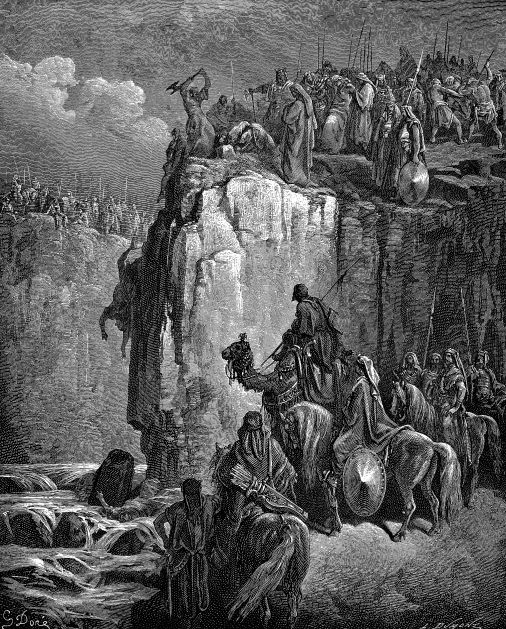
30Then Elijah said to all the people, “Come near to me.” So all the people came near to him. And he repaired the altar of the Lord that was broken down. 31 And Elijah took twelve stones, according to the number of the tribes of the sons of Jacob, to whom the word of the Lord had come, saying, “Israel shall be your name.” 32 Then with the stones he built an altar in the name of the Lord; and he made a trench around the altar large enough to hold two seahs of seed. 33And he put the wood in order, cut the bull in pieces, and laid it on the wood, and said, “Fill four waterpots with water, and pour it on the burnt sacrifice and on the wood.” 34 Then he said, “Do it a second time,” and they did it a second time; and he said, “Do it a third time,” and they did it a third time. 35 So the water ran all around the altar; and he also filled the trench with water. 36 And it came to pass, at the time of the offering of the evening sacrifice, that Elijah the prophet came near and said, “Lord God of Abraham, Isaac, and Israel, let it be known this day that You are God in Israel and I am Your servant, and that I have done all these things at Your word. 37 Hear me, O Lord, hear me, that this people may know that You are the Lord God, and that You have turned their hearts back to You again.” 38Then the fire of the Lord fell and consumed the burnt sacrifice, and the wood and the stones and the dust, and it licked up the water that was in the trench. 39Now when all the people saw it,they fell on their faces; and they said, “The Lord, He is God! The Lord, He is God!” 40 And Elijah said to them, “Seize the prophets of Baal! Do not let one of them escape!” So they seized them; and Elijah brought them down to the Brook Kishon and executed them there. (1 Kings 18:20-40)
Elijah arrives to do battle for the soul of the nation. He no longer makes his appeals to the king or queen, or to the false priests. He summons the people themselves, and he gives them an ultimatum. Follow God or follow Baal. No man can have two masters—there is no neutrality when it comes to God. There is an echoing of the language of Joshua 24:15 here: “choose for yourselves this day whom you will serve, whether the gods which your fathers served that were on the other side of the [Euphrates] River, or the gods of the Amorites, in whose land you dwell.” But they remain silent and unconvinced. They do not want to feel pressured to take a side, they want to remain in the middle. Elijah describes himself as the lone prophet, compared to 450 of the prophets of Baal. The 400 prophets of Asherah are probably in attendance, as it is not said that they are absent, but they are not the main offender in this story.
The competition is for both of them to light an altar on fire, a sacrifice. Mt. Carmel lies inside Baal’s “territory”. At this time, it is thought that gods controlled only certain regions, as there was little concept of a universal God for most religions. The challenge itself is also designed to play to Baal’s strength as the god of the storm. Calling down fire and lighting to the altar should be child’s play for him. The prophets of Baal have every expectation of this, and they may have seen it before. Angels and demons have real power. There is a great many supernatural things that happen in this world that are not of God, but of the Devil. But when it comes to a direct contest, there is no comparison, and God restrained the angel that masked itself as Baal from calling down fire of his own.
The prophets of Baal cry about for hours and dance for Baal to send down fire, and he does not. If there was a modern equivalent, this might be the point where we tell them they can stop and begin our turn. “You’re wearing yourself out. Here, have a seat.” And then we pray for God to show them the error of their ways. Elijah does no such thing. He mocks them, viciously. “Cry Harder! Surely Baal will hear you, isn’t he a god? Maybe he’s busy, or sleeping, or on vacation! Maybe he’s on the toilet!” And that drives the prophets into a frenzy, crying louder, cutting themselves with blades until the blood rushed from their wounds. They are bringing themselves to the brink of death for the sake of their pagan god, and they do this for hours, from noon to sundown. The prophets seem to be very sincere, they truly believe Baal will send fire down from heaven and prove their power over this upstart Elijah, will validate their choices and lifestyles. But no voice answers, “no one paid attention”. It reveals the hollowness in their godlessness. And Elijah confronts them with this directly. These people who have led his nation into sin and idolatry are given no soft words.
No one is paying attention anymore to the prophets of Baal. Elijah has let them demonstrate the hollowness of their religion, so when he summons the people to watch him rebuild the altar, they are entirely focused on him. He rebuilds the altar and floods it with water, gallons and gallons of it. The altar is practically underwater. And then Elijah makes his appeal to heaven, in front of “all Israel.” This is a specific prayer, meant to remind Israel of its covenant history. He calls God the “Lord God of Abraham, Isaac, and Israel,” their patriarchs, the founders of the tribes of Israel, the recipients of the covenant with God. He says that God is the God of Israel and in Israel, and that Elijah is His servant. God is not far off, God has not abandoned His people, God hears His servants, and is actively working for them. God is not on vacation, He is not too busy—God is not Baal. God can turn His people’s hearts back to Himself.
God demonstrates this with a sign of fire, sending down the blaze to consume the sacrifice, and the wood and the stones and water, burning hot enough to “lick” the water away with tongues of flame. And the people fall down on their faces to praise God. And Elijah invokes the Deuteronomic Law, calling upon the people to seize the prophets. And they drag them down the Brook of Kishon, where Elijah beheads every single one. They would no longer defile the nation with their presence but be swept away into the Mediterranean Sea.
Ahab is now entirely at the mercy of Elijah and his impromptu army. Elijah tells him to go look for clouds that would indicate rain is coming. Remember that Ahab probably still believes rain cannot come, as this is in the middle of Baal’s seven drought year cycle. And then, a small cloud rises from the Sea where the blood of the prophets of Baal had trickled down to, a small cloud that turns into a raging torrent of rain, cleansing the land. Ahab flees before the storm with his chariot, twenty miles to Jezreel. One imagines him fleeing at the very edge of the storm, with the rain licking his heels, threatening to muddy down the wheels of his chariots. And ahead of him, Elijah runs, the whole way. Ahab’s prophets were as nothing and are dead. God turned the people against him, and now even the symbol of military might is being put to flight, and being shamed by the power of God in a single man.
V. Should the Nation Pursue Righteousness
Sooner or later we were going to run into the following quandary, and this chapter is the right time to delve into it. What you do not find in 1&2 Kings is religious toleration. What we call “religious pluralism” or “tolerance” they called “idolatry.” Nowhere in Scripture is tolerance of evil seen as a good thing.
Israel as a unique covenant nation, containing both national and ecclesiastical properties, which makes it very hard to do application at times. There are, however, some principles that remain in effect. To quote Psalm 33:12, 12 “Blessed is the nation whose God is the Lord; and the people whom he hath chosen for his own inheritance” (Psalm 33:12). God blesses and judges individuals, but he also blesses and judges corporately—the righteous people of Israel suffer from the drought, same as the unrighteous. When invading armies of Assyria, Egypt, or Babylon plunder the nation of Israel, they are not checking the hearts of men before they kill them. The nation is a corporate body that suffers corporate justice for its sins. And so, to make repentance, there are time when the nation re-aligns itself towards God. Reformer kings like Asa are exalted when they slay false prophets and wicked men, remove the cult prostitutes from the land, scatter the idols, and cut down the sacred groves. The nation is blessed or cursed in measure of its faithfulness towards God.
Is righteousness in the public square, righteous laws, justice not all things we are still meant to pursue? If so, does that not mean that false religion, and the ungodliness that accompanies it, should be opposed from taking power and practice wherever possible? Is there actually something wrong with us following the path of Gideon, Asa, and Elijah and driving out the false prophets doing damage to the nation? Elijah did not wait for a new king to come to the throne and hope for change. Nor did the people have the acceptable excuse of “well, we simply are not in power.” Elijah went to the people directly, to convince them to return to God, and they acted, despite having no institutional power.
I think this principle is related to, if not directly connected to, the ongoing conversations revolving around Christian Nationalism, the Christian’s political life, etc. For the past 300 years, America has largely enjoyed a Christian consensus, where the average, everyday laws and customs were based on Christian principles. Postmodernism is grinding away at that, because Postmodernism has asserted that all religions are on equal footing, and therefore secular atheism should be the religion in charge of the state, that atheism can achieve a Neutral state before God, neither for nor against him. But this is impossible. Laws being made in a nation must come from a moral standard, the question is not whether that will be the case, but which standard will rule. There is no neutrality with God, you are for Him or against Him. I think 1&2 Kings outlines what happens when a nation gives up the Word of God as its standard, and so I have no issue with an assertion that we can make laws aligning to the Law God has revealed.
VI. Elijah Flees from Jezebel
One would think Ahab would now repent. He has seen the power of God, seen his false religion destroyed, been humbled at every turn. But he does not repent, he runs to hide behind his wife’s skirt and tell her all that has happened. Jezebel wears the pants in this relationship.
And Ahab told Jezebel all that Elijah had done, also how he had executed all the prophets with the sword. 2 Then Jezebel sent a messenger to Elijah, saying, “So let the gods do to me, and more also, if I do not make your life as the life of one of them by tomorrow about this time.” 3And when he saw that, he arose and ran for his life, and went to Beersheba, which belongs to Judah, and left his servant there. 4But he himself went a day’s journey into the wilderness, and came and sat down under a broom tree. And he prayed that he might die, and said, “It is enough! Now, Lord, take my life, for I am no better than my fathers!” 5 Then as he lay and slept under a broom tree, suddenly an angel touched him, and said to him, “Arise and eat.” 6Then he looked, and there by his head was a cake baked oncoals, and a jar of water. So he ate and drank, and lay down again. 7 And theangel of the Lord came back the second time, and touched him, and said, “Arise and eat, because the journey is too great for you.” 8So he arose, and ate and drank; and he went in the strength of that food forty days and forty nights as far as Horeb, the mountain of God. 9And there he went into a cave, and spent the night in that place; and behold, the word of the Lord came to him, and He said to him, “What are you doing here, Elijah?” 10 So he said, “I have been very zealous for the Lord God of hosts; for the children of Israel have forsaken Your covenant, torn down Your altars, and killed Your prophets with the sword. I alone am left; and they seek to take my life.” (1 Kings 19:1-11)
Jezebel swears by her own gods that she will kill him by tomorrow, and Elijah runs for his life, all the way to Beersheba, the southernmost tip of Judah. After that, he travels into the wilderness, and finds a tree to sit under, where he asks God to kill him (verse 4). “It is enough! Now, Lord, take my life, for I am no better than my fathers!” Elijah has lost hope. Even after everything, Ahab did not repent. Elijah has failed. Perhaps he thought himself better than those who came before him. He understood more, he had been granted greater blessings, he managed to slay the false prophets. If anyone could have changed the trajectory of his nation, it would have been him. And yet, he thinks he could not. He sees now that he is the same as those who came before him, like the unnamed prophet who challenged Jeroboam, or countless other prophets who failed to save Israel from itself. He was no greater than they, and now faced even greater challenges. He failed and Israel is lost. Better he were to die than live with that pain.
In his agony, he forgets that he is not truly alone. There are still prophets in Israel, and many followers at Mount Carmel that he has just made. But God is not done with Elijah yet. He sends an angel to bring him food and water, and through 40 days and 40 nights leads him to through the wilderness to Mount Horeb, AKA Mount Sinai. There are several parallels between Elijah and Moses. One is the site itself—Mt. Sinai. Another is the 40 days and 40 nights in the wilderness, and that God himself provides food for Elijah, like the manna from Heaven. God displays his power in a triad of wind, earthquake, and fire as he did for Moses. Another is that Elijah veiled his face before going out to speak to God, for when Moses was at Mount Sinai, God told him none can see His face and live. Elijah is set at the same status as Moses here—where Moses was the chief giver of the law, Elijah is chief among the prophets. These two figures appear side by side with Jesus at the Mount of Transfiguration.
It is there that God asks Elijah why he is here. Elijah tells him that the children of Israel have broken the covenant, torn down the altars, killed the prophet, and only Elijah is left. He is the lone voice crying in the wilderness, and no one is listening. He has come to bring the charge of covenant breaking to the place of covenant renewal. It is a sobering truth to bring to God. God promises him that there will be justice for the breaking of his covenant and gives him three new tasks. Anoint Hazael as king over Syria, Jehu as king over Israel, and Elisha as his successor. Whoever Hazael does not kill, Jehu will, and whoever Jehu does not kill, Elisha will. God does not promise the restoration and repentance of all of Israel. Israel is going to suffer the covenant curses. But God has reserved 7,000 people in Israel who have not bowed the knee to Baal. A remnant has been preserved for God.
VII. Final Themes
This leads into the main theme of these chapters. God will provide for His people, and he will always preserve His people. It may not be the majority of the visible body, it might even be a small minority of them. But God will bring judgment to the guilty and preserve for Himself the innocent. We, like Elijah, might some day fall down beneath a tree and weep, because we have done all we could and it still wasn’t enough to save our home here on Earth. But our work is not fruitless, and God will call us to our eternal home in heaven. We must not give in to despair.
 Covenantide
Leave a comment