
Confronting Idolatry
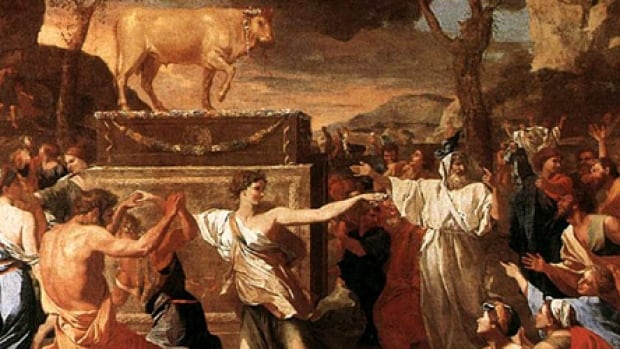
Before the holidays I was asked the question of how and when we need to confront idolatry like Elijah did in his confrontation with the prophets of Baal. The question was timely, since in December 2023 the Satanist Temple of Iowa erected a statue of the goat-headed idol Baphomet in the Iowa State House. Although state officials denounced it, they left it up on religious free speech grounds, and shortly thereafter it was vandalized by a US Navy reservist and Christian conservative because it was blasphemous. The display was removed entirely a few days later. In any event, as I began to think about an answer, I thought others might in interested in the question as well and, thus, it would be good to share the answer more broadly. So, that is what I will do now.
The Just War Tradition as a Paradigm
As we are seeing in this study of 1 and 2 Kings, the issue of confronting idolatry is at the front and center. The downward spiral of ancient Israel and Judah is directly driven by the idolatry that the kings and their people engaged in. So, what does that mean for us today, especially in light of the New Testament? The Apostle Paul writes in Ephesians 6:10-12 (the beginning of the “Armor of God” passage), “10 Finally, my brethren, be strong in the Lord, and in the power of his might. 11 Put on the whole armour of God, that ye may be able to stand against the wiles of the devil. 12 For we wrestle not against flesh and blood, but against principalities, against powers, against the rulers of the darkness of this world, against spiritual wickedness in high places.” We are in a spiritual war, and, as such, we are called to stand against evil. The question is, how do we do this?
A useful framework for thinking about this is the Just War Tradition. This is a framework for Christian thought that goes back at least to Augustine of Hippo in the fifth century AD and has been the dominant paradigm for thinking about conflict ever since. In suggesting this, there are three possible objections that need to be addressed up front. First, the Just War Tradition only applies to physical combat, but we are in a spiritual conflict. Second, the Just War Tradition only applies to violent conflict, not to non-violent conflict. And, lastly, the Just War Tradition is a checklist, such that if you do not have all the boxes checked, then the conflict is inherently unjust. Let me address each of these objections in turn.
First, it is true that when we talk about the “culture war” we are talking metaphorically, and we are in a spiritual war (although some people in our culture have been radicalized to such an extent that they are seeing the “culture war” as something that they need to take up real arms against). That said, issues as to what is a “just” war, who gets to decide, what are the constraints in how the war is fought, and how to we think about motives and ends are all things that need to be taken into consideration even in thinking about a spiritual and cultural conflict. Indeed, it is for this reason that I think the Just War Tradition gives us a useful framework for working through things comprehensively and ethically. Granted, there are differences in the nature of a spiritual war and how it is conducted that will necessitate making some adjustments to the tradition as we reflect on it, but this will not necessitate disposing of the framework as a whole.
Second, with regard to the difference between a violent physical conflict and non-violent spiritual conflict, Western society over time has drawn an arbitrary line between non-violence and violence and then assumed that anything non-violent is good and any violent is bad. Any serious student of conflict knows however conflict exists on a spectrum. The Prussian military theorist, Karl von Clausewitz, famously observed that, “War is the continuation of politics by other means.” Means are not inherently just or unjust simply because they are non-violent or violent. Experience has shown that there can be justice in the use of violence and injustice in non-violence. The violence/non-violence distinction does not negate the use of the Just War Tradition.
And third, the Just War Tradition is not a checklist, even though it has been used that way, especially since the Second World War. Throughout history the Just War Tradition has been a framework for reflection, not an automatic checklist. It only began to be used as a checklist by pacificists who were against all war whatsoever; by using it as a legalistic checklist then they could show that no war perfectly meets all the criteria, so therefore war is inherently immoral and pacificism is the only acceptable alternative. That certainly has not been the position of mainstream Christianity throughout the centuries, and it is not the position of the historical Reformed tradition.
With these objections addressed, let us briefly consider what the Just War Tradition is. As it has developed over the centuries, it can be divided into three major categories: jus ad bellum (justice to the war, i.e. the causes and resort to war); jus in bello (justice in the conduct of war); and jus post bellum (justice after the war). Of these, the first two categories have been around for centuries, but the third category has been developing over the course of the past century and really over the course of the past few decades.
Just Cause—Countering Idolatry
In thing about the causes for which to engage in conflict, in the spiritual war that we are in countering idolatry is at the top of the list. As much as Scripture talks about resisting idolatry in both the Old and New Testaments, this does not require much exegesis. What does require more discussion is “What do we mean by idolatry?” I would suggest there are three ways the term is used.
First, the biblical definition from the Decalogue is fairly specific.
3 Thou shalt have no other gods before me. 4 Thou shalt not make unto thee any graven image, or any likeness of any thing that is in heaven above, or that is in the earth beneath, or that is in the water under the earth: 5 Thou shalt not bow down thyself to them, nor serve them: for I the Lord thy God am a jealous God, visiting the iniquity of the fathers upon the children unto the third and fourth generation of them that hate me; 6 And shewing mercy unto thousands of them that love me, and keep my commandments.
Essentially, idolatry is (1) the worship of gods other than the true God or (2) the worship of the true God in ways other than what He has stipulated. The way that the First Commandment is written (specifically, the reference to “before me”) also suggests (3) a prohibition on religious syncretism. In what we have covered in 1 Kings, we have seen all of these prohibitions violated. Solomon’s sin was in accepting syncretism. Jeroboam led the people in a man-constructed—and therefore false—worship, rather than divinely ordained worship. In time, those things led to the outright worship of other gods, as evidenced by the official cult of Baal that Jezebel set up and which Elijah subsequently confronted.
In the modern context, there are two primary ways in which the term “idolatry” is used. First, on the conservative right, the term is often used in a generalized and unspecific way to express moral indignation at something. One can see this in Christians talking about how others are “Making the state into another religion” or “Making diversity into a religion.” In these cases, it is never clear what they mean by “religion” or how the “state” or “diversity” or whatever is actually being constituted as “another religion.” At its core, this simply is a way of expressing emotional distain toward a particular position. There may or may not be a legitimate justification for such antipathy, but it is working on the level of unexplained assumptions. I had a colleague years ago who would often say that he was “morally opposed to broccoli.” Because the statement seemed so nonsensical, I asked him why he said that. He responded that to say that he simply disliked broccoli would be a matter of personal preference, however, to say that he was morally opposed to it meant that he wanted others to share his disgust with broccoli. This use of “idolatry” is basically doing the same thing.
Another view popular in our circles is that expressed by Timothy Keller in his book, Counterfeit Gods. Keller asks, “What is an idol? It is anything more important to you than God, anything that absorbs your heart and imagination more than God, anything you seek to give you what only God can give.” This broadens the concept considerably. Earlier Keller noted that “We think that idols are bad things, but that is almost never the case. The greater the good, the more likely we are to expect that it can satisfy our deepest needs and hopes. Anything can serve as a counterfeit god, especially the very best things in life.”[1] Thus, things like money, sex, and power can be idols, and indeed, in Keller’s understanding, all sin is essentially tantamount to idolatry.
There are, however, several problems with this. First, there is a category error here. The Bible does not equate all sin with idolatry but identifies idolatry as a species of sin. For example, Paul in various places makes specific lists of sins, in which idolatry is listed as one among many, such as in Gal. 5:19-21 and 1 Cor. 6:9-10. The root of these sins listed is not idolatry, but disobedience to God’s revealed law; idolatry is but one poisonous fruit of this disobedience. In Romans 1:20-25, in fact, disobedience and rejection of God leads to the darkening of men’s thoughts, then to idolatry and other accompanying sins as God’s judgment.
It is also important to note that the parallelism Keller makes between ancient idolatry and modern idolatry does not hold biblically. In his view, in the ancient world men worshipped idols, but in the modern world men “worship” things like money, sex, and power. In this formulation, idolatry amounts to disordered desires, but that would make idolatry redundant with things like drunkenness or fornication, which in turn begs the exegetical question as to why Paul would bother to differentiate idolatry from these sins. In actual fact, the ancients desired money, sex, and power as well; there is not a contrastive difference between antiquity and modernity on this point. In the ancient world, worship of Baal and other associated or similar gods was typically associated with fertility, both of the womb and of the field. More sex, associated with the Baal cult, would lead to more children; more children meant more workers for the field and more people to take care of you in old age. More crops would lead to more wealth for oneself and one’s family. More wealth, in turn, would lead to more power and influence, including political influence, within the city’s gates. Thus, idolatry was the mechanism by which the ancients sought to assure their prosperity. This is why it was such a challenge to Israel’s faithfulness to God’s covenant; it was a way to hedge their bets and secure their security apart from God.
By considering all sin to be idolatry and idolatry to be tantamount to disordered desires, Keller inadvertently diminishes the seriousness of idolatry as a particular sin. Idolatry is a clear rejection of God as God, either in replacing Him with another god or in refashioning Him into an image of our own making. G. K. Beale, in his excellent book, We Become What We Worship; A Biblical Theology of Idolatry, says that “The word idolatry can refer to the worship of other gods besides the true God, or the reverence of images. According to both the ancient Near East and the Old Testament, an idol or image contained a god’s presence, though that presence was not limited to the image.”[2] In this regard, idolatry provides an intellectual coherence to man’s rebellion against God. For this reason, idolatry is a most serious sin and is treated as such throughout Scripture. It is not a “good thing” taken to an extreme but is intrinsically bad because it effectively calls good evil and evil good, and thus enables other sins. Granted, we do not worship the Baalim today—although to be sure, real paganism is growing significantly—but it may be more accurate to think of modern-day equivalents to ancient idolatries as being things like alternative religions (e.g., Islam, Buddhism, Mormonism, New Age spiritualism, etc.), worldly philosophies (e.g., Marxism, Critical Theory, Queer Theory, etc.), or totalistic political movements (e.g., fascism, Communism, etc.) from which people seek ultimate meaning.
Clarity about the nature of idolatry is important for our practical sanctification and faithfulness to God. As Christians seeking to glorify God, we need to flee from and put away idolatry and idolatrous things, but we will not be able to do that if we cannot accurately define what idolatry really is. If we are supposed to keep ourselves from idolatry and flee from it, as the Apostles tell us, then simply considering it to be something good that is out of balance contradicts the strong and clear impact of those commands. If idolatry is a good thing taken too far—“workaholism,” for example—then how does one define “too far”? “Idolatry,” thus becomes a matter to be subjectively defined, and if that is the case, then it will be easy to rationalize that we have addressed it when in reality we have not. On the other hand, if modern idolatries are things like alternative religions, worldly philosophies, totalistic political movements or uncritical adulation of prominent social or cultural figures, then that allows us to maintain clear insight on what we need to keep ourselves from, as well as what we need to rightly keep in focus to be faithful to our Lord.
Just Authority
With the other Just War criteria, I will be briefer in the interest of time. In the Just War Tradition there is the question of who the legitimate authority is to determine whether a war is just and whether it should be carried out. In the context of our cultural and spiritual war, this is a harder question to answer, especially since the church is not a united monolith. Nevertheless, the issue is an important one and at its root is the principle that private individuals do not get to determine solely by themselves what idolatry is and how to confront it. This particularly needs to be said in our radicalized age. Today, especially among Christian charismatics and evangelicals, there is a growing movement called the New Apostolic Reformation (NAR) which holds that the situation is so bad that God is raising up a new group of Apostles, equal to those who lived in Christ’s day who are receiving God’s word directly, doing miracles, and can lead God’s people into a new era of Christian dominion. This movement is very political in our contemporary context. It is also very wrong, and to see that, we need to understand biblically what prophecy was and who the apostles were.
It is a well-entrenched view among many evangelicals and charismatics that the Old Testament prophets were primarily future seers and miracle doers. With that image, it is not too much of a stretch to get to the claims of the NAR adherents. Biblically speaking, however, while the prophets did receive God’s word directly and did do miracles, they were much more than that. They were basically God’s covenantal advocates pressing God’s covenantal lawsuit against God’s covenantal people and calling them to repentance. Thus, the focus was not in speaking against the unbelievers outside the covenantal community, but against apostasy and unbelief within the covenantal community. In translating that to today, the covenantal community is not a nation state, like Israel and Judah, but the Christian church. The prophets were calling God’s people back to God’s word and God’s law. The miracles that were done were tangible demonstrations authenticating that God’s word had indeed come to them. In the New Testament, while the Apostles shared many characteristics of the Old Testament prophets, a key distinction is that the Apostles were eyewitnesses to the earthly ministry of the Lord, to His death, and to His resurrection. That is not repeatable in subsequent generations. Their authority was unique. Moreover, Hebrews 1:1-3 indicates that the final revelation is in Christ Himself; after that first generation passed away, the canon of Scripture was closed—after all, how could there be subsequent revelation after the final revelation in Christ?
What these modern so-called prophets and apostles are doing is, in effect if not necessarily in intention, is claiming authority for themselves independent of the constraints of Scripture. Note well the warning that Scripture gives about false prophets—death (Deut. 18:20). We have seen in 1 Kings several examples of false prophets, so anyone claiming to speak for God must be tested by God’s word. What this means for us today is that as we confront idolatry, we need to be doing so rooted in Scripture. Moreover, given the temptations of idolatry in our day and age, we need to be first and foremost instructing the Christian community in what is true, calling Christians to repentance, and enabling them to withstand the seductions of the age. As a teacher of God’s word, I cannot bind your conscience and demand your obedience to things that go beyond what Scripture says. False prophets, however, precisely want you to put more trust in their words than God’s words, even as they smoothly claim that they are speaking a “further” word from God. The Apostle Paul emphatically warned the Galatians that anyone who gives them a “gospel” other than what they received from him earlier should be damned. This is serious stuff.
Right Intention, Reasonable Chance of Success, Last Resort
In thinking about conflict, having the right intention, weighing whether there is a reasonable chance of success, and determining what can be done first before escalating to measures with extreme consequences (i.e., war) are prudential actions associated with the jus ad bellum criteria of the Just War Tradition. These also apply well to cultural and spiritual conflict in confronting idolatry.
Having the right intention is particularly apropos for our day. As Christians, we are bound to observe all of the Ten Commandments, including the Third Commandment, regarding not misusing the name of the Lord. This is commonly understood as not using the Lord’s name as a cuss word, but in reality, it goes far beyond that. In the Lord’s Prayer, we pray that the Lord’s name be hallowed (that is, honored). What this means is that we need to be mindful of whether our actions will reflect honorably or dishonorably on the Lord. In other words, will the Lord be honored and glorified by what we are doing? Here we need a serious examination of our hearts. We live in a day when virtue signaling is far more popular than actually being virtuous. We can pride ourselves on supporting the “right” causes, and rationalize that we are glorifying God, especially when such signaling costs little more than fueling the outrage machine on social media. The prophets and the righteous individuals that we have seen in our study of 1 Kings, however, all had to pay some kind of price for faithfulness—even Elijah, who experienced the stunning triumph of God over the prophets of Baal and would subsequently be taken up into heaven without dying had to flee for his life from Queen Jezebel, exhausted and discouraged and needing to be protected and restored by God.
The Just War criteria for reasonable chance of success and last resort are specifically tied to war and the violence associated with it. That said, in applying these criteria to the cultural and spiritual war of our day, it is legitimate to ask whether any actions have a legitimate chance of success and whether there is a strategy behind what we are doing. If we are to maintain a credible witness, then there also needs to be clarity about the directness of the actions we are taking relative to the idols we are combating. All too often there is a temptation to do something simply to show action or to focus on symbolic actions. Such an approach might feel good psychologically but will not make a dent in actually challenging the idols of our age. There is also a desire for quick results, which rarely is effective. Changing culture, however, takes time, often requires gradual escalation, and needs to maintain constant focus on the ultimate goals. We will see as we go forward in 2 Kings that even the reforms of the good kings of Judah would not really outlive the king’s own reign because they failed do this.
Justice in War and Post-War
The historic Just War criteria for justice in war focus on discrimination and proportionality. In applying these to the cultural and spiritual war of our day we need to keep in mind, first of all, the nature of the conflict we are in. Ours is a spiritual conflict that requires spiritual means. The temptation of our day is to use political means to achieve things that can only be achieved by the church. Francis Schaeffer has pointed out that changes in religion and philosophy lead to changes in high culture, then low culture, then politics and economics. Thus, if we are aiming to change culture we need to go upstream, and change the church, enabling the church to be the church. Apologetics, evangelism, discipleship, worship and prayer will be as or more important than political activism. The changes brought by those means will be less flashy, but more durable over time.
The means that we do employ in combating the idols of our age do matter. There is a saying among apologists that “What you win them with is what you win them to.” This needs emphasizing today because there is a tendency among those on the right to think that tactics are neutral, and we can adopt the tactics of the left and be pragmatically effective. The problem with that is the symbolic tactics of the left are Leninist, geared toward destabilizing the system and seizing power. What may work for doing that, however, will not work for governance afterwards. By de-legitimizing things, it means that if you do take power you will have to rely on increasingly coercive means to rule because goodwill or sympathy for one’s ideas will have been exhausted. Moreover, the means we employ will affect our moral credibility; once that is lost, it will be really difficult to regain.
[1] Timothy Keller, Counterfeit Gods; The Empty Promises of Money, Sex, and Power, and the Only Hope that Matters. (New York NY: Dutton, 2009), xvii.
[2] G. K. Beale, We Become What We Worship; A Biblical Theology of Idolatry (Downer’s Grove IL: InterVarsity Press, 2008), 17.
 Covenantide
Leave a comment