Elisha’s Miracles
Note: This lesson was taught by Kyle Simmons
I. The Miracle of the Oil (2 Kings 4:1-7)
4 Now there cried a certain woman of the wives of the sons of the prophets unto Elisha, saying, Thy servant my husband is dead; and thou knowest that thy servant did fear the Lord: and the creditor is come to take unto him my two sons to be bondmen. 2 And Elisha said unto her, What shall I do for thee? tell me, what hast thou in the house? And she said, Thine handmaid hath not any thing in the house, save a pot of oil. 3 Then he said, Go, borrow thee vessels abroad of all thy neighbours, even empty vessels; borrow not a few. 4 And when thou art come in, thou shalt shut the door upon thee and upon thy sons, and shalt pour out into all those vessels, and thou shalt set aside that which is full. 5So she went from him, and shut the door upon her and upon her sons, who brought the vessels to her; and she poured out. 6 And it came to pass, when the vessels were full, that she said unto her son, Bring me yet a vessel. And he said unto her, There is not a vessel more. And the oil stayed. 7 Then she came and told the man of God. And he said, Go, sell the oil, and pay thy debt, and live thou and thy children of the rest.
A few things to note in this passage. First is the existence of a community known as “the sons of the prophets.” Little is definitively known about this community, but given the Scripture references, they begin to emerge during the ministries of Elijah and particularly Elisha. There are nine references to such a community between 1 Kings 20 and 2 Kings 9 (1 Kings 20:35; 2 Kings 2:3, 5, 7, 15; 4:1, 38, 5:22, 6:1, and 9:1), and the community seemed to exist exclusively in the northern kingdom of Israel. Commentators have described the variously as a guild, a class, or a school, but it may be best to think of them as an organized remnant of the godly in Israel. As most of these references are associated with Elisha, it is likely that he was the leader of this community. The purpose of this community was to maintain faithfulness to the LORD and speak His truth to the nation in light of the apostasy and idolatry of the day.
In this passage it is not surprising that the widow of one of these “sons of the prophets” was so impoverished that her sons were going to be taken into slavery. If this is a community of the godly remnant, then people almost certainly had to make sacrifices for their faithfulness and, by not going along with the official religion, would be financially strapped. What this episode shows is that God provides for His faithful servants. Here it was not a handout, but the means by which she could raise the money to pay her debts. Although this is a miracle, it was done in private. This preserved her dignity, while providing for her needs. The care of widows and orphans is an important mark of the covenantal community, and in the New Testament, this can be seen in Paul’s description of the care for widows in 1 Tim. 5:2-16.
II. The Shunammite Woman and Her Son (2 Kings 4:8-37)
8 And it fell on a day, that Elisha passed to Shunem, where was a great woman; and she constrained him to eat bread. And so it was, that as oft as he passed by, he turned in thither to eat bread. 9 And she said unto her husband, Behold now, I perceive that this is an holy man of God, which passeth by us continually. 10 Let us make a little chamber, I pray thee, on the wall; and let us set for him there a bed, and a table, and a stool, and a candlestick: and it shall be, when he cometh to us, that he shall turn in thither. 11 And it fell on a day, that he came thither, and he turned into the chamber, and lay there. 12 And he said to Gehazi his servant, Call this Shunammite. And when he had called her, she stood before him. 13 And he said unto him, Say now unto her, Behold, thou hast been careful for us with all this care; what is to be done for thee? wouldest thou be spoken for to the king, or to the captain of the host? And she answered, I dwell among mine own people. 14 And he said, What then is to be done for her? And Gehazi answered, Verily she hath no child, and her husband is old. 15 And he said, Call her. And when he had called her, she stood in the door. 16 And he said, About this season, according to the time of life, thou shalt embrace a son. And she said, Nay, my lord, thou man of God, do not lie unto thine handmaid. 17 And the woman conceived, and bare a son at that season that Elisha had said unto her, according to the time of life.
18 And when the child was grown, it fell on a day, that he went out to his father to the reapers. 19 And he said unto his father, My head, my head. And he said to a lad, Carry him to his mother. 20 And when he had taken him, and brought him to his mother, he sat on her knees till noon, and then died. 21 And she went up, and laid him on the bed of the man of God, and shut the door upon him, and went out. 22 And she called unto her husband, and said, Send me, I pray thee, one of the young men, and one of the asses, that I may run to the man of God, and come again. 23 And he said, Wherefore wilt thou go to him to day? it is neither new moon, nor sabbath. And she said, It shall be well. 24 Then she saddled an ass, and said to her servant, Drive, and go forward; slack not thy riding for me, except I bid thee. 25 So she went and came unto the man of God to mount Carmel. And it came to pass, when the man of God saw her afar off, that he said to Gehazi his servant, Behold, yonder is that Shunammite: 26 Run now, I pray thee, to meet her, and say unto her, Is it well with thee? is it well with thy husband? is it well with the child? And she answered, It is well. 27 And when she came to the man of God to the hill, she caught him by the feet: but Gehazi came near to thrust her away. And the man of God said, Let her alone; for her soul is vexed within her: and the Lord hath hid it from me, and hath not told me. 28 Then she said, Did I desire a son of my lord? did I not say, Do not deceive me? 29 Then he said to Gehazi, Gird up thy loins, and take my staff in thine hand, and go thy way: if thou meet any man, salute him not; and if any salute thee, answer him not again: and lay my staff upon the face of the child. 30 And the mother of the child said, As the Lord liveth, and as thy soul liveth, I will not leave thee. And he arose, and followed her. 31 And Gehazi passed on before them, and laid the staff upon the face of the child; but there was neither voice, nor hearing. Wherefore he went again to meet him, and told him, saying, The child is not awaked. 32 And when Elisha was come into the house, behold, the child was dead, and laid upon his bed. 33 He went in therefore, and shut the door upon them twain, and prayed unto the Lord. 34 And he went up, and lay upon the child, and put his mouth upon his mouth, and his eyes upon his eyes, and his hands upon his hands: and he stretched himself upon the child; and the flesh of the child waxed warm. 35 Then he returned, and walked in the house to and fro; and went up, and stretched himself upon him: and the child sneezed seven times, and the child opened his eyes. 36 And he called Gehazi, and said, Call this Shunammite. So he called her. And when she was come in unto him, he said, Take up thy son. 37 Then she went in, and fell at his feet, and bowed herself to the ground, and took up her son, and went out.
Here is an account of another woman associated with the ministry of Elisha, this time a wealthy woman further to the north in Shunem. Shunem is in the territory of Issachar, on the southern slope of Mount Moreh, near Jezreel. The Shunammite woman recognized that Elisha was a genuine man of God, and she made her house into a lodging point for when Elisha was in the region. She is not looking for anything in return, but Elisha does want to bless her in some way. Elisha’s servant Gehazi recognizes that she has no children, and her husband is old, which means that when he dies, she could be left destitute, with no one to care for her. So, God, through Elisha, promises her a son, which is born the following year. Years later, that boy suffers some kind of ailment with his head and dies. The woman puts him in the room where Elisha would usually stay, and then goes on a 17-mile journey to seek Elisha out personally, both to pour out her grief to him but also with an expectation that he can do something about it, which he does. Like Elijah in Zarephath on the Sidonian coast (1 Kings 17:8-24), Elisha raises the boy from the dead. In the case with Elijah, the miracle proved to the Zidonian woman that Elijah was truly a man of God and that the word of the LORD was in his mouth. With the Shunammite woman, it proved her faith that the same was true for Elisha as well.
It is worth noting that these miracles, and particularly the one regarding the Shunammite woman, point forward to the earthly ministry of Christ Jesus. Luke 7:11-17 records Christ performing a similar miracle in Nain. Nain is on the north side of Mount Moreh, near Shunem. No doubt word of Elisha resurrecting the Shunammite woman’s son probably became entrenched as part of the local tradition of that area. Jesus’s miracle was the first of three resurrections that He performed in His ministry, which included the healing of Jairus’s daughter (Luke 8:40-56) and of Lazarus (John 11:38-44). Given the tradition associated with Elisha, when Jesus healed the son of the widow of Nain, it almost certainly would have been seen in the same light, namely as a confirmation that Jesus was indeed a man of God and that word of God was truly in Him.
III. “Death in the Pot” (2 Kings 4:38-41)
38 And Elisha came again to Gilgal: and there was a dearth in the land; and the sons of the prophets were sitting before him: and he said unto his servant, Set on the great pot, and seethe pottage for the sons of the prophets. 39 And one went out into the field to gather herbs, and found a wild vine, and gathered thereof wild gourds his lap full, and came and shred them into the pot of pottage: for they knew them not. 40 So they poured out for the men to eat. And it came to pass, as they were eating of the pottage, that they cried out, and said, O thou man of God, there is death in the pot. And they could not eat thereof. 41 But he said, Then bring meal. And he cast it into the pot; and he said, Pour out for the people, that they may eat. And there was no harm in the pot.
In this passage, we return again to the sons of the prophets community, this time in Gilgal, which is near Bethel, and was probably the center of the prophetic community. Here, the failure of the one gathering the herbs to accurately identify the poisonous gourds could have led to the poisoning of the main community. Had that poisoning been fatal, it would have struck a severe blow to the faithful witness in Israel. Elisha’s response in curing the stew shows the graciousness of God in protecting and sustaining His people.
IV. Feeding a Multitude (2 Kings 4:42-44)
42 And there came a man from Baal-shalisha, and brought the man of God bread of the firstfruits, twenty loaves of barley, and full ears of corn in the husk thereof. And he said, Give unto the people, that they may eat. 43 And his servitor said, What, should I set this before an hundred men? He said again, Give the people, that they may eat: for thus saith the Lord, They shall eat, and shall leave thereof. 44 So he set it before them, and they did eat, and left thereof, according to the word of the Lord.
Baal-shalisha is a village near Gilgal, in the hill country of Ephraim, so again, near to the center of the sons of the prophets community. He is bringing food to the community but (in his mind) it is not sufficient to feed the entire community of one hundred or so men. He is told nevertheless to set it before the community, which he does and the men ate and had bread left over. This clearly anticipates Christ’s miracles of the feeding of the 5,000 at Bethsaida (Matt. 14:13-21, Mark 6:30-44, Luke 9:10-17, John 6:1-14) and the feeding of the 4,000 at Decapolis (Matt. 15:32-39, Mark 8:1-9). Again, this is a miracle of God providing for and sustaining His people as try to be faithful to Him.
V. Naaman’s Leprosy (2 Kings 5:1-27)
5 Now Naaman, captain of the host of the king of Syria, was a great man with his master, and honourable, because by him the Lord had given deliverance unto Syria: he was also a mighty man in valour, but he was a leper. 2 And the Syrians had gone out by companies, and had brought away captive out of the land of Israel a little maid; and she waited on Naaman’s wife. 3 And she said unto her mistress, Would God my lord were with the prophet that is in Samaria! for he would recover him of his leprosy. 4 And one went in, and told his lord, saying, Thus and thus said the maid that is of the land of Israel. 5 And the king of Syria said, Go to, go, and I will send a letter unto the king of Israel. And he departed, and took with him ten talents of silver, and six thousand pieces of gold, and ten changes of raiment. 6 And he brought the letter to the king of Israel, saying, Now when this letter is come unto thee, behold, I have therewith sent Naaman my servant to thee, that thou mayest recover him of his leprosy. 7 And it came to pass, when the king of Israel had read the letter, that he rent his clothes, and said, Am I God, to kill and to make alive, that this man doth send unto me to recover a man of his leprosy? wherefore consider, I pray you, and see how he seeketh a quarrel against me. 8 And it was so, when Elisha the man of God had heard that the king of Israel had rent his clothes, that he sent to the king, saying, Wherefore hast thou rent thy clothes? let him come now to me, and he shall know that there is a prophet in Israel. 9 So Naaman came with his horses and with his chariot, and stood at the door of the house of Elisha. 10 And Elisha sent a messenger unto him, saying, Go and wash in Jordan seven times, and thy flesh shall come again to thee, and thou shalt be clean. 11 But Naaman was wroth, and went away, and said, Behold, I thought, He will surely come out to me, and stand, and call on the name of the Lord his God, and strike his hand over the place, and recover the leper. 12 Are not Abana and Pharpar, rivers of Damascus, better than all the waters of Israel? may I not wash in them, and be clean? So he turned and went away in a rage. 13 And his servants came near, and spake unto him, and said, My father, if the prophet had bid thee do some great thing, wouldest thou not have done it? how much rather then, when he saith to thee, Wash, and be clean? 14 Then went he down, and dipped himself seven times in Jordan, according to the saying of the man of God: and his flesh came again like unto the flesh of a little child, and he was clean.
15 And he returned to the man of God, he and all his company, and came, and stood before him: and he said, Behold, now I know that there is no God in all the earth, but in Israel: now therefore, I pray thee, take a blessing of thy servant. 16 But he said, As the Lord liveth, before whom I stand, I will receive none. And he urged him to take it; but he refused. 17 And Naaman said, Shall there not then, I pray thee, be given to thy servant two mules’ burden of earth? for thy servant will henceforth offer neither burnt offering nor sacrifice unto other gods, but unto the Lord. 18 In this thing the Lord pardon thy servant, that when my master goeth into the house of Rimmon to worship there, and he leaneth on my hand, and I bow myself in the house of Rimmon: when I bow down myself in the house of Rimmon, the Lord pardon thy servant in this thing. 19 And he said unto him, Go in peace. So he departed from him a little way.
20 But Gehazi, the servant of Elisha the man of God, said, Behold, my master hath spared Naaman this Syrian, in not receiving at his hands that which he brought: but, as the Lord liveth, I will run after him, and take somewhat of him. 21 So Gehazi followed after Naaman. And when Naaman saw him running after him, he lighted down from the chariot to meet him, and said, Is all well? 22 And he said, All is well. My master hath sent me, saying, Behold, even now there be come to me from mount Ephraim two young men of the sons of the prophets: give them, I pray thee, a talent of silver, and two changes of garments. 23 And Naaman said, Be content, take two talents. And he urged him, and bound two talents of silver in two bags, with two changes of garments, and laid them upon two of his servants; and they bare them before him. 24 And when he came to the tower, he took them from their hand, and bestowed them in the house: and he let the men go, and they departed. 25But he went in, and stood before his master. And Elisha said unto him, Whence comest thou, Gehazi? And he said, Thy servant went no whither. 26 And he said unto him, Went not mine heart with thee, when the man turned again from his chariot to meet thee? Is it a time to receive money, and to receive garments, and oliveyards, and vineyards, and sheep, and oxen, and menservants, and maidservants? 27 The leprosy therefore of Naaman shall cleave unto thee, and unto thy seed for ever. And he went out from his presence a leper as white as snow.
There are a lot of things going on in this account. There had been continuing frictions between the House of Ahab in Israel and Ben-Hadad, the king of Damascus in Syria. It is in the course of these border frictions that a young girl was captured and made a servant in the house of Aram’s military commander, Naaman the Syrian. When Naaman contracts leprosy, it is the servant girl who suggests he can be healed by Elisha, the prophet in Israel. Rather than seeking him out privately, Naaman accompanies a diplomatic entourage to Samaria to first engage Jehoram, king of Israel, on the assumption that a prophet operating within Israel would actually be in the court of the king. Jehoram’s spiritual blindness is such, however, that he completely misreads Syrian intentions and assumes that it is a provocation to initiate a war. Elisha, upon hearing of the king’s reaction, sees this as an opportunity to demonstrate that there is a genuine prophet in Israel. When Naaman comes to Elisha’s house, he is simply told to go and wash himself in the Jordan seven times. At first indignant, he is confronted by his servants for his unbelief and backs down. The washing in the Jordan actually heals Naaman by God’s grace, resulting in him being healed of his leprosy and in praising God. Naaman’s confession of the true God and his newfound faith, contrasts starkly with the lack of faith of Jehoram and with greedy exploitation of Naaman by Elisha’s servant, Gehazi.
This experience would have been a prophetic warning to Israel that without repentance, it too would become unclean and would be banished from God’s presence, but that if it repented, then it too would be blessed. Indeed, God’s blessing is not limited to Israel alone, but would be expanded to include the Gentiles. This incident would also prefigure the truth we see in the New Testament, that grace entirely is by faith alone. It cannot be bought or sold. This is especially true of the salvation extended to us by God through Christ Jesus.
VI. The Floating Axe Head (2 Kings 6:1-7)
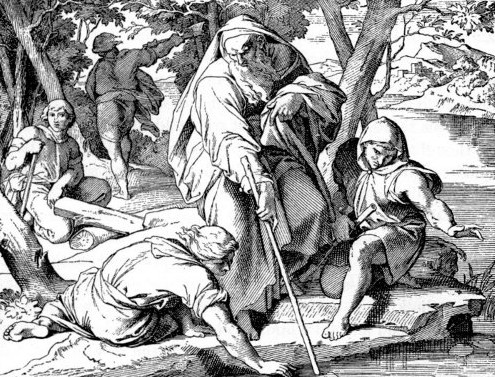
6 And the sons of the prophets said unto Elisha, Behold now, the place where we dwell with thee is too strait for us. 2 Let us go, we pray thee, unto Jordan, and take thence every man a beam, and let us make us a place there, where we may dwell. And he answered, Go ye. 3 And one said, Be content, I pray thee, and go with thy servants. And he answered, I will go. 4So he went with them. And when they came to Jordan, they cut down wood. 5But as one was felling a beam, the axe head fell into the water: and he cried, and said, Alas, master! for it was borrowed. 6 And the man of God said, Where fell it? And he shewed him the place. And he cut down a stick, and cast it in thither; and the iron did swim. 7 Therefore said he, Take it up to thee. And he put out his hand, and took it.

Again we see God’s providence in providing for the community of the sons of the prophets. In this particular age, iron tools probably were very expensive, and to accidently lose one could be financially costly, perhaps even to the point of risking indentured servitude to repay the debt. Recovering the iron axe head, therefore, would have been cause for great rejoicing.
VII. The Significance of These Miracles
All these accounts beg the question as to why they are in 1 and 2 Kings, or, a better question is, “How do these narratives advance the overall theme of these two books?” Remember, Jeremiah wrote these books to those in exile to explain why God’s chosen lost their land and were driven into exile. These chapters notably deviate from the focus on kings. The chapters on the kings focus on the retrograde actions they took or failed to take which contributed to the downward, unbelieving spiral. These chapters, however, focus on the believing remnant, highlighting God’s miraculous providence for His faithful people. To a people in exile, this provides a positive example for them to follow during their exile, namely to hold fast in faith to their God, who has delivered and will continue to deliver his people, and to follow true prophets speaking the true words of God. This example is one that still applies to us even today.
 Covenantide
Leave a comment