
Jehu’s Purge
I. Jehoram and Ahaziah of Judah (2 Kings 8:16-29)
In the previous lesson, Elisha engaged the Syrians three times. First, he blinded Syrian raiders sent by Ben-Hadad, led them into Samaria and out of it, and ensured they no more would launch raids on Israel. Second, Ben Hadad gathered up another army and laid siege to Samaria during a famine while Elisha was there, but God drove away the Syrians, just as Elisha had prophesied. And lastly, Elisha traveled to Damascus to tell Hazael he shall be king of Syria and shall cause great destruction and sorrow upon Syria. Hazael was the second of the three avengers God commanded Elijah to appoint back in 1 Kings 19, Elisha being the first, and the last being Jehu. In this lesson, we will see how Jehu ended the line of Ahab, the consequences of Judah’s association with Israel, and how different the kingdom of Israel looked like under Jehu’s rule. Before doing that, however, we need to look at Judah. The last king we followed there was Jehoshaphat, during the war between Israel, Judah, and Edom against Moab.
16 And in the fifth year of Joram the son of Ahab king of Israel, Jehoshaphat being then king of Judah, Jehoram the son of Jehoshaphat king of Judah began to reign. 17 Thirty and two years old was he when he began to reign; and he reigned eight years in Jerusalem. 18 And he walked in the way of the kings of Israel, as did the house of Ahab: for the daughter of Ahab was his wife: and he did evil in the sight of the Lord. 19 Yet the Lord would not destroy Judah for David his servant’s sake, as he promised him to give him alway a light, and to his children. 20In his days Edom revolted from under the hand of Judah, and made a king over themselves. 21 So Joram went over to Zair, and all the chariots with him: and he rose by night, and smote the Edomites which compassed him about, and the captains of the chariots: and the people fled into their tents. 22 Yet Edom revolted from under the hand of Judah unto this day. Then Libnah revolted at the same time. 23 And the rest of the acts of Joram, and all that he did, are they not written in the book of the chronicles of the kings of Judah? 24 And Joram slept with his fathers, and was buried with his fathers in the city of David: and Ahaziah his son reigned in his stead.
25 In the twelfth year of Joram the son of Ahab king of Israel did Ahaziah the son of Jehoram king of Judah begin to reign. 26 Two and twenty years old was Ahaziah when he began to reign; and he reigned one year in Jerusalem. And his mother’s name was Athaliah, the daughter of Omri king of Israel. 27 And he walked in the way of the house of Ahab, and did evil in the sight of the Lord, as did the house of Ahab: for he was the son in law of the house of Ahab. 28 And he went with Joram the son of Ahab to the war against Hazael king of Syria in Ramoth-gilead; and the Syrians wounded Joram. 29 And king Joram went back to be healed in Jezreel of the wounds which the Syrians had given him at Ramah, when he fought against Hazael king of Syria. And Ahaziah the son of Jehoram king of Judah went down to see Joram the son of Ahab in Jezreel, because he was sick.
These verses outline the deepening relationship between Israel and Judah. Despite God’s warnings and punishments, Judah continued to associate with Israel more and more. This began with Jehoshaphat, who launched joint military campaigns with King Ahab, and then trade expeditions with Ahaziah, the son of Ahab. Jehoram, king of Judah, followed in his foreign policy, marrying Athaliah, the daughter of Ahab.
We will not spend much time on Jehoram of Judah, save to say that he is another evil king. He killed his brothers and many court officials upon his ascension and set up shrines and high places on the hills of Judah. In short, he led Judah astray, and Judah was punished by it with dual revolts—one from Edom in the east, and one from the city of Libnah in the West. Jehoram was so bad that he received a letter from Elijah, apparently written before his [Elijah’s] ascension, telling him he would die of a bowel disease, literally excreting out his own organs. And he did, but not before the Philistines attacked Judah, killed every one of his sons save the youngest, Ahaziah. He died after eight years on the throne.
Ahaziah took the throne as a young man of 22, and as a son-in-law of the house of Ahab, he did evil like the house of Ahab. It is here that we see the connection between Israel and Judah take its final connecting form, how close Ahaziah is to the kings of Israel. Joram is his uncle by marriage, after all, so its not unexpected when Ahaziah travels to Israel to visit Joram when he falls ill. The failure of Judah to obey God, to avoid yoking of themselves with the unrighteous, the attempted fellowship between light and darkness, is going to have disastrous events for the throne of Judah, starting with Ahaziah. Now that we’ve caught up to the present in Judah, we’re going to head back north to Israel.
II. Commission of Jehu (2 Kings 9:1-13)
9 And Elisha the prophet called one of the children of the prophets, and said unto him, Gird up thy loins, and take this box of oil in thine hand, and go to Ramoth-gilead: 2 And when thou comest thither, look out there Jehu the son of Jehoshaphat the son of Nimshi, and go in, and make him arise up from among his brethren, and carry him to an inner chamber; 3Then take the box of oil, and pour it on his head, and say, Thus saith the Lord, I have anointed thee king over Israel. Then open the door, and flee, and tarry not. 4 So the young man, even the young man the prophet, went to Ramoth-gilead. 5 And when he came, behold, the captains of the host were sitting; and he said, I have an errand to thee, O captain. And Jehu said, Unto which of all us? And he said, To thee, O captain. 6 And he arose, and went into the house; and he poured the oil on his head, and said unto him, Thus saith the Lord God of Israel, I have anointed thee king over the people of the Lord, even over Israel. 7 And thou shalt smite the house of Ahab thy master, that I may avenge the blood of my servants the prophets, and the blood of all the servants of the Lord, at the hand of Jezebel. 8For the whole house of Ahab shall perish: and I will cut off from Ahab him that pisseth against the wall, and him that is shut up and left in Israel: 9 And I will make the house of Ahab like the house of Jeroboam the son of Nebat, and like the house of Baasha the son of Ahijah: 10 And the dogs shall eat Jezebel in the portion of Jezreel, and there shall be none to bury her. And he opened the door, and fled.
11 Then Jehu came forth to the servants of his lord: and one said unto him, Is all well? wherefore came this mad fellow to thee? And he said unto them, Ye know the man, and his communication. 12 And they said, It is false; tell us now. And he said, Thus and thus spake he to me, saying, Thus saith the Lord, I have anointed thee king over Israel. 13 Then they hasted, and took every man his garment, and put it under him on the top of the stairs, and blew with trumpets, saying, Jehu is king.
As noted earlier, Jehu is the third and final sword that God appointed back in 1 Kings 19, a commander in the army of Israel. Elijah went immediately to Elisha, but did not go directly to Hazael and Jehu, as God told him in 1 Kings 21 that He promised to delay judgement on Ahab until the days of his son, because Ahab had humbled himself before God after allowing the execution of Naboth of Jezreel. As such, it fell to Elisha, who decided it was time for Jehu’s commission.
Elisha has cut a path through Israel, from his beginning in the south near Judah, to his lodging at Dothan, to Samaria, to Damascus. Where Elijah’s travels had him constantly on the run, retreating and hiding, Elisha has been as straight as an arrow. This makes it somewhat curious that Elisha chooses now to act through an intermediary, one of the sons of the prophets, rather than going himself, particularly since he himself has been given the spirit and ministry of Elijah, and this was Elijah’s charge. So, why did he act through an intermediary? Why didn’t he go himself? There are a couple of possible answers. Maybe he was getting old and cannot move as fast as he knew he would need to; maybe he was busy; maybe he wanted this to be done clandestinely so that Elisha, famous and recently departed from one kingmaking, would not be announced to be heading to the army of Israel, which Joram might rightly understand to mean Elisha was preparing for a second kingmaking. Any and all of those possibilities could be true, but what is also true is that Elisha did not need to go. It is not the spirit of Elisha that makes kings, it is the Spirit of God, and it is not possessed by only one man, great as he may be. All who have the Spirit of God can act for His purposes, and all can serve.
So, Elisha sends another with the Spirit to speak the Word of God to Jehu and anoint him as King of Israel. He tells the prophet to go Ramoth Gilead, take Jehu into a separate room, make him king, and then run out in haste. He also gives him instructions on how to go and how to leave. In verse 1, some translations have “tuck your robe into your belt,” others have “make yourself ready.” “Girding up your loins” involves taking your tunic or robe and tying it around your waist, making them into short shorts, so you can run. This is not done in preparation for speed walking, this is done for war and sprinting. And the prophet is going to need to sprint.
The young prophet takes Jehu aside (more evidence for the secrecy argument), anoints his head with oil, and declares him king, repeating the message Elijah gave to Ahab in 1 Kings 21:19, that the whole house of Ahab would perish, and Jezebel will be eaten by dogs at Naboth’s vineyard, the vineyard she had murdered for. The blood that they had shed would be avenged. When the prophet left, the other commanders, their interest piqued, asked Jehu what he wanted, and called him a madman. He doesn’t appear mad in any way, except maybe that he’s got his pants pulled up high and tight for running. This is likely another case of “normal” being seen as insane. During times of madness, that which is evil is reckoned as good, and good reckoned as evil. An Orthodox Monk named St Anthony the Great, from the 3rd century AD once said, “A time is coming,” when men will go mad, and when they see someone who is not mad, they will attack him, saying, “You are mad; you are not like us.”” Despite his apparent “madness”, they want to know what he said. When they asked Jehu what he said, Jehu told them “Oh you know, just crazy stuff.” As he just ignores the oil dripping down his head. The commanders do not believe him, and they demand he tells them the truth. And then Jehu does just that—that God has made him King over Israel. Jehu was reticent to reveal this—telling the king’s army you’re going to launch a coup against the king is a risky play—but instead of executing him for treason, they rush to be the first to tear off their clothes and spread them under his feet.
Joram is clearly not a popular king-the constant raids from Syria, the famine, the recent rebellion of Moab, and the fact he got wounded and chose to recover at his palace in Jezreel, not at the front lines in Ramoth Gilead likely contributed to this. The nation is in economic decline, it had constant wars along its far-flung borders for decades now, and it is at war right now, which is why Jehu and the army are in Ramoth Gilead, and why Joram is wounded/sick in Jezreel. People are desperate for anyone with charisma and strength to stand up, take control, and move the nation in a different direction. Folks need someone to give them hope. And so, the main army of Israel declares for Jehu against Joram.
III. Joram of Israel Killed (2 Kings 9:14-37)
14 So Jehu the son of Jehoshaphat the son of Nimshi conspired against Joram. (Now Joram had kept Ramoth-gilead, he and all Israel, because of Hazael king of Syria. 15 But king Joram was returned to be healed in Jezreel of the wounds which the Syrians had given him, when he fought with Hazael king of Syria.) And Jehu said, If it be your minds, then let none go forth nor escape out of the city to go to tell it in Jezreel. 16 So Jehu rode in a chariot, and went to Jezreel; for Joram lay there. And Ahaziah king of Judah was come down to see Joram.
While the positive sentiment might have been shared by much of the army, the conspirators could not assume that it would be shared across the nation. The coup needed to be as stealthy as possible, and that meant an information lockdown. Jehu stopped anyone from going to Jezreel to alert the king of his treachery by instituting a quarantine of the whole camp. No one was to be allowed to leave for fear they would warn Joram, and now we know why the young prophet had a need to sprint as soon as he accomplished his mission. Jehu is like a bomb you just lit the fuse on, and now you have got to get out of the blast radius.
17 And there stood a watchman on the tower in Jezreel, and he spied the company of Jehu as he came, and said, I see a company. And Joram said, Take an horseman, and send to meet them, and let him say, Is it peace? 18 So there went one on horseback to meet him, and said, Thus saith the king, Is it peace? And Jehu said, What hast thou to do with peace? turn thee behind me. And the watchman told, saying, The messenger came to them, but he cometh not again. 19 Then he sent out a second on horseback, which came to them, and said, Thus saith the king, Is it peace? And Jehu answered, What hast thou to do with peace? turn thee behind me. 20 And the watchman told, saying, He came even unto them, and cometh not again: and the driving is like the driving of Jehu the son of Nimshi; for he driveth furiously. 21 And Joram said, Make ready. And his chariot was made ready. And Joram king of Israel and Ahaziah king of Judah went out, each in his chariot, and they went out against Jehu, and met him in the portion of Naboth the Jezreelite. 22 And it came to pass, when Joram saw Jehu, that he said, Is it peace, Jehu? And he answered, What peace, so long as the whoredoms of thy mother Jezebel and her witchcrafts are so many? 23 And Joram turned his hands, and fled, and said to Ahaziah, There is treachery, O Ahaziah. 24 And Jehu drew a bow with his full strength, and smote Jehoram between his arms, and the arrow went out at his heart, and he sunk down in his chariot. 25 Then said Jehu to Bidkar his captain, Take up, and cast him in the portion of the field of Naboth the Jezreelite: for remember how that, when I and thou rode together after Ahab his father, the Lord laid this burden upon him; 26Surely I have seen yesterday the blood of Naboth, and the blood of his sons, saith the Lord; and I will requite thee in this plat, saith the Lord. Now therefore take and cast him into the plat of ground, according to the word of the Lord.
27 But when Ahaziah the king of Judah saw this, he fled by the way of the garden house. And Jehu followed after him, and said, Smite him also in the chariot. And they did so at the going up to Gur, which is by Ibleam. And he fled to Megiddo, and died there. 28 And his servants carried him in a chariot to Jerusalem, and buried him in his sepulchre with his fathers in the city of David. 29 And in the eleventh year of Joram the son of Ahab began Ahaziah to reign over Judah.
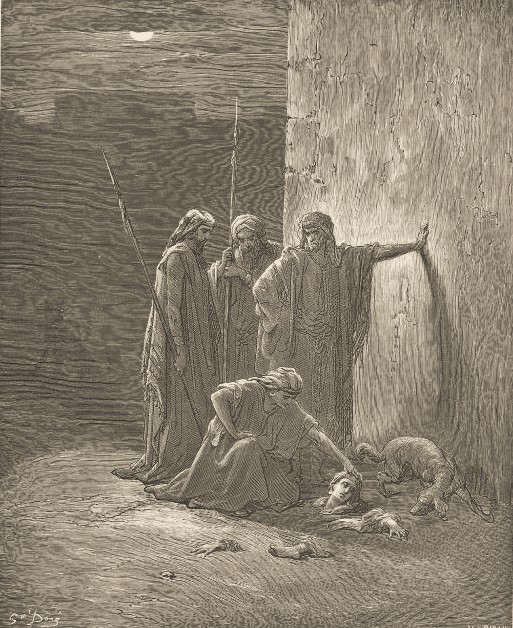
30 And when Jehu was come to Jezreel, Jezebel heard of it; and she painted her face, and tired her head, and looked out at a window. 31 And as Jehu entered in at the gate, she said, Had Zimri peace, who slew his master? 32 And he lifted up his face to the window, and said, Who is on my side? who? And there looked out to him two or three eunuchs. 33 And he said, Throw her down. So they threw her down: and some of her blood was sprinkled on the wall, and on the horses: and he trode her under foot. 34 And when he was come in, he did eat and drink, and said, Go, see now this cursed woman, and bury her: for she is a king’s daughter. 35 And they went to bury her: but they found no more of her than the skull, and the feet, and the palms of her hands. 36 Wherefore they came again, and told him. And he said, This is the word of the Lord, which he spake by his servant Elijah the Tishbite, saying, In the portion of Jezreel shall dogs eat the flesh of Jezebel: 37 And the carcase of Jezebel shall be as dung upon the face of the field in the portion of Jezreel; so that they shall not say, This is Jezebel.
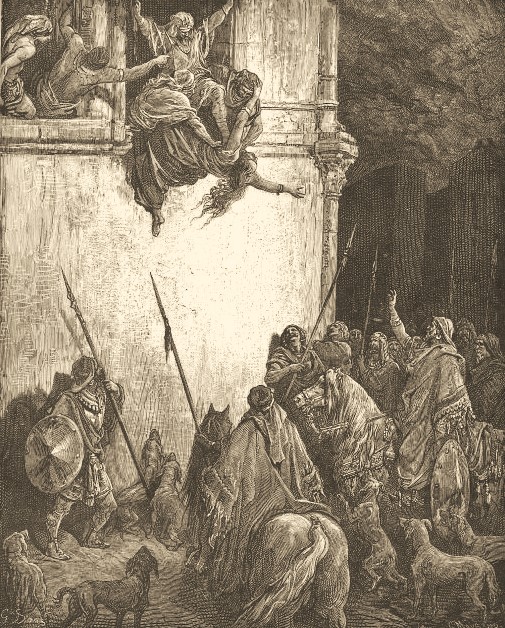
Jehu rode for Jezreel at great speed with a company of soldiers behind him. The watchman from the city alerted Joram, and he sent a horseman to ask Jehu what his intentions were. Any number of things could have happened—it could have been that something terrible had befallen the rest of their army at Ramoth Gilead, or that such a great victory had been won, the war was over, but the question “is it peace?” indicates that Joram and others suspected treachery. When the horseman asks the question, Jehu’s answer is “What have you to do with peace?” Essentially, he is saying, “What has peace done for you? We are here for violence. Join us. You can either ride with us or be mowed down.” And it plays out the same with the second horseman Joram sends. Joram’s messengers aren’t coming back, but joining up with Jehu.
One has to wonder what was going through Joram’s head, if he was confused or concerned or worried. His messengers not returning, they are joining up with Jehu and coming back full tilt. Now, both Joram of Israel and Ahaziah of Judah came out to meet Jehu to ask what is going on. Given their later questions on “Are you peaceful?” this is an enormously silly mistake. Jehu has a company of soldiers with him, and Joram meets him on the road, instead of calling down to him from the walls of the city, or Joram’s fortress. Both kings suspected that this was rebellion. Whatever the case, they met Jehu at Jezreel, at the property of Naboth the Jezreelite. And Jehu finally answer Joram’s question of peace—“How can there be peace, so long as the whoredoms of thy mother and her witchcrafts are so many?” In other words, how can there be peace with such evil? There cannot be. Jehu grasps what Judah has failed to: you cannot have fellowship with evil, you must crush it. Jehu shot Joram in the back, shot the arrow so hard it punched through Joram’s entire body, exiting near his heart.
Most archaeological evidence suggests that bows that were used for warfare during this time usually had a draw weight of around 50 lbs, what we consider a medium weight bow. Evidence for larger weight bows like 100 pounders has been scant, and you cannot fire bows that heavy from a chariot. A close range shot with a lighter weight bow (50 lbs) can pass through an entire person. However, the arrow cannot hit a bone, nor can it hit armor. Even modern arrows with steel armor piercing points and crossbows with draw weight equal to the English longbow (160 lbs) struggle to punch more than a handful of inches through layered linen armor (gambeson). Add in other types of armor like scale, mail, or bronze breastplates? That arrow isn’t going through. So, either God imbued Jehu with supernatural strength, or Joram wasn’t wearing armor to this meeting, which is doubtful. This arrow is God’s arrow, and a little thing like physics is not going to stop it.
The reason Jehu gives for his rebellion is Jezebel, her whoredoms, and her witchcraft. Scripture has before made a close association between idolatry and adultery, Israel and Judah are often compared to an adulterous woman who has betrayed her husband (i.e., God). But here, given her close association with pagan fertility cults, it is not a stretch to consider that she partook in those rituals herself, earning herself the moniker of “harlot.” “Jezebel” has been used as a synonym for prostitute, following a pattern established by the Jezebel of Revelation 2:20. Is this the greatest motivation of Jehu? Almost certainly not. But it could help explain why the people are so fed up with this line of kings.
Joram is thrown into the field for the birds to eat. Ahaziah escapes for a time before he is hunted down and killed, leaving both the thrones of Israel and Judah vacant. And Jehu is just getting started. He walks up to the palace of Jezreel. When Jezebel hears that he is at the gate, she puts on her makeup, and does her hair up. Judgement has come for her, and she decides she wants to spend her final moments in an act of vanity. Others humble themselves before God, shave their heads in mourning, put on sackcloth and ashes. She does not even try to make things right with God, she lives for this world and this one only. She does not plead for her life, she insults Jehu, God’s Sword.
Jehu does not trade insults, he just looks to the palace and asks who in the castle is with him, and a couple eunuchs decide to throw her out the window. Eunuchs are famously attached to ancient courts because they can be trusted around the concubines. And because they cannot have kids, their futures are tied to the crown. So even these, the most trusted of her people, betray Jezebel. Jehu then tramples her with a horse and left her corpse lying there while he went inside to eat. After he was done, he told his men to bury her, honoring her station as the daughter of a king. But while Jehu had feasted, so did the dogs, who ate her. She does not get a burial, but rather, she becomes dung in the fields and alleyways of the city, fulfilling God’s prophecy. What so far have we seen is Jehu’s attitude towards God? Jehu acknowledges God’s authority and power, and obeys him, throwing Joram into the land plot of Naboth.
IV. Jehu’s Revolution Completed (2 Kings 10:1-17)
10 And Ahab had seventy sons in Samaria. And Jehu wrote letters, and sent to Samaria, unto the rulers of Jezreel, to the elders, and to them that brought up Ahab’s children, saying, 2 Now as soon as this letter cometh to you, seeing your master’s sons are with you, and there are with you chariots and horses, a fenced city also, and armour; 3 Look even out the best and meetest of your master’s sons, and set him on his father’s throne, and fight for your master’s house. 4 But they were exceedingly afraid, and said, Behold, two kings stood not before him: how then shall we stand? 5 And he that was over the house, and he that was over the city, the elders also, and the bringers up of the children, sent to Jehu, saying, We are thy servants, and will do all that thou shalt bid us; we will not make any king: do thou that which is good in thine eyes. 6 Then he wrote a letter the second time to them, saying, If ye be mine, and if ye will hearken unto my voice, take ye the heads of the men your master’s sons, and come to me to Jezreel by to morrow this time. Now the king’s sons, being seventy persons, were with the great men of the city, which brought them up. 7 And it came to pass, when the letter came to them, that they took the king’s sons, and slew seventy persons, and put their heads in baskets, and sent him them to Jezreel. 8 And there came a messenger, and told him, saying, They have brought the heads of the king’s sons. And he said, Lay ye them in two heaps at the entering in of the gate until the morning. 9 And it came to pass in the morning, that he went out, and stood, and said to all the people, Ye be righteous: behold, I conspired against my master, and slew him: but who slew all these? 10 Know now that there shall fall unto the earth nothing of the word of the Lord, which the Lord spake concerning the house of Ahab: for the Lord hath done that which he spake †by his servant Elijah. 11 So Jehu slew all that remained of the house of Ahab in Jezreel, and all his great men, and his kinsfolks, and his priests, until he left him none remaining.
12 And he arose and departed, and came to Samaria. And as he was at the shearing house in the way, 13 Jehu met with the brethren of Ahaziah king of Judah, and said, Who are ye? And they answered, We are the brethren of Ahaziah; and we go down to salute the children of the king and the children of the queen. 14 And he said, Take them alive. And they took them alive, and slew them at the pit of the shearing house, even two and forty men; neither left he any of them. 15 And when he was departed thence, he lighted on Jehonadab the son of Rechab coming to meet him: and he saluted him, and said to him, Is thine heart right, as my heart is with thy heart? And Jehonadab answered, It is. If it be, give me thine hand. And he gave him his hand; and he took him up to him into the chariot. 16 And he said, Come with me, and see my zeal for the Lord. So they made him ride in his chariot. 17 And when he came to Samaria, he slew all that remained unto Ahab in Samaria, till he had destroyed him, according to the saying of the Lord, which he spake to Elijah.
In many stories, someone’s family is killed but a few escape; while the job is completed, those people come back to continue the cycle of revenge. This is not one of those stories. Jehu is thorough. There are 70 sons of the house of Ahab still alive, as well as all his court and allies. Jehu threw down the gauntlet, and commanded his enemies to come at him via letter. This is basically a taunt: “Go on. Try it. You’ve got armies, put your best contender on the throne and let’s go.” The most dangerous thing to a coup is a counter-coup, and Jehu is getting all his enemies out in front of him. The elders of Israel, however, were afraid of the guy who had just killed two kings, and so they tell him that they will serve him and do whatever he says; they will not fight. Jehu puts them to the test: “Ok, then kill the sons of Ahab, those men and boys you raised, and send their heads to me. Prove your loyalty.” And they did, sending the heads to Jezreel. Jehu lays them at the gate, then addresses the people showcasing his charisma.
In his speech, Jehu exults the people. “You are righteous, you are safe from God’s wrath. I killed my master. And who killed these? Samaria and Ahab’s former allies. All are with me.” And Jehu turned around and killed everyone who remained of Ahab in Jezreel: his allies, acquaintances, priests, even those who had given the sons to him, as they had proven they could not be trusted. Jehu then went to Samaria, and on the road he met with kinsmen of Ahaziah of Judah who were coming to pay their respects to Jezebel and the 70 sons of Ahab he had just killed. And he killed them too, leaving the royal house of Judah with very few offspring left. When he arrives in Samaria, he kills all those who remain of Ahab. None of these losses would have happened to the House of Judah had they obeyed God and stayed away. But they chose their own wisdom over the wisdom of God, tied themselves to unbelievers.
V. The Massacre of the Prophets of Baal (2 Kings 10:18-31)
18 And Jehu gathered all the people together, and said unto them, Ahab served Baal a little; but Jehu shall serve him much. 19 Now therefore call unto me all the prophets of Baal, all his servants, and all his priests; let none be wanting: for I have a great sacrifice to do to Baal; whosoever shall be wanting, he shall not live. But Jehu did it in subtilty, to the intent that he might destroy the worshippers of Baal. 20 And Jehu said, Proclaim a solemn assembly for Baal. And they proclaimed it. 21 And Jehu sent through all Israel: and all the worshippers of Baal came, so that there was not a man left that came not. And they came into the house of Baal; and the house of Baal was full from one end to another. 22 And he said unto him that was over the vestry, Bring forth vestments for all the worshippers of Baal. And he brought them forth vestments. 23 And Jehu went, and Jehonadab the son of Rechab, into the house of Baal, and said unto the worshippers of Baal, Search, and look that there be here with you none of the servants of the Lord, but the worshippers of Baal only. 24 And when they went in to offer sacrifices and burnt offerings, Jehu appointed fourscore men without, and said, If any of the men whom I have brought into your hands escape, he that letteth him go, his life shall be for the life of him. 25 And it came to pass, as soon as he had made an end of offering the burnt offering, that Jehu said to the guard and to the captains, Go in, and slay them; let none come forth. And they smote them with the edge of the sword; and the guard and the captains cast them out, and went to the city of the house of Baal. 26 And they brought forth the images out of the house of Baal, and burned them. 27 And they brake down the image of Baal, and brake down the house of Baal, and made it a draught house unto this day. 28 Thus Jehu destroyed Baal out of Israel. 29 Howbeit from the sins of Jeroboam the son of Nebat, who made Israel to sin, Jehu departed not from after them, to wit, the golden calves that were in Beth-el, and that were in Dan. 30 And the Lord said unto Jehu, Because thou hast done well in executing that which is right in mine eyes, and hast done unto the house of Ahab according to all that was in mine heart, thy children of the fourth generation shall sit on the throne of Israel. 31 But Jehu took no heed to walk in the law of the Lord God of Israel with all his heart: for he departed not from the sins of Jeroboam, which made Israel to sin
There was one group left who was very close to Ahab who could still be a thorn in the side of Jehu and that was the prophets of Baal. Jehu lied to gather the prophets of Baal, all of them throughout the nation, all who were Ahab’s and Jezebel’s. He told them he would kill them if they did not show up. He dressed them in special garments that were easily identifiable and told them to filter out any who were not Baal worshippers. And then he sent 80 men to kill them all, and he destroyed the icons and carvings in the temple. He turned their temple into a latrine.
So, this is a huge victory for the good guys! Ahab’s line of kings is gone! Jezebel is gone! The prophets of Baal that have afflicted Israel for hundreds of years are gone! Their idols were burned, their temple is a public latrine. We have a strong king, a warrior, one who speaks about God with respect! He executes His law! Things are good, right? Right? Wrong. Yes, Jehu did all that. He was a sword against evil and purged it from Israel. This was good, make no mistake. But Jehu was not a man of God. He did not walk in the ways of God with all his heart, soul, mind, and strength. He returned to the worship of the golden calves, back to the ways of Jeroboam who made Israel sin. Because he had destroyed the house of Ahab and did everything to them that was in the heart of God, his sons were promised to sit on the throne of Israel to the fourth generation. But only to the fourth generation.
And it was during this time that God took away parts of Israel, gave them to Hazael of Syria. Everything east of the Jordan. Lands of entire tribes, torn away. Israel did not receive prosperity from Jehu; he did not “fix” Israel. For his 28-year reign, he replaced a great evil with a slightly less-bad evil; he sought neutrality for Israel in the same way Solomon and Jeroboam did. And there’s no neutrality with God. If you want real, lasting hope for the nation, you cannot find it in the strong arms of a godless king. We are not facing that at this day and age, and no Jehu has stepped forth to clear out the idols of our time. But I think it is entirely possible someone might, someone with charisma and power who offers hope to change things for the better. And that Sword may kill the evil we wish it to. But the power to give life to a nation, that’s only found with God, and in His Word.
Note: This lesson was taught by Kyle Simmons
 Covenantide
Leave a comment