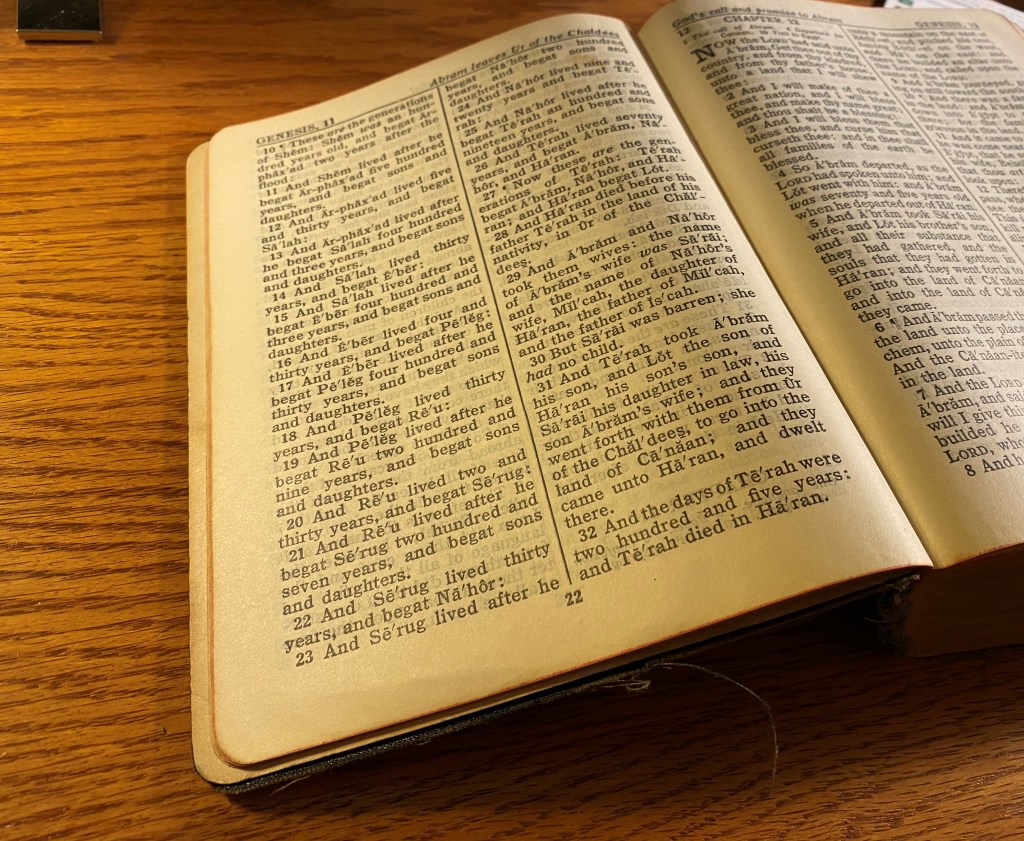
A Different Kind of Bible Reading Plan
Christians should read Scripture on a daily basis because it is through Scripture that our covenant LORD revealed who He is and how we are to relate to Him, and this helps us to see how our He works all things for His glory and our good. Many people, however, struggle to develop good habits of regular Scripture-reading. Some read devotionals that highlight a verse or a short passage, disconnected from context, and thus lose sight of the overarching narrative of Scripture in favor of the devotion writer’s personal meditations. Others use one of the plethora of Bible reading plans that are available, most of which aim to go through the entire Bible in year, following the lead of 19th century Scottish pastor, Robert Murray M’Cheyne. The advantage of such plans is that they are systematic and by reading through the entire Bible in a short span of time, one can both capture the overarching narrative of Scripture and grow in familiarity with the Bible in general. Doing this on a yearly basis will no doubt make the Bible become ingrained in habit and discipline of the Christian life.
Bible-in-a-Year reading plans, however, have their drawbacks. They require reading at least four to five chapters a day, and for many people that is a more involved time commitment. At such a pace, if one misses a couple of days, then catching up can be daunting. As a result, a person’s good intent to read through the Bible is likely to get derailed. Some find that the pace of such a plan puts pressure on them to “keep up with the schedule,” thereby causing them to read superficially rather than reflectively. Scripture reading thus becomes a chore rather than a delight. Also, many Bible-in-a-Year reading plans follow a strictly canonical order to reading through the Bible, but this order does not help the reader to draw out natural connections between the books. If a Bible-in-a-Year plan works for you, then I encourage you to use it, but for me—and probably others as well—such plans have not worked out well. So, in response, I developed this reading plan which I call the Covenantide Lectionary.
In church history, a regular program of Scripture reading was called a lectionary. A lectionary is simply a list of Scripture readings, often used in a liturgical setting. There are two kinds of lectionaries, the lectio continua and the lectio selecta. The lectio continua is designed to read through all of Scripture; the lectio selecta is simply a compilation of selected passages. The Covenantide Lectionary is a three-year program of reading through Bible, with both lectio continua and lectio selecta readings. The readings are set up on a weekly basis, which allows one flexibility to read more or less on a given day than is necessarily assigned, and thus better maintain a pace that is more adaptable to daily life.
The lectio continua readings amount to roughly a chapter from the Old Testament, a chapter from the New Testament and a Psalm each day. At this pace, one would get through one-third of the Old Testament, all of the New Testament, and the Psalms twice in a year. The lectio continua readings have been arranged not in the canonical, but in a chronological order, so that one can better grasp the overarching narrative of Scripture. In Reformed theology, God’s covenantal plans unfolded in history, and thus historical sections like Kings or Acts are interwoven with the prophetic writings (in the Old Testament) or the epistles (in the New Testament) to illuminate how these prophecies or epistles speak to the times in which they were written.
The lectio selecta readings include key selected passages on the three Persons of the Trinity at the beginning and end of the year, readings in the ecumenical creeds (i.e., the Apostles’ Creed, the Nicene Creed, the Athanasian Creed, and the Symbol of Chalcedon), along with Lord’s Day readings from the Westminster Standards (i.e., the Westminster Confession of Faith, the Westminster Larger Catechism, and the Westminster Shorter Catechism), and the Three Forms of Unity (i.e., the Belgic Confession, the Canons of Dort, and the Heidelberg Catechism). In addition to private devotionals, such a listing may be a help to pastors and worship leaders in planning worship.
No lectionary or Bible reading plan is perfect, including this one, but if it helps you make a regular habit of Scripture reading then it will have achieved its purpose. The goal is consistency in reading Scripture, not the quantity of Scripture read. If you decide to use this, I welcome any feedback on whether you found it useful and any improvements you might suggest.
Soli Deo Gloria
S. J. Hatch
 Covenantide