Deuteronomy 1:1-4
These be the words which Moses spake unto all Israel on this side Jordan in the wilderness, in the plain over against the Red sea, between Paran, and Tophel, and Laban, and Hazeroth, and Dizahab. 2 (There are eleven days’ journey from Horeb by the way of mount Seir unto Kadesh Barnea.) 3 And it came to pass in the fortieth year, in the eleventh month, on the first day of the month, that Moses spake unto the children of Israel, according unto all that the LORD had given him in commandment unto them; 4 After he had slain Sihon the king of the Amorites, which dwelt in Heshbon, and Og the king of Bashan, which dwelt at Astaroth in Edrei: (Deut. 1:1-4)
I. On the Plains of Moab (Deut. 1:1-3)
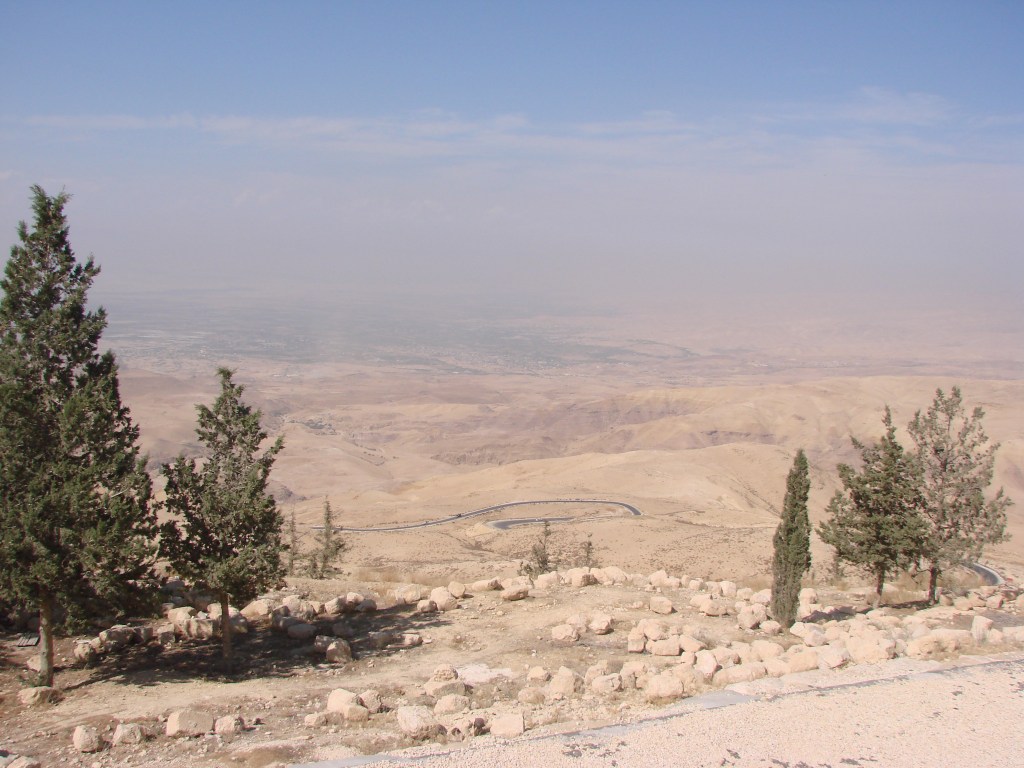
The Book of Deuteronomy has an inauspicious beginning relative to the grand narrative it encapsulates: “These be the words which Moses spake unto all Israel on this side Jordan in the wilderness, in the plain over against the Red sea, between Paran, and Tophel, and Laban, and Hazeroth, and Dizahab. 2 (There are eleven days’ journey from Horeb by the way of mount Seir unto Kadesh Barnea.) 3 And it came to pass in the fortieth year, in the eleventh month, on the first day of the month, that Moses spake unto the children of Israel…” Even though modern archaeology has not identified all the locations listed in verse 1, the general vicinity is well-established as just north of the Dead Sea on the plateau of Moab in modern-day Jordan. It is January 1406 BC, nearly forty years since the Lord their God led His people out of Egypt in the Exodus. The people were poised to enter the Promised Land and would begin the conquest in a couple of months, on the fortieth anniversary of the Exodus (Josh. 5:10).
In the Authorized Version (AV), verse two is punctuated as a parenthetical comment, but it brackets the redemptive history of the people of God described in the first four books of the Pentateuch. According to the covenant He made with Abraham (Gen. 15:13-21), the Lord brought His people out of Egypt in the Exodus, to Horeb. “Horeb” is an alternative term for Mount Sinai. Sinai is where the Lord first called Moses to service in the encounter at the burning bush and where He led His people back to after the Exodus from Egypt. It was at Sinai that the people faced the Lord with fear and trembling, who gave them His covenant for how they should live to reflect Him now that they had been saved. It was at Sinai where they had almost been destroyed by that same God because of their apostasy with the Golden Calf. It was at Sinai where Moses mediated for them and the Lord restored His covenantal relationship with after their sin. And it was at Sinai where they then built the Tabernacle to Him. The nation was at Sinai for just over a year, before the Lord commanded them to move out to the land which He promised their forefathers (Num. 10:11).
Mount Seir is in the land of Edom, the descendants of Esau, Israel’s kin, which had already settled in the land which the Lord allotted to them. The reference here in 1:2 is probably only to describe a common route of travel; the more significant reference is to Kadesh-barnea. Kadesh-barnea was just south of the Negev, the southern part of the land of Canaan, and was to be the launching point for the conquest of Canaan. It was from Kadesh-barnea that Moses sent the spies into the land, whose negative report about the people being giants and the land being fortified deterred the Israelites from following the Lord’s command to go up against it. After Moses pronounced the Lord’s judgment on them for failing to trust Him, the people tried to invade the land in their own strength, only to be miserably routed. Israel would stay at Kadesh-barnea for most of the next 38 years. Moses’ sister Miriam would die there, his brother would die not far from there, and because of Moses’ own sin there of presumptuous against the Lord, the Lord declared that Moses himself would not be allowed to go into the land. Kadesh-barnea and the vicinity around it was Israel’s wilderness wandering.
II. The Words of the Mediator (1:1-3)
“These be the words which Moses spake unto all Israel… according unto all that the LORD had given him in commandment unto them” (Deut. 1:1, 3). Thus begins Deuteronomy. Like every other book of the Pentateuch except Exodus, Deuteronomy begins with words being spoken, but unlike those other books, Moses for the first time is identified as the one speaking, rather than God. This fact is noteworthy in light of the structure of Deuteronomy. Since Deuteronomy is written as a covenant, these opening verses are the preamble to the covenant. Normally in ancient Near Eastern covenants the preamble is where the suzerain is introduced with his titles and honors. Moses, however, is not the suzerain nor is he given any titles. This fact highlights Moses’ role as Mediator of the covenant, the representative of the Lord speaking to the people and the representative of the people standing before God (1:3).
At 120 years old, Moses was at the end of his life and was personally prohibited from entering the Promised Land (Deut. 1:37, 3:26, 4:21, 34:4) because he failed to honor the Lord before the people: instead of speaking the Lord’s word to give the people water, he assumed to himself the prerogative of the Lord alone, struck the rock and said he was giving them water (Num. 20:9-13). The Lord’s Mediator was obligated to be obedient to the Lord’s command and speak the Lord’s words alone. Moses failed to do that, and that cost him.
No doubt, Moses feared for the Israelites’ future without him as they entered the Promised Land. He had been with them since the Exodus in all the years of their wandering and knew too well just how stubborn and rebellious they were. Indeed, the last of the generation which had come out of Egypt in the Exodus as adults had died off a year or two earlier (2:14-16), the result of the Lord’s judgment on them after they refused to trust Him to fight their battles in conquering the Land. Moses almost certainly knew he was not indispensable, since it was the Lord alone who saved and sustained His people. Nevertheless, he had been the mediator between the people and the Lord for more than forty years; with his impending death the people still needed a mediator.
III. The Covenant and the Transition
It is in this setting that Moses wrote the Book of Deuteronomy. He wrote it, curiously enough, in the form of a covenant. In the ancient Near East, a covenant was a treaty. It bound two sovereigns together by oaths of mutual loyalty, with stipulations of obligation on one or both parties, was incentivized by blessings and curses, sealed by a formal ratification ceremony and enforced by the gods. In most cases, a covenant was between a suzerain overlord and a vassal king and was the legal means by which the suzerain bound the vassal to himself and regulated their relationship. At the time Moses wrote Deuteronomy, the ancient Near East was experiencing a heyday of diplomacy, yet interestingly, the biblical covenants were unique in that they are the only examples from antiquity in which a god made a covenant with his people. There is a genuine basis then for the rhetorical question Moses asks in Deut. 4:8, “And what nation is there so great, that hath statutes and judgments so righteous as all this law, which I set before you this day?”
That the Lord would make a covenant with His people seems strange in light of the fact that covenants were basically treaties. Making a treaty seems on first glance to be too formal, too distancing. At the same time, it was on the basis of the God’s covenant with Abraham that He brought His people out from Egypt with great judgments, sustained them in the wilderness and, at this point in biblical revelation, was about to bring them into the Promised Land. The formality of the covenant was the very basis for the people’s assurance that the Lord would indeed follow through on his promises in light of their sins.
Covenants typically were made whenever there was a significant development in the relationship between the two parties; Moses’ approaching death and Israel’s pending entry into the Promised Land constituted just such developments. Ancient kings would often use covenants with other kings—and even with their own people—to secure legal recognition for their heir apparent. That is true in the case of Deuteronomy, insofar as Moses is transitioning leadership of the nation to Joshua, son of Nun. Joshua had been one of the men who spied out the land forty years earlier, but unlike all the others (save Caleb), he faithfully trusted God to deliver the land to Israel. In Deuteronomy, however, this is leadership succession with a twist: the covenant is not focused on Joshua per se, but on God. While Joshua would lead the people into the Land, Moses was pointing the people to their true leader, namely the Lord Himself. It is the Lord who promised them the land, the Lord who delivered them from Egypt, the Lord who sustained them in the wilderness, and the Lord who was already fighting their battles in conquering the land. This was Moses’ last act as Mediator. Note that this does not diminish Joshua’s (subordinate) authority but establishes it: ancient Near Eastern covenants typically presumed the vassal would be exclusively loyal to his suzerain and if the people were loyal to the Lord, then they were to be loyal to Joshua as well.
Although Moses transferred his leadership to Joshua, he transferred his mediatorial responsibilities to the covenant itself. It is the covenant that would be the standard to which God’s people would be held, and in adhering to the covenant the people would be reflecting their Lord. This was the second time in the Israel’s history the nation was poised to enter the land the Lord promised to their forefathers. The first time was when the nation was at Sinai, and the Lord made a covenant with them there, that He would be their God and they would be His people (Exod. 6:7 cf. Exod. 19:3-6). The covenant on the plateau of Moab reflected the evolution in the relationship between Lord and His people. At Sinai, the Lord had just delivered His people from Egypt, and they had not yet sinned against Him. Shortly thereafter, they sinned in disbelief and were condemned to judgment in the wilderness. The covenant, then, was one of renewal, now with the succeeding generation and reflective of the need for the Lord to be direct with His people because of their past experience sins against Him. It is this covenant, which extends and builds on Sinai, that was to become the constitutional foundation for God’s relationship with His people.
IV. The Defeater of Sihon and Og (1:4)
The Lord is not absent from this passage, and verse four describes Him as the defeater of Sihon and Og. “Defeater of Sihon and Og” does not seem like a terribly impressive title, but it was significant for God’s people at that time. While in the broad schema of things these were relatively minor kings, in the context of God’s relationship with His people the defeat of these kings showed the Israelites that God was fulfilling His covenants with their forefathers, Abraham, Isaac, and Jacob, to fight their battles and bring His people into the land He promised them. This title alone would have been sufficient basis for them to trust Him and be obedient to Him. It would have been a source of confidence and a token that He would fulfill His covenantal promises. He who made the heavens and the earth and all that is in them could also completely defeat their enemies and overcome the challenges immediately before them. They needed to know that.
V. Anticipating Christ
Moses was a Mediator between the Lord and His People. What does this mean and why is it important? We often think of a mediator as a middleman trying to broker a deal between two parties. That is not what Moses did. Rather, he sought to represent God to the people and to intercede with God on behalf of the people. In this he spoke the Lord’s words to the people of Israel and lifted up their needs and cries to the Lord Himself. At times, Moses interposed himself between God and Israel, mostly to protect the people from the fullness of God’s wrath toward their sins. With Moses’s pending death, the mediatorial role that he had played in making God and His standard known to Israel was transferred, not to Joshua, but to the testimony of the Law. In that regard, the one can say that Deuteronomy really is a kind of last will and testament of Moses. The intercessory role Moses had during his life would be assumed in the remainder of the Old Testament by judges (in the Judges period) and later by the prophets.
Moses foreshadowed the mediatorial role that Christ Jesus would ultimately assume. The Father would send His Son, our Lord Jesus Christ, the very Word of God (John 1:1), to make God known to men and intercede on behalf of His people. His intercession, however, goes beyond what Moses ever did: Christ actually died in place of His people on the cross of Calvary. That is the only thing that would once and for all turn away—propitiate—the Father’s wrath toward His people’s sin. With His resurrection from the dead, Christ’s intercessory work continues, as He lifts up the prayers of God’s people to the Father continually, because He is seated at the right hand of the Father. It is important for us to understand that because Christ Himself is our Mediator, we do not need some other intermediary to intercede for us with God, whether deceased saints, angels, or even the Church; we can approach Christ directly. In fact, to set any of these things up as a mediator between us and God would be to turn to them for that which only Christ Jesus can provide. If Moses’s mediatorial role points to Christ, then His words in Deuteronomy also find their fulfillment in Christ. In this light, reading Deuteronomy is not a mere historical exercise of looking at rules from God. Rather it is in understanding the heart of our Lord, who has saved a people for Himself and expects this people to honor Him in how they are to live. Moses’s readers were poised to enter the Promised Land, where they would find their rest in the God who would dwell among them. For us, we are looking for a heavenly Promised Land, where we will find our rest in union with Christ and eternal communion with Him.
 Covenantide