Category: Biblical Commentary

  • Descent into Ungodliness (Lesson 11)

    Descent into Ungodliness (Lesson 11)

    Confronting Idolatry

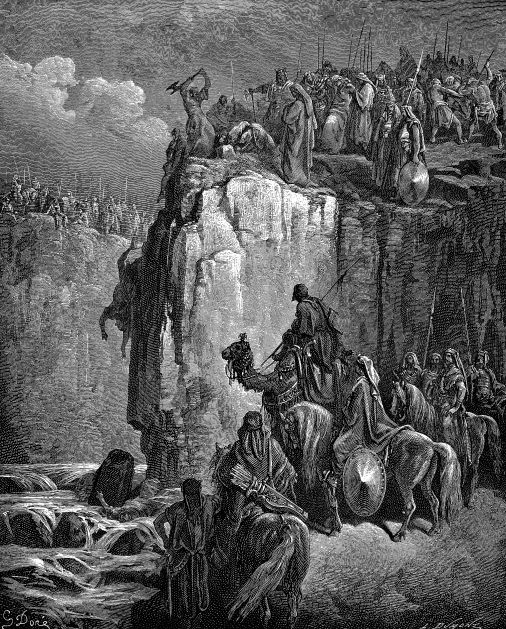
    Before the holidays I was asked the question of how and when we need to confront idolatry like Elijah did in his confrontation with the prophets of Baal.  The question was timely, since in December 2023 the Satanist Temple of Iowa erected a statue of the goat-headed idol Baphomet in the Iowa State House.  Although state officials denounced it, they left it up on religious free speech grounds, and shortly thereafter it was vandalized by a US Navy reservist and Christian conservative because it was blasphemous.  The display was removed entirely a few days later.  In any event, as I began to think about an answer, I thought others might in interested in the question as well and, thus, it would be good to share the answer more broadly.  So, that is what I will do now.
    The Just War Tradition as a Paradigm

    As we are seeing in this study of 1 and 2 Kings, the issue of confronting idolatry is at the front and center.  The downward spiral of ancient Israel and Judah is directly driven by the idolatry that the kings and their people engaged in.  So, what does that mean for us today, especially in light of the New Testament?  The Apostle Paul writes in Ephesians 6:10-12 (the beginning of the “Armor of God” passage), “10 Finally, my brethren, be strong in the Lord, and in the power of his might. 11 Put on the whole armour of God, that ye may be able to stand against the wiles of the devil. 12 For we wrestle not against flesh and blood, but against principalities, against powers, against the rulers of the darkness of this world, against spiritual wickedness in high places.” We are in a spiritual war, and, as such, we are called to stand against evil.  The question is, how do we do this?

    A useful framework for thinking about this is the Just War Tradition.  This is a framework for Christian thought that goes back at least to Augustine of Hippo in the fifth century AD and has been the dominant paradigm for thinking about conflict ever since.  In suggesting this, there are three possible objections that need to be addressed up front.  First, the Just War Tradition only applies to physical combat, but we are in a spiritual conflict.  Second, the Just War Tradition only applies to violent conflict, not to non-violent conflict.  And, lastly, the Just War Tradition is a checklist, such that if you do not have all the boxes checked, then the conflict is inherently unjust.  Let me address each of these objections in turn.

    First, it is true that when we talk about the “culture war” we are talking metaphorically, and we are in a spiritual war (although some people in our culture have been radicalized to such an extent that they are seeing the “culture war” as something that they need to take up real arms against).  That said, issues as to what is a “just” war, who gets to decide, what are the constraints in how the war is fought, and how to we think about motives and ends are all things that need to be taken into consideration even in thinking about a spiritual and cultural conflict.  Indeed, it is for this reason that I think the Just War Tradition gives us a useful framework for working through things comprehensively and ethically.  Granted, there are differences in the nature of a spiritual war and how it is conducted that will necessitate making some adjustments to the tradition as we reflect on it, but this will not necessitate disposing of the framework as a whole.

    Second, with regard to the difference between a violent physical conflict and non-violent spiritual conflict, Western society over time has drawn an arbitrary line between non-violence and violence and then assumed that anything non-violent is good and any violent is bad.  Any serious student of conflict knows however conflict exists on a spectrum.  The Prussian military theorist, Karl von Clausewitz, famously observed that, “War is the continuation of politics by other means.”  Means are not inherently just or unjust simply because they are non-violent or violent.  Experience has shown that there can be justice in the use of violence and injustice in non-violence.  The violence/non-violence distinction does not negate the use of the Just War Tradition.

    And third, the Just War Tradition is not a checklist, even though it has been used that way, especially since the Second World War.  Throughout history the Just War Tradition has been a framework for reflection, not an automatic checklist.  It only began to be used as a checklist by pacificists who were against all war whatsoever; by using it as a legalistic checklist then they could show that no war perfectly meets all the criteria, so therefore war is inherently immoral and pacificism is the only acceptable alternative.  That certainly has not been the position of mainstream Christianity throughout the centuries, and it is not the position of the historical Reformed tradition.

    With these objections addressed, let us briefly consider what the Just War Tradition is.  As it has developed over the centuries, it can be divided into three major categories: jus ad bellum (justice to the war, i.e. the causes and resort to war); jus in bello (justice in the conduct of war); and jus post bellum (justice after the war).  Of these, the first two categories have been around for centuries, but the third category has been developing over the course of the past century and really over the course of the past few decades. 

    Just Cause—Countering Idolatry

    In thing about the causes for which to engage in conflict, in the spiritual war that we are in countering idolatry is at the top of the list.  As much as Scripture talks about resisting idolatry in both the Old and New Testaments, this does not require much exegesis.  What does require more discussion is “What do we mean by idolatry?”  I would suggest there are three ways the term is used.

    First, the biblical definition from the Decalogue is fairly specific.

    Thou shalt have no other gods before me. Thou shalt not make unto thee any graven image, or any likeness of any thing that is in heaven above, or that is in the earth beneath, or that is in the water under the earth: Thou shalt not bow down thyself to them, nor serve them: for I the Lord thy God am a jealous God, visiting the iniquity of the fathers upon the children unto the third and fourth generation of them that hate me; And shewing mercy unto thousands of them that love me, and keep my commandments.

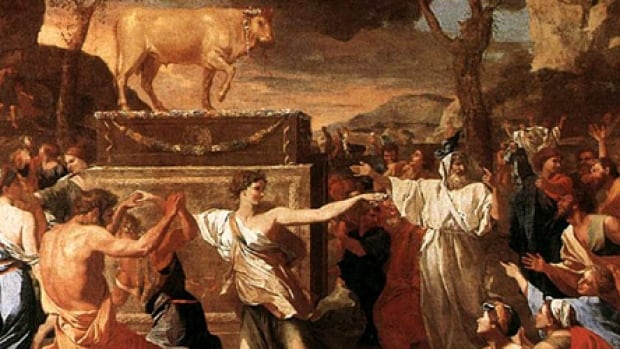
    Essentially, idolatry is (1) the worship of gods other than the true God or (2) the worship of the true God in ways other than what He has stipulated.  The way that the First Commandment is written (specifically, the reference to “before me”) also suggests (3) a prohibition on religious syncretism.  In what we have covered in 1 Kings, we have seen all of these prohibitions violated.  Solomon’s sin was in accepting syncretism.  Jeroboam led the people in a man-constructed—and therefore false—worship, rather than divinely ordained worship.  In time, those things led to the outright worship of other gods, as evidenced by the official cult of Baal that Jezebel set up and which Elijah subsequently confronted.

    In the modern context, there are two primary ways in which the term “idolatry” is used.  First, on the conservative right, the term is often used in a generalized and unspecific way to express moral indignation at something.  One can see this in Christians talking about how others are “Making the state into another religion” or “Making diversity into a religion.”  In these cases, it is never clear what they mean by “religion” or how the “state” or “diversity” or whatever is actually being constituted as “another religion.”  At its core, this simply is a way of expressing emotional distain toward a particular position.  There may or may not be a legitimate justification for such antipathy, but it is working on the level of unexplained assumptions.  I had a colleague years ago who would often say that he was “morally opposed to broccoli.”  Because the statement seemed so nonsensical, I asked him why he said that.  He responded that to say that he simply disliked broccoli would be a matter of personal preference, however, to say that he was morally opposed to it meant that he wanted others to share his disgust with broccoli.  This use of “idolatry” is basically doing the same thing.

    Another view popular in our circles is that expressed by Timothy Keller in his book, Counterfeit Gods. Keller asks, “What is an idol?  It is anything more important to you than God, anything that absorbs your heart and imagination more than God, anything you seek to give you what only God can give.”  This broadens the concept considerably.  Earlier Keller noted that “We think that idols are bad things, but that is almost never the case.  The greater the good, the more likely we are to expect that it can satisfy our deepest needs and hopes.  Anything can serve as a counterfeit god, especially the very best things in life.”[1]  Thus, things like money, sex, and power can be idols, and indeed, in Keller’s understanding, all sin is essentially tantamount to idolatry.

    There are, however, several problems with this.  First, there is a category error here.  The Bible does not equate all sin with idolatry but identifies idolatry as a species of sin.  For example, Paul in various places makes specific lists of sins, in which idolatry is listed as one among many, such as in Gal. 5:19-21 and 1 Cor. 6:9-10.  The root of these sins listed is not idolatry, but disobedience to God’s revealed law; idolatry is but one poisonous fruit of this disobedience.  In Romans 1:20-25, in fact, disobedience and rejection of God leads to the darkening of men’s thoughts, then to idolatry and other accompanying sins as God’s judgment.

    It is also important to note that the parallelism Keller makes between ancient idolatry and modern idolatry does not hold biblically.  In his view, in the ancient world men worshipped idols, but in the modern world men “worship” things like money, sex, and power.  In this formulation, idolatry amounts to disordered desires, but that would make idolatry redundant with things like drunkenness or fornication, which in turn begs the exegetical question as to why Paul would bother to differentiate idolatry from these sins.  In actual fact, the ancients desired money, sex, and power as well; there is not a contrastive difference between antiquity and modernity on this point.  In the ancient world, worship of Baal and other associated or similar gods was typically associated with fertility, both of the womb and of the field.  More sex, associated with the Baal cult, would lead to more children; more children meant more workers for the field and more people to take care of you in old age.  More crops would lead to more wealth for oneself and one’s family.  More wealth, in turn, would lead to more power and influence, including political influence, within the city’s gates.  Thus, idolatry was the mechanism by which the ancients sought to assure their prosperity.  This is why it was such a challenge to Israel’s faithfulness to God’s covenant; it was a way to hedge their bets and secure their security apart from God.

    By considering all sin to be idolatry and idolatry to be tantamount to disordered desires, Keller inadvertently diminishes the seriousness of idolatry as a particular sin.  Idolatry is a clear rejection of God as God, either in replacing Him with another god or in refashioning Him into an image of our own making.  G. K. Beale, in his excellent book, We Become What We Worship; A Biblical Theology of Idolatry, says that “The word idolatry can refer to the worship of other gods besides the true God, or the reverence of images.  According to both the ancient Near East and the Old Testament, an idol or image contained a god’s presence, though that presence was not limited to the image.”[2]  In this regard, idolatry provides an intellectual coherence to man’s rebellion against God.  For this reason, idolatry is a most serious sin and is treated as such throughout Scripture.  It is not a “good thing” taken to an extreme but is intrinsically bad because it effectively calls good evil and evil good, and thus enables other sins.  Granted, we do not worship the Baalim today—although to be sure, real paganism is growing significantly—but it may be more accurate to think of modern-day equivalents to ancient idolatries as being things like alternative religions (e.g., Islam, Buddhism, Mormonism, New Age spiritualism, etc.), worldly philosophies (e.g., Marxism, Critical Theory, Queer Theory, etc.), or totalistic political movements (e.g., fascism, Communism, etc.) from which people seek ultimate meaning.

    Clarity about the nature of idolatry is important for our practical sanctification and faithfulness to God.  As Christians seeking to glorify God, we need to flee from and put away idolatry and idolatrous things, but we will not be able to do that if we cannot accurately define what idolatry really is.  If we are supposed to keep ourselves from idolatry and flee from it, as the Apostles tell us, then simply considering it to be something good that is out of balance contradicts the strong and clear impact of those commands.   If idolatry is a good thing taken too far—“workaholism,” for example—then how does one define “too far”?  “Idolatry,” thus becomes a matter to be subjectively defined, and if that is the case, then it will be easy to rationalize that we have addressed it when in reality we have not.  On the other hand, if modern idolatries are things like alternative religions, worldly philosophies, totalistic political movements or uncritical adulation of prominent social or cultural figures, then that allows us to maintain clear insight on what we need to keep ourselves from, as well as what we need to rightly keep in focus to be faithful to our Lord.

    Just Authority

    With the other Just War criteria, I will be briefer in the interest of time.  In the Just War Tradition there is the question of who the legitimate authority is to determine whether a war is just and whether it should be carried out.  In the context of our cultural and spiritual war, this is a harder question to answer, especially since the church is not a united monolith.  Nevertheless, the issue is an important one and at its root is the principle that private individuals do not get to determine solely by themselves what idolatry is and how to confront it.  This particularly needs to be said in our radicalized age.  Today, especially among Christian charismatics and evangelicals, there is a growing movement called the New Apostolic Reformation (NAR) which holds that the situation is so bad that God is raising up a new group of Apostles, equal to those who lived in Christ’s day who are receiving God’s word directly, doing miracles, and can lead God’s people into a new era of Christian dominion.  This movement is very political in our contemporary context.  It is also very wrong, and to see that, we need to understand biblically what prophecy was and who the apostles were.

    It is a well-entrenched view among many evangelicals and charismatics that the Old Testament prophets were primarily future seers and miracle doers.  With that image, it is not too much of a stretch to get to the claims of the NAR adherents.  Biblically speaking, however, while the prophets did receive God’s word directly and did do miracles, they were much more than that.  They were basically God’s covenantal advocates pressing God’s covenantal lawsuit against God’s covenantal people and calling them to repentance.  Thus, the focus was not in speaking against the unbelievers outside the covenantal community, but against apostasy and unbelief within the covenantal community.  In translating that to today, the covenantal community is not a nation state, like Israel and Judah, but the Christian church.  The prophets were calling God’s people back to God’s word and God’s law.  The miracles that were done were tangible demonstrations authenticating that God’s word had indeed come to them.  In the New Testament, while the Apostles shared many characteristics of the Old Testament prophets, a key distinction is that the Apostles were eyewitnesses to the earthly ministry of the Lord, to His death, and to His resurrection.  That is not repeatable in subsequent generations.  Their authority was unique.  Moreover, Hebrews 1:1-3 indicates that the final revelation is in Christ Himself; after that first generation passed away, the canon of Scripture was closed—after all, how could there be subsequent revelation after the final revelation in Christ?

    What these modern so-called prophets and apostles are doing is, in effect if not necessarily in intention, is claiming authority for themselves independent of the constraints of Scripture.  Note well the warning that Scripture gives about false prophets—death (Deut. 18:20).  We have seen in 1 Kings several examples of false prophets, so anyone claiming to speak for God must be tested by God’s word.  What this means for us today is that as we confront idolatry, we need to be doing so rooted in Scripture.  Moreover, given the temptations of idolatry in our day and age, we need to be first and foremost instructing the Christian community in what is true, calling Christians to repentance, and enabling them to withstand the seductions of the age.  As a teacher of God’s word, I cannot bind your conscience and demand your obedience to things that go beyond what Scripture says.  False prophets, however, precisely want you to put more trust in their words than God’s words, even as they smoothly claim that they are speaking a “further” word from God.  The Apostle Paul emphatically warned the Galatians that anyone who gives them a “gospel” other than what they received from him earlier should be damned.  This is serious stuff.

    Right Intention, Reasonable Chance of Success, Last Resort

    In thinking about conflict, having the right intention, weighing whether there is a reasonable chance of success, and determining what can be done first before escalating to measures with extreme consequences (i.e., war) are prudential actions associated with the jus ad bellum criteria of the Just War Tradition.  These also apply well to cultural and spiritual conflict in confronting idolatry.

    Having the right intention is particularly apropos for our day.  As Christians, we are bound to observe all of the Ten Commandments, including the Third Commandment, regarding not misusing the name of the Lord.  This is commonly understood as not using the Lord’s name as a cuss word, but in reality, it goes far beyond that.  In the Lord’s Prayer, we pray that the Lord’s name be hallowed (that is, honored).  What this means is that we need to be mindful of whether our actions will reflect honorably or dishonorably on the Lord.  In other words, will the Lord be honored and glorified by what we are doing?  Here we need a serious examination of our hearts.  We live in a day when virtue signaling is far more popular than actually being virtuous.  We can pride ourselves on supporting the “right” causes, and rationalize that we are glorifying God, especially when such signaling costs little more than fueling the outrage machine on social media.  The prophets and the righteous individuals that we have seen in our study of 1 Kings, however, all had to pay some kind of price for faithfulness—even Elijah, who experienced the stunning triumph of God over the prophets of Baal and would subsequently be taken up into heaven without dying had to flee for his life from Queen Jezebel, exhausted and discouraged and needing to be protected and restored by God.

    The Just War criteria for reasonable chance of success and last resort are specifically tied to war and the violence associated with it.  That said, in applying these criteria to the cultural and spiritual war of our day, it is legitimate to ask whether any actions have a legitimate chance of success and whether there is a strategy behind what we are doing.  If we are to maintain a credible witness, then there also needs to be clarity about the directness of the actions we are taking relative to the idols we are combating.  All too often there is a temptation to do something simply to show action or to focus on symbolic actions.  Such an approach might feel good psychologically but will not make a dent in actually challenging the idols of our age.  There is also a desire for quick results, which rarely is effective.  Changing culture, however, takes time, often requires gradual escalation, and needs to maintain constant focus on the ultimate goals.  We will see as we go forward in 2 Kings that even the reforms of the good kings of Judah would not really outlive the king’s own reign because they failed do this.

    Justice in War and Post-War

    The historic Just War criteria for justice in war focus on discrimination and proportionality.  In applying these to the cultural and spiritual war of our day we need to keep in mind, first of all, the nature of the conflict we are in.  Ours is a spiritual conflict that requires spiritual means.  The temptation of our day is to use political means to achieve things that can only be achieved by the church.  Francis Schaeffer has pointed out that changes in religion and philosophy lead to changes in high culture, then low culture, then politics and economics.  Thus, if we are aiming to change culture we need to go upstream, and change the church, enabling the church to be the church.  Apologetics, evangelism, discipleship, worship and prayer will be as or more important than political activism.  The changes brought by those means will be less flashy, but more durable over time.

    The means that we do employ in combating the idols of our age do matter.  There is a saying among apologists that “What you win them with is what you win them to.”  This needs emphasizing today because there is a tendency among those on the right to think that tactics are neutral, and we can adopt the tactics of the left and be pragmatically effective.  The problem with that is the symbolic tactics of the left are Leninist, geared toward destabilizing the system and seizing power.  What may work for doing that, however, will not work for governance afterwards.  By de-legitimizing things, it means that if you do take power you will have to rely on increasingly coercive means to rule because goodwill or sympathy for one’s ideas will have been exhausted.  Moreover, the means we employ will affect our moral credibility; once that is lost, it will be really difficult to regain.


    [1] Timothy Keller, Counterfeit Gods; The Empty Promises of Money, Sex, and Power, and the Only Hope that Matters. (New York NY: Dutton, 2009), xvii.

    [2] G. K. Beale, We Become What We Worship; A Biblical Theology of Idolatry (Downer’s Grove IL: InterVarsity Press, 2008), 17.

  • The Descent into Ungodliness (Lesson 10)

    The Descent into Ungodliness (Lesson 10)

    From Elijah to Elisha

    I. Summary of Jehoshaphat’s Reign (1 Kings 22:44-50)

    41 And Jehoshaphat the son of Asa began to reign over Judah in the fourth year of Ahab king of Israel. 42 Jehoshaphat was thirty and five years old when he began to reign; and he reigned twenty and five years in Jerusalem. And his mother’s name was Azubah the daughter of Shilhi. 43 And he walked in all the ways of Asa his father; he turned not aside from it, doing that which was right in the eyes of the Lord: nevertheless the high places were not taken away; for the people offered and burnt incense yet in the high places. 44 And Jehoshaphat made peace with the king of Israel. 45 Now the rest of the acts of Jehoshaphat, and his might that he shewed, and how he warred, are they not written in the book of the chronicles of the kings of Judah? 46 And the remnant of *the sodomites, which remained in the days of his father Asa, he took out of the land. 47 There was then no king in Edom: a deputy was king. 48 Jehoshaphat made ships of Tharshish to go to Ophir for gold: but they went not; for the ships were broken at Ezion-geber. 49 Then said Ahaziah the son of Ahab unto Jehoshaphat, Let my servants go with thy servants in the ships. But Jehoshaphat would not. 50 And *Jehoshaphat slept with his fathers, and was buried with his fathers in the city of David his father: and Jehoram his son reigned in his stead.

    By way of summary, Jehoshaphat was a king of Judah, the son of Asa, and generally a good king.  He starts reigning at age 35 and rules 25 years.  He like Asa, is a reformer king, who worked to do justice and appoint righteous priests and Levites as judges.  Judah’s territory extends as far south as Ezion Geber, as in Solomon’s reign, and he even builds a fleet to sail to Ophir as Solomon did.  Edom is not in revolt but is a vassal kingdom to Judah again.  Judah is almost at the heights which existed under Solomon, which explains why Jehoshaphat reaches out to Israel—he is trying to reestablish that golden era.  Unfortunately, he is going to do the same thing as Solomon, that is, start with godliness and fall into syncretism, uniting godliness and ungodliness.  This takes the form of his reaching out to Ahab to form an alliance, which he likely sealed with the marriage of Jehoshaphat’s son Jehoram to Ahab’s daughter Athaliah.  In 2 Chronicles 19:2-3, a seer sent by the Lord confronts Jehoshaphat over this deadly alliance.

    2 And Jehu the son of Hanani the seer went out to meet him, and said to king Jehoshaphat, “Shouldest thou help the ungodly and love them that hate the LORD?  Therefore is wrath upon thee from before the Lord. 3Nevertheless good things are found in thee, in that thou hast taken away the groves out of the land, and hast prepared thine heart to seek God.

    In reading this as Christians, Hanani’s question poses a challenge for us, since he clearly implies that we should not help the wicked or love those who hate the LORD.  Yet, how should we reconcile that with Christ’s command to love our enemies and do good to those who persecute us (Matt. 5:44-47)?  We should not set Hanani’s comment in opposition to the Lord’s.  In thinking about this we need to be discerning in terms of who we are to love, to what ends, and what exactly do we mean by “love.”  We can love someone in terms of wanting what is best for them, in accordance with what God has said is best for all people.  What they want and what God wants, however, may be separate things.  A man in an adulterous affair may want his mistress, but genuine love for him would seek for him to break off the affair.  While we are to love even our enemies, we also need to be cognizant of who God’s enemies are.  Our enemies are not necessarily God’s enemies, and we should not support those who have consciously set themselves in opposition to God’s authority and kingdom.  Indeed, we should be faithful to God first and foremost, even contrary to such individuals.

    In this regard, Jehoshaphat lacked discernment in dealing with the Ahab’s house.  First Kings 22:48-49 and 2 Chronicles 20:35 describe a joint venture that Jehoshaphat made with Ahaziah, Ahab’s son, to build ships for a trade expedition to Ophir. The LORD, however, sent another prophet to tell Jehoshaphat that his works would be smashed for allying with Ahaziah.  In 1 Kings 22:49 then states that Jehoshaphat would not permit Ahaziah to join in on his trade expedition to Ophir, denying them the wealth that would have surely been split between them. The Lord then smashes the merchant ships in a storm, true to his word.  God’s people are warned about building bonds with hypocrites and evil men, as poor company corrupts good morals: I have not sat with vain persons, neither will I go in with dissemblers. I have hated the congregation of evil doers; and will not sit with the wicked. I will wash mine hands in innocency: So will I compass thine altar, O Lord.  Jehoshaphat tried to pretend he could ignore the sins of evil men because doing so would result in more prosperity. God shut that down, since holiness of the nation is the goal, not prosperity through sin.

    II. Ahaziah of Israel’s Reign (1 Kings 22:51-2 Kings 1:18)

    So, with that quick summary of Jehoshaphat, let u roll back in time to where we were at the end of last lesson.  We still have Jehoshaphat in Judah, Jezebel is queen mother in Israel, and Ahaziah takes over the throne of Israel upon the death of his father Ahab, around 853 BC.

    51 *Ahaziah the son of Ahab began to reign over Israel in Samaria the seventeenth year of Jehoshaphat king of Judah, and reigned two years over Israel. 52 And he did evil in the sight of the Lord, and walked in the way of his father, and in the way of his mother, and in the way of Jeroboam the son of Nebat, who made Israel to sin: 53For he served Baal, and worshipped him, and provoked to anger the Lord God of Israel, according to all that his father had done.

    Previous kings of Israel have been referred to as walking in the way of their fathers, or more frequently, in the way of Jeroboam, “who made Israel sin.”  Ahab, however, was an exception he surpassed Jeroboam in sin.  Ahaziah, his son, walks in the way of his father and mother, as well as Jeroboam.  Jezebel here is a new addition to this list. Even in the past when we assumed the mother of the king, like Rehoboam’s mother, was pagan, this is the first reference we have to her being evil.  Indeed, evil enough to warrant inclusion alongside Jeroboam and Ahab in their sins.  Jezebel is not getting let off the hook for what she has done. In many ways, Jezebel is worse than Ahab.  When Ahab was cowed after Mt. Carmel, it was she who threatened to kill Elijah.  When Ahab was sulking about not being able to get Naboth’s Garden, it was she who laid the charge of false blasphemy at Naboth’s feet, subverted God’s law, and had him executed.  Ahab humbled himself before God when Elijah pronounced that the curse would fall on him and destroy his family.  Jezebel did not.  There is a reason the name “Jezebel” has been an insult in the past.  Ahaziah follows in her path, bowing down to Baal in worship.  Because Ahab humbled himself before God, God postponed the enactment of judgement on the house of Ahab until after Ahab’s death.

    1 Then Moab rebelled against Israel after the death of Ahab. And Ahaziah fell down through a lattice in his upper chamber that was in Samaria, and was sick: and he sent messengers, and said unto them, Go, inquire of Baal-zebub the god of Ekron whether I shall recover of this disease.

    Even from the first verse, we see things starting to unravel.  The first verse said that Moab is in rebellion against Israel, and the next loss is that Ahaziah falls through a lattice. This can also be translated as fall through railing, a reference to Deuteronomic Law. Deuteronomy 22:8 commands Israelites to build railings on their roofs, so that people cannot fall off of them. “When you build a new house, then you shall make a parapet for your roof, that you may not bring guilt of bloodshed on your household if anyone falls from it” (NKJV).  If Ahaziah thinks he can shelter himself from God behind his strong castle walls, he is dead wrong (emphasis on the dead).  After Ahaziah falls/injures himself, he calls upon messengers to ask Baal-Zebub, the god of Ekron (a Phoenician coastal city), if he will recover.  He did not wish to know what he could do to get better, only to know his fortune.  His accident happened in his palace, not on the battlefield against Moab. This, combined with the fact that he has no heir, suggests a king profoundly disinterested in his duties.

    It is not certain who this Baal-Zebub is, as this is only time in the Old Testament that this name is mentioned. Some scholars think it is Baal or a different aspect of Baal, and it has already been noted that Ahaziah worshipped Baal.  Others think that this is an intentional mocking of Baal using a misspelling, since Baal-zebub means “Lord of Flies/Dung”) versus Baal-zebul, which means the Lord of Heavens. This particular verse draws a lot of attention because Jesus identifies the prince of demons (Satan) in Matthew 12:24 (|| Mark 3:22 || Luke 11:15) by a name very similar to this.  What is important in this context is that Ahaziah is not reaching out to God, but rather, he is reaching out to a deity other than the LORD and of a completely separate city which he does not even rule over.  And so, God sends Elijah to intercept the messengers of Ahaziah sent to pray to Ekron, and give them a message for Ahaziah.

    But the angel of the Lord said to Elijah the Tishbite, Arise, go up to meet the messengers of the king of Samaria, and say unto them, Is it not because there is not a God in Israel, that ye go to inquire of Baal-zebub the god of Ekron? Now therefore thus saith the Lord, Thou shalt not come down from that bed on which thou art gone up, but shalt surely die. And Elijah departed. And when the messengers turned back unto him, he said unto them, Why are ye now turned back? And they said unto him, There came a man up to meet us, and said unto us, Go, turn again unto the king that sent you, and say unto him, Thus saith the Lord, Is it not because there is not a God in Israel, that thou sendest to inquire of Baal-zebub the god of Ekron? therefore thou shalt not come down from that bed on which thou art gone up, but shalt surely die. And he said unto them, What manner of man was he which came up to meet you, and told you these words? And they answered him, He was an hairy man, and girt with a girdle of leather about his loins. And he said, It is Elijah the Tishbite.

    Ahaziah probably groaned at hearing that not only was Elijah still alive, he was being a thorn in his side as much as he had been to his fathers.  He may also have been mindful of the fact that everything Elijah prophesied came come true.  So now Ahaziah knows he is dying. In a last desperate stroke of revenge, he sends fifty men to go fetch Elijah, get him off the mountain and bring him to Ahaziah (and probably kill him). And so when they threaten him, Elijah calls down fire from Heaven, burning them all away.  The Puritan Matthew Henry points out in his commentary that Elijah did this not to secure himself, nor to avenge himself, but to prove his mission, and to reveal the wrath of God from heaven against the ungodliness and unrighteousness of men.”  Ahaziah sent another fifty men, and when they threaten Elijah, he also has them consumed.  Elijah is not retrieved until a third group of fifty men comes, led by a captain who crawled on his knees before Elijah and begs him not to kill him and his men. “Have respect for my life and the lives of these fifty men, your servants.”  An angel of the Lord told Elijah that he can trust these men, and Elijah does.  He is escorted into the halls of Ahaziah by an honor guard, and he pronounced the judgement of God upon Ahaziah.  Ahaziah died, having only reigned two years.  With no son as his heir, Ahaziah’s brother Joram took the throne in 852 BC.

    III. The Transition from Elijah to Elisha (2 Kings 2:1-18)

    Elijah is back at full strength.  In Chapter 19 we saw him waver, flee from Israel and Jezebel, but subsequently again pronounced judgement on Ahab. And here, we see him boldly calling down fire, walking into the fortress of his enemy surrounded by hostile soldiers, and pronouncing death and judgment upon Ahaziah, as he did his father. Elijah has his mojo back. This begs the question as to why Elijah did not call down such fire upon Ahab and Jezebel when they first threatened his life, after the battle of Mt. Carmel.  Why was Elijah no longer afraid now? Or a better question, why was Elijah afraid in the first place? One possibility, of course, is the inconsistency and weakness of man.  We are given tremendous promises by God, but it is sometimes hard to focus on those promises and ignore the fears pressing right up against us.  Like Peter who walked a handful of steps on water, and yet his faith faltered in the face of the storm, such that he fell into the sea. Beyond this, however, there may have been unmet expectations. Elijah’s expectations, his dream of national renewal were dashed after Jezebel’s threat. And his crushed spirit was so caught up in that, he could not remember God or His promises.  But now, Elijah is back for one final chapter.  Second Kings Chapter 2 is about the transference of the prophetic office from Elijah to Elisha.

    2 And it came to pass, when the Lord would take up Elijah into heaven by a whirlwind, that Elijah went with Elisha from Gilgal. And Elijah said unto Elisha, Tarry here, I pray thee; for the Lord hath sent me to Beth-el. And Elisha said unto him, As the Lord liveth, and as thy soul liveth, I will not leave thee. So they went down to Beth-el. And the sons of the prophets that were at Beth-el came forth to Elisha, and said unto him, Knowest thou that the Lord will take away thy master from thy head to day? And he said, Yea, I know it; hold ye your peace. And Elijah said unto him, Elisha, tarry here, I pray thee; for the Lord hath sent me to Jericho. And he said, As the Lord liveth, and as thy soul liveth, I will not leave thee. So they came to Jericho. And the sons of the prophets that were at Jericho came to Elisha, and said unto him, Knowest thou that the Lord will take away thy master from thy head to day? And he answered, Yea, I know it; hold ye your peace. And Elijah said unto him, Tarry, I pray thee, here; for the Lord hath sent me to Jordan. And he said, As the Lord liveth, and as thy soul liveth, I will not leave thee. And they two went on. And fifty men of the sons of the prophets went, and stood to view afar off: and they two stood by Jordan. And Elijah took his mantle, and wrapped it together, and smote the waters, and they were divided hither and thither, so that they two went over on dry ground. And it came to pass, when they were gone over, that Elijah said unto Elisha, Ask what I shall do for thee, before I be taken away from thee. And Elisha said, I pray thee, let a double portion of thy spirit be upon me. 10 And he said, Thou hast asked a hard thing: nevertheless, if thou see me when I am taken from thee, it shall be so unto thee; but if not, it shall not be so. 11 And it came to pass, as they still went on, and talked, that, behold, there appeared a chariot of fire, and horses of fire, and parted them both asunder; and Elijah went up by a whirlwind into heaven.

    This passage opens with saying that that it was time for Elijah to depart, not by death and burial in the ground, but by taking Elijah via “whirlwind.”  What this exactly means—and views differ—the importance of this chapter is the functional death of Elijah. The Lord is going to take him away from Elisha.  Elijah tells Elisha three times to stay as he goes away, once at Bethel, once at Jericho, once at the banks of the Jordan.  Elisha refuses each time, insisting on accompanying Elijah to the very end. “As the LORD lives, and as your soul lives, I will not leave you!” Elijah once complained about how he alone was left.  Now, he cannot get rid of this guy Elisha. God answers prayers! Like a son tries to follow his father around and do what he does, Elisha is set on following after Elijah.  Elijah may be trying to spare Elisha the pain of seeing him taken from him.  This is hard for Elisha, as evidenced when the “sons of the prophets” ask Elisha “Do you know that God is taking Elijah away from you today?” and Elisha’s response is basically “Yes. Shut up!”  Elijah and Elisha continue across the Jordan alone, which Elijah parts by striking it with his cloak, like Moses with his staff did the Red Sea.  Then Elijah asks Elisha what gift he can give him before his departure. Elisha asks only for a double portion of the same Spirit that dwelt within Elijah.  This is a big ask. Solomon’s request for wisdom looks tiny reasonable compared to this.  This also is in line with the “adopted son” dynamic we see between these two. The double portion is the right of the firstborn son, his inheritance, and Elisha requests this of Elijah.  The recognition of varying degrees of the Holy Spirit within people is true, particularly in gifts of the Spirit, as Christ gives the gift of the Spirit to whom he desires. But unto every one of us is given grace according to the measure of gift of Christ. Wherefore he saith: When He ascended up on high, He led captivity captive, and gave gifts to men(Ephesians 4:7-8).  We are the adopted sons of God, like Elisha was the adopted son of Elijah. We are granted the gifts of inheritance given to Christ, as we are co-heirs with him.  Jesus gave the best gifts of all: His Holy Spirit, His Righteousness, His glory. Through our union with him, we will have all of these everlasting, unto eternity.

    However, blessings do not come without responsibility. Elijah himself said to Elisha that Elisha asked for a hard thing. To those who much is given, much will be expected.  They continued talking until a chariot of fire with flaming steeds separated the two of them, and a whirlwind caught Elijah up into the sky.

    12 And Elisha saw it, and he cried, My father, my father, the chariot of Israel, and the horsemen thereof. And he saw him no more: and he took hold of his own clothes, and rent them in two pieces. 13 He took up also the mantle of Elijah that fell from him, and went back, and stood by the bank of Jordan; 14 And he took the mantle of Elijah that fell from him, and smote the waters, and said, Where is the Lord God of Elijah? and when he also had smitten the waters, they parted hither and thither: and Elisha went over. 15 And when the sons of the prophets which were to view at Jericho saw him, they said, The spirit of Elijah doth rest on Elisha. And they came to meet him, and bowed themselves to the ground before him. 16 And they said unto him, Behold now, there be with thy servants fifty strong men; let them go, we pray thee, and seek thy master: lest peradventure the Spirit of the Lord hath taken him up, and cast him upon some mountain, or into some valley. And he said, Ye shall not send. 17 And when they urged him till he was ashamed, he said, Send. They sent therefore fifty men; and they sought three days, but found him not. 18 And when they came again to him, (for he tarried at Jericho,) he said unto them, Did I not say unto you, Go not?  (2 Kings 2:12-18)

    Elisha calls out to Elijah, calling him his father, and the chariot of Israel, the chariot representing the military power and might of Israel. Elijah was a warrior for the faith, and this marks the end of his ministry, up to and including his priestly robes, AKA his mantle, falling to the ground and remaining there with Elisha.  Elisha will never see him again, he knows it. When the sons of the prophets went out searching for Elisha, he told them not to, for he knew they would not find him. Elijah is gone, and now the mantle of responsibility lies before Elisha.  Elisha takes it up, both literally and figuratively.

    He could have left the mantle by the river. He could have gone home to his farm and his oxen. He could have spared himself a lot of toil and pain, left the nation to its own devices, and lived a peaceful life. But he did not. He chose the hard path because that was the path he had been called to follow by God.  And to signify this, his first miracle was the same as Elijah’s last, parting the Jordan River as he re-enters the promised land, like the Israelites did so long ago, and like Moses parted the Red Sea.

    IV. The Miracles of Elisha (2 Kings 2:19-25)

    19 And the men of the city said unto Elisha, Behold, I pray thee, the situation of this city is pleasant, as my lord seeth: but the water is naught, and the ground barren. 20 And he said, Bring me a new cruse, and put salt therein. And they brought it to him. 21 And he went forth unto the spring of the waters, and cast the salt in there, and said, Thus saith the Lord, I have healed these waters; there shall not be from thence any more death or barren land. 22So the waters were healed unto this day, according to the saying of Elisha which he spake.

    Many of Elisha’s miracles are similar to other figures in the Bible. He parts waters, heals lepers, multiplies food for the hungry, and raises the dead. In many of Elisha’s miracles as prophet, one can think forward to the coming of Christ, the last prophet, who does all Elisha does and more.  Elisha is not just a clone of Elijah though.  Elijah did eight miracles, whereas Elisha did 16 (a literal echo of “double portion” element).  Elijah was very much an outcast character, wearing rough garments, dealing with individuals and not making many allies. Elisha, in his very first solo act, heals the water for a whole town and makes it good for drinking. He heals food and drink for others and provides for many more than a single family.  He is his own man, and does many things Elijah did not, which is a good segue into our last section.

    23 And he went up from thence unto Beth-el: and as he was going up by the way, there came forth little children out of the city, and mocked him, and said unto him, Go up, thou bald head; go up, thou bald head. 24 And he turned back, and looked on them, and cursed them in the name of the Lord. And there came forth two she bears out of the wood, and tare forty and two children of them. 25 And he went from thence to mount Carmel, and from thence he returned to Samaria.

    Elisha continues on the road to Israel, and must pass through Bethel to do so. On his way there, he is confronted some “youths” who call him bald, and so Elisha casts “summon bears” who maul a bunch of them. We know Bethel as a city of sin- still containing that golden calf of Jeroboam.

    Here is an instance where a lot of translations miss the ball. The KJV translates this “little children,” the NIV as “boys,” and the ESV as “small boys.”  Grammatically, this is a fair translation, since the Hebrew word na’ar for “boy” can also mean anything from young adult to servant.  Solomon uses the same word to describe himself when he prayed to God for wisdom.  So it misses the mark to call these little children, when what is being depicted here is the immaturity of young men.  What we have here is not a gaggle of preschoolers, it’s a gang of young men.  The insults of these young men “go up, you baldhead,” are not merely calling him bald, but has multiple dimensions.  Baldness was a sign of disease like leprosy, and the reference to “go up” was no doubt a reference to Elijah, who had been taken from Elisha.  These young men are insulting and mocking God’s propjet, and so Elisha calls down a curse on them, which God immediately fulfills in the form of two bears.  Elisha here is following the path of Joshua.  He parts the Jordan river, enters Israel, and sends the local wildlife after the unbelievers. True to the covenant curses of Deuteronomy, the land itself is rising up against them.  The metaphor for being torn apart by wild beasts is also found in messages of the minor prophets like Hosea, as symbolism for the destruction of a nation.  As we will see in the next lesson, Elisha will continue to be God’s witness to a nation devolving into apostasy.

  • Descent into Ungodliness (Lesson 9)

    Descent into Ungodliness (Lesson 9)

    Ahab’s Misrule and Ultimate Defeat

    The previous lesson (1 Kings 16:289-19:21) introduced us to Ahab’s reign (874-853 BC), including the well-known confrontation between the godly prophet Elijah and the priests of Baal, who Ahab had introduced into the kingdom of Israel at the prompting of his wife Jezebel.  Jezebel was a zealous Baal worshipper, as could be expected from one who was a princess of Zidon (a Phoenician kingdom) whose father, Ethbaal (“Baal is alive”), was himself named after the god Baal.  In the contest, the LORD shows His absolute power in contrast to the impotency of the prophets of Baal.  The destruction of the prophets of Baal, however, evoked the bitter enmity Jezebel against Elijah, prompting him to flee for his life.  One would have thought that the defeat of the prophets of Baal would have prompted Ahab to return to the LORD, but that was not the case.  In the chapters we will look at in this lesson, we will examine three notable benchmarks leading to the collapse of Ahab’s reign, and indeed, even to the ultimate destruction of the Omride dynasty.

    I. Ahab’s Deliverance from Ben-Hadad (ch. 20)

    The first of these episodes center around Ahab’s wars with the Aramean/Damascene king Ben-Hadad.  Ben-Hadad besieged Samaria with a large, allied force of 32 kings with the goal of reducing Israel to a tributary state.  Ben-Hadad was prepared to take whatever he wanted, whether silver or gold or Ahab’s wives or children.  Ahab indicated that he was ready to capitulate, when Ben-Hadad reiterated his demands, possibly to provoke a conflict with Israel and take it down a few notches.  At this point, Ahab consults the elders and the people and they exhort him to resist Ben-Hadad, who, while getting drunk among his commanders, decided to go ahead and take the city.

    At this point an unnamed prophet (“Man of God”) comes to Ahab with a word from the LORD that the LORD will deliver the Syrians into Ahab’s hands to demonstrate that the LORD is the true God. 

    13 And, behold, there came a prophet unto Ahab king of Israel, saying, Thus saith the Lord, Hast thou seen all this great multitude? behold, I will deliver it into thine hand this day; and thou shalt know that I am the Lord. 14 And Ahab said, By whom? And he said, Thus saith the Lord, Even by the young men of the princes of the provinces. Then he said, Who shall order the battle? And he answered, Thou. (1 Kings 20:13-14)

    Ahab initiates the battle with a hastily assembled force of 232 commanders and 7,000 fighters, and surprises the Arameans, who were getting drunk at midday and did not expect the Israelites to show any backbone.  The Arameans were routed and fled the field, including Ben-Hadad who fled by horse.  The prophet told Ahab that the Syrians would be back in the spring.

    The Syrians did indeed return in the spring, assuming that their defeat was due to God being a god of the hills.  The goal the second time around would be to force a battle in the plain, assuming that God was not there and that the plain would allow them to use their chariots and horses to better advantage.  Before this battle as well, an unnamed “man of God” told Ahab that the LORD would give the Syrians over to them in this battle as well, so that everyone knew that God was a god of both the hills and the plains.

    28 And there came a man of God, and spake unto the king of Israel, and said, Thus saith the Lord, Because the Syrians have said, The Lord is God of the hills, but he is not God of the valleys, therefore will I deliver all this great multitude into thine hand, and ye shall know that I am the Lord. 
    (1 Kings 20:28)

    And so it was.  Ben-Hadad sued for peace, promising to restore to Ahab cities which the Syrians had previously taken from Israel, and Ahab consented to codify that in a covenant.  This concession prompted a “son of the prophets” to confront Ahab.  This prophet asks an associate to strike him, and when the associate refuses, the prophet says that as soon as the associate departs, he will be attacked and killed by a lion (1 Kings 20:36).  The fact that it comes to pass validates the truthfulness of the prophet’s claims.  Another associate wounds the prophet and then prophet goes and puts ashes (or a bandage) on to disguise himself as he confronts Ahab.  The prophet confronts Ahab with a story: during the battle he was told to guard a prisoner and if the prisoner went missing, then he would lose his life.  Since the prisoner went missing, the prophet asked, what should the judgment be.  Ahab replied that the man pronounced his own judgment.  The man then revealed that he was a prophet and said,

    42 And he said unto him, Thus saith the Lord, Because thou hast let go out of thy hand a man whom I appointed to utter destruction, therefore thy life shall go for his life, and thy people for his people.

    Ahab was not pleased.

    So, what is the significance of all this?  God demonstrates His superiority over not only the situation, but also reasserts Himself over Israel.  God continues to reach out to His people, but His people need to be open to Him.  If Ahab had been spiritually attuned, it would have been an opening for the nation to put away its idols and return to the LORD.  That would have been true both for the nation and for Ahab.  Ahab, however, was spiritually deadened.  He accepted the victories from the LORD, did not give the LORD any credit, and then was prepared to return to business as usual.  Winston Churchill, in the last volume of his history of the Second World War, describes the them of that volume as “How the Great democracies triumphed, and so were able to resume the follies which had so nearly cost them their life.”  Ahab’s actions here could be described in a similar manner.  Ahab’s failure highlights his spiritual deadness, which will lead to his death and the destruction of his people.  Salvation, even national salvation, requires repentance.

    II. Ahab Seizes the Vineyard of Naboth (ch. 21)

    The second episode in Ahab’s downfall surrounds the vineyard of Naboth the Jezreelite, whose land abutted that of the king’s palace.  Ahab wanted to possess the vineyard and he offers Naboth a good deal, namely, either a better vineyard elsewhere or a fair price in cash for the vineyard.  Naboth refuses, as the land is his ancestral land.  Ahab reacts petulantly, and is rebuked by his wife Jezebel, who promises to get him the land.

    Jezebel concocts a complicated scheme to get Ahab the land.  First, she elevates Naboth’s status, exercising royal authority in Ahab’s name to invite Israel’s elders and nobles to a gathering.  At the gathering, however, she has two disreputable individuals make the false charge that Naboth blasphemed God and king.  On the basis of those charges, Naboth is stoned to death.  Thus, having not only effectively killed Naboth but also discredited his reputation—which would prevent other members of Naboth’s family from making any claim to the land—it was then easy to seize Naboth’s land by force majeure.  Jezebel then presented the vineyard to her husband as a gift.

    Word of what Jezebel has done reaches Elijah the Tishbite.  Elijah then confronts Ahab directly as Ahab goes to possess the land and pronounces the LORD’s judgement on him for what has been done to Naboth. 

    19 And thou shalt speak unto him, saying, Thus saith the Lord, Hast thou killed, and also taken possession? And thou shalt speak unto him, saying, Thus saith the Lord, In the place where dogs licked the blood of Naboth shall dogs lick thy blood, even thine. 20 And Ahab said to Elijah, Hast thou found me, O mine enemy? And he answered, I have found thee: because thou hast sold thyself to work evil in the sight of the Lord. 21 Behold, I will bring evil upon thee, and will take away thy posterity, and will cut off from Ahab him that pisseth against the wall, and him that is shut up and left in Israel, 22 And will make thine house like the house of Jeroboam the son of Nebat, and like the house of Baasha the son of Ahijah, for the provocation wherewith thou hast provoked me to anger, and made Israel to sin. 23 And of Jezebel also spake the Lord, saying, The dogs shall eat Jezebel by the wall of Jezreel. 24 Him that dieth of Ahab in the city the dogs shall eat; and him that dieth in the field shall the fowls of the air eat.

    One side note to mention here.  Modern translations of v. 21 (e.g., ESV and NKJV) translate the verse as “will cut off Ahab from every male in Israel, both bond and free” but the translates the Hebrew literally.  The modern translations do not do justice to the text.  The idiom is indeed a vulgar one, but it semantically conveys the force of what is being said here.  One who “pisses against a wall” conveys the connotation of one void of any sense of propriety and decency.  Ahab is not only going to be cut off from the reputable in Israel, but even from disreputable and worthless individuals: that is how total the destruction of the Omride dynasty will be.  It will be utterly destroyed.  Indeed, the rest of the judgment reinforces this.  Even those that die in the city will be eaten by dogs and those that die in the countryside will be left for carrion.  They will not have the honor of even being buried.  Jezebel herself will be eaten by dogs.  In the ancient world, to be denied a decent burial was dishonoring and utterly shameful.  One need only think of Sophocles’ play Antigone, in which the heroine herself defies a royal edict to give her brother an honorable burial, even though it results in her own death.  Here in this text, in verses 22 and 25-26 this judgment on Ahab and his house is conjoined with the broader indictment of the idolatry and overall evil that Ahab fostered, often at the instigation of his wife.

    Why did this incident trigger this judgment?  Naboth’s refusal to sell his land is not just a sentimental attachment to his family’s land.  All the land was understood as ultimately belonging to the LORD.  By holding onto his land, Naboth is not only honoring his ancestors, but God as well.  For Ahab and Jezebel to seize the land for their own purposes (“to grow herbs”) trivializes the land and the covenantal relationship that it embodies.  Moreover, Jezebel’s actions leading up to Naboth’s execution maintained the form of adherence to the Deuteronomic covenant, all the while subverting it.  This is not only greed, and ruthless murder, it is blasphemy against God and His covenant.

    Upon hearing the pronouncement of judgment, Ahab actually repents in this instance, leaving the LORD to relent in bringing down the destruction of his house during the days of Ahab’s life, and reserving it to the next generation (1 Kings 21:27-29).  Why did God do this?  Even though Ahab’s repentance was only superficial, God demonstrates His justness in rewarding repentant behavior.   Ultimately God wants genuine repentance.  Nevertheless, as we shall see, Ahab, Jezebel and their families do ultimately die ignominious deaths.

    Ahab is an idolater and a spiritual dullard.  In this episode we see him as both childish in his reaction to Naboth’s rebuff, and indulgent in his wife’s brazen, blasphemous ruthlessness.  Jezebel has a pragmatic mentality that the ends justifies the means.  We need to be careful about those who say we should be as ruthless as our enemies in order to gain power that we purport to use for good.  The reality is that such pragmatism compromises all moral credibility.

    III. Ahab’s Effort to Capture Ramoth-Gilead (ch. 22)

    The final episode in the decline and demise of Ahab centers around a joint Israel-Judah military effort to retake Ramoth-gilead.  Ramoth-gilead was originally founded as a Levitical city of refuge in the territory of Gad, on the east side of the Jordan River, but at some subsequent point came under Syrian control.  The city was fortified and was strategic in the control of north-south trade routes.  There was little military necessity for Israel to seize the city at the time, since it was at that point at peace with Syria.  Control of Ramoth-gilead would give Israel control of the lucrative north-south trade route; Judah, it should be noted, had little to gain from this directly, given the distance of the city from Judah proper.

    The chapter begins with Jehoshaphat, king of Judah, paying call upon Ahab, the king of Israel.  Ahab presents his plan for a joint war on Ramoth-gilead, and Jehoshaphat suggests that they consult the LORD about this plan.  Ahab brings together 400 prophets, who all say that the Lord will bless this plan with success.  Jehoshaphat then asks specifically if there is a prophet of YHWH who could speak to this.  Ahab acknowledges there is one, Micaiah, but is dismissive of him because “he doth not prophesy good concerning me, but evil” (1 Kings 22:8).  Jehoshaphat’s response of “Let not the king say so” has an almost naïve tone.

    Micaiah is brought to the court, and the messenger bringing him coaches him to speak good of Ahab’s plan.  Micaiah responds plainly by saying he will speak whatever the LORD gives him.  When he into the presence of the king, however, he—probably sarcastically—says, “Go, and prosper: for the LORD shall deliver it into the hand of the king” (1 Kings 22:15).  In an effort to play to Jehoshaphat’s sensibilities, Ahab says, “How many times shall I adjure thee that thou tell me nothing but that which is true in the name of the LORD” (1 Kings 22:16).  The irony, of course, is that Ahab is really indifferent to the Word of the LORD and that is why he hates Micaiah.  Ahab’s response, however, gives Micaiah the opening he was probably looking for to really speak God’s truth.

    And he said, I saw all Israel scattered upon the hills, as sheep that have not a shepherd: and the Lord said, These have no master: let them return every man to his house in peace. 18 And the king of Israel said unto Jehoshaphat, Did I not tell thee that he would prophesy no good concerning me, but evil? 19 And he said, Hear thou therefore the word of the Lord: I saw the Lord sitting on his throne, and all the host of heaven standing by him on his right hand and on his left. 20 And the Lord said, Who shall persuade Ahab, that he may go up and fall at Ramoth-gilead? And one said on this manner, and another said on that manner. 21 And there came forth a spirit, and stood before the Lord, and said, I will persuade him. 22 And the Lord said unto him, Wherewith? And he said, I will go forth, and I will be a lying spirit in the mouth of all his prophets. And he said, Thou shalt persuade him, and prevail also: go forth, and do so. 23 Now therefore, behold, the Lord hath put a lying spirit in the mouth of all these thy prophets, and the Lord hath spoken evil concerning thee.

    For his brazenness, Micaiah is slapped and rebuked by one of Ahab’s court prophets.  Ahab, for his part, orders Micaiah to be thrown in prison and treated harshly until Ahab returns from battle.  Micaiah retorts, “If thou return at all in peace, the LORD hath not spoken by me” and then continues by saying, “Hearken, O people, every one of you” (1 Kings 22:28).

    Despite Micaiah’s warning, Ahab and Jehoshaphat went up against Ramoth-gilead.  Ahab told Jehoshaphat that he would disguise himself, but Jehoshaphat could wear the royal robes.  In the assault, the King of Syria gave orders that his army was to only go after the king of Israel, and the Syrians initially mistook Jehoshaphat for Ahab because he was wearing royal robes.  Ahab’s deceit did not protect him though: an arrow shot at random penetrated the gaps of his armor, mortally killing him.  With his death, the soldiers scattered, and dogs did lick Ahab’s blood from his chariot.  Micaiah’s prophecy came to pass.  In the end, Ahab’s life was characterized by idolatry, spiritual deadness, unbelief, and arrogant presumptuousness against God.  Such character took an evil situation in Israel and made it far, far worse.  As we will see in subsequent chapters, the rest of God’s judgment on the Omride dynasty would come to pass as well.

    Ahab Dying on His Chariot

    IV. Jehoshaphat’s Reign (1 Kings 22:41-50)

    One question that leaps out from these chapters is, why did Jehoshaphat go along with this and ally himself with Ahab?  Jehoshaphat was one of the godly kings of Israel.  Consider this characterization of his reign:

    41 And Jehoshaphat the son of Asa began to reign over Judah in the fourth year of Ahab king of Israel. 42 Jehoshaphat was thirty and five years old when he began to reign; and he reigned twenty and five years in Jerusalem. And his mother’s name was Azubah the daughter of Shilhi. 43 And he walked in all the ways of Asa his father; he turned not aside from it, doing that which was right in the eyes of the Lord: nevertheless the high places were not taken away; for the people offered and burnt incense yet in the high places. 44 And Jehoshaphat made peace with the king of Israel. 45Now the rest of the acts of Jehoshaphat, and his might that he shewed, and how he warred, are they not written in the book of the chronicles of the kings of Judah? 46 And the remnant of *the sodomites, which remained in the days of his father Asa, he took out of the land. 47 There was then no king in Edom: a deputy was king. 48 Jehoshaphat made ships of Tharshish to go to Ophir for gold: but they went not; for the ships were broken at Ezion-geber. 49 Then said Ahaziah the son of Ahab unto Jehoshaphat, Let my servants go with thy servants in the ships. But Jehoshaphat would not. 50 And *Jehoshaphat slept with his fathers, and was buried with his fathers in the city of David his father: and Jehoram his son reigned in his stead.
    (1 Kings 22:41-50)

    Worse, as we will see in subsequent chapters, Jehoshaphat had his son marry a daughter of Ahab.  So, again, why did Jehoshaphat do this? 

    A few things may help flesh out the rationale.  First, Ahab may have calculated that reconciliation with Judah would both eliminate a potential threat to his south at the time when he was being pressed by the Syrians from the north.  Second, it was a way for both countries to recapture some of the influence that they had under the unified reign of Solomon.  Ahab’s marriage to Jezebel extended Israel’s influence northward, toward the economic powerhouses of Tyre and Sidon.  Control of Ramoth-gilead would give Israel control of major trade routes.  For Judah, support for the Ramoth-gilead offensive was perhaps the price for enlisting Israel’s support for creating a merchant fleet at Ezion-geber that could trade for gold from Ophir as well as goods elsewhere (1 Kings 22:48-49 cf. 2 Chron. 20:36-37), although that literally fell apart as the ships broke.  Third, in the way that Jehoshaphat interacts with Ahab there is a sense that, despite the division of the country and their many differences, they were still kin.  That helped to undergird peace overtures between the two, especially on Judah’s part.  And, lastly, on Jehoshaphat’s part, there probably was a willingness to be content with externalism in religious reform and pragmatism in the face of the evil in the north.  Jehoshaphat could not legitimately claim ignorance about the idolatry that was plaguing the northern kingdom, especially given what he probably heard from refugees and what he saw in Ahab’s court.  But he minimized it.

    The question that exists for us today is how are we like Jehoshaphat in our personal lives, in the life of the church and in the life of our nation?

  • Descent into Ungodliness (Lesson 8)

    Descent into Ungodliness (Lesson 8)

    Elijah’s Confrontation with Ahab

    This lesson was taught by Kyle Simmons

    In our last lesson, we saw peace in much of Judah, and chaos in Israel.  Asa of Judah ruled capably and peacefully as the reformer king, who removed the false idols and restored true worship to Judah.  In the northern kingdom of Israel, however, we saw countless wars—Baasha against Asa, Baasha against Ben-Hadad, Elah vs Zimri, Zimri vs Omri, Omri vs Tibni. Omri eventually emerged as the victor after the civil war with Tibni and began a new ruling dynasty with a 12-year reign.  It is at this point that Omri’s son Ahab, the most evil of all the kings of Israel or Judah we have seen thus far enters.  At the same time, though, we also see the entrance of the prophet Elijah who will confront Ahab on behalf of God.

    The Destruction of the Prophets of Baal

    I. Ahab Takes the Throne (1 Kings 16:29-34)

    29 In the thirty-eighth year of Asa king of Judah, Ahab the son of Omri became king over Israel; and Ahab the son of Omri reigned over Israel in Samaria twenty-two years.  30Now Ahab the son of Omri did evil in the sight of the Lord, more than all who were before him31And it came to pass, as though it had been a trivial thing for him to walk in the sins of Jeroboam the son of Nebat, that he took as wife Jezebel the daughter of Ethbaal, king of the Sidonians; and he went and served Baal and worshiped him32Then he set up an altar for Baal in the temple of Baal, which he had built in Samaria.  33And Ahab made a wooden image. Ahab did more to provoke the Lord God of Israel to anger than all the kings of Israel who were before him. 34In his days Hiel of Bethel built Jericho. He laid its foundation with Abiram his firstborn, and with his youngest son Segub he set up its gates, according to the word of the Lord, which He had spoken through Joshua the son of Nun. (1 Kings 16:29-34)

    Ahab is the seventh king of Israel during Asa’s lifetime, and like his father, he did evil in the sight of the Lord, indeed more than any before him.  Thus, we not only have a continuation of evil, but an escalation of evil.  Ahab walked in the sins of Jeroboam as if they all were trivial.  To recall, what were the four major sins of Jeroboam? (1) he established a new religious center and high places; (2) he made idols; (3) he made priests of anyone who paid enough for it, including himself; and (4) he established a false feast.

    Ahab does worse than Jeroboam in that he did not even make a pretense of following God.  He took as his wife Jezebel, the daughter of a pagan king of Sidon, and served and worshipped Baal.  We will get more into Jezebel later, but we again see, like with Solomon, the connection between marriage to pagan women and the worship of false gods or at least building idols for them.  Worshipping the golden calves at Bethel or Dan was not good enough for Ahab. He set up a temple to Baal in his capital of Samaria, which will hereafter serve as the permanent capital of Israel. He also set up an altar to Baal, in a dark inversion of the Holy Temple of Jerusalem. And he made a wooden image to set at that altar inside the temple. In sum, “Ahab did more to provoke the Lord God of Israel to anger than all the kings of Israel who were before him.

    To underscore just how evil these days were, it was during Ahab’s reign that Hiel of Bethel rebuilt the fortifications of Jericho.  Jericho was a city in the south of Israel, near the border of Judah.  It may be asked why no one had added defensive walls and gates to this city since their destruction by Joshua, nearly 500 years earlier. The reason for that is the curse that Joshua laid upon the city, saying: Then Joshua charged them at that time, saying, ‘Cursed be the man before the Lord who rises up and builds this city Jericho; he shall lay its foundation with his firstborn, and with his youngest he shall set up its gates’” (Joshua 6:26).Hiel of Bethel, a city of idols in its own right, set about fortifying it. And as a result, he “laid its foundation” with his firstborn son, and with his youngest son he set up its gates.  The Hebrew word here implies a cost, or a loss.  A bit of digging, however, reveals that what is actually being shown here is the practice of foundation sacrifice.  Foundation sacrifice refers to the practice of burying a human being in the foundation of a new building to try and make sure that it stands for a long time. To appease local spirits and deities, you offer a sacrifice. We know that child sacrifice is prevalent in the land of Israel, and this is a facet of that.  Archeological digs done at the site of Jericho have uncovered several instances of infants’ bones built under or into ordinary house walls.  So, what we have is Hiel of Bethel actively practicing child sacrifice in his architecture, sacrificing his oldest and youngest sons as part of the construction of these walls and gates.  Israel is a horrid place right now.  And when God’s covenant nation is breaking that covenant, he sends them a prophet—in this case Elijah.

    II. Elijah, the Drought, and the Widow (1 Kings 17:1-24)

    1And Elijah the Tishbite, of the inhabitants of Gilead, said to Ahab, “As the Lord God of Israel lives, before whom I stand, there shall not be dew nor rain these years, except at my word.” Then the word of the Lord came to him, saying,“Get away from here and turn eastward, and hide by the Brook Cherith, which flows into the Jordan. And it will be that you shall drink from the brook, and I have commanded the ravens to feed you there.” So he went and did according to the word of the Lord, for he went and stayed by the Brook Cherith, which flows into the Jordan. The ravens brought him bread and meat in the morning, and bread and meat in the evening; and he drank from the brook. 7And it happened after a while that the brook dried up, because there had been no rain in the land.

    Elijah, previously serving the inhabitants of Gilead, is summoned by God to prophesy to Ahab, and he tells Ahab there will be no rainfall in Israel, nor dew to collect from the ground, unless Elijah says so.  Elijah then walks out of Samaria and stays in the wilderness of Israel, drinking from a nearby brook and being fed by ravens who bring him bread and meat.  Like the Israelites in the wilderness before him, and John the Baptist after him, God provides food from nature for his chosen.  Eventually, the brook dries up, courtesy of the drought.

    Israel is a very mountainous land, devoid of the vast fertile valleys fueled by major rivers like the Tigris, Euphrates or Nile. Its utterly dependent on rainfall to water its crops. No rain means no crops, and no pastures to feed the beasts of the field. No rain is thus an agricultural disaster, which has plagued Israel throughout its history.   Droughts are also a sign of punishment upon covenant breakers, as outlined in Deuteronomy 28.  Thus, Israel is at the mercy of storms, which is why the worship of Baal got traction.

    Baal (which means master or lord) was worshipped in the Canaanite pantheon as a king of gods, the god of the storm, rain, dew, and also fertility. In Baal mythology, Baal, representing life, battles a sea god of death every seven years for control over the weather. If Baal wins, the rain falls, and life grows.  But if Baal loses to the god of death, the rain does not fall, and life fades.  Also as always, Baal is a fertility god, so by necessity that means worship of Baal involves some bizarre sexual practices, up to and including bestiality.

    Returning to Elijah, after the brook dries up, God sends Elijah to Zarephath, in the land of Sidon, in the heart of Baal’s and Ahab’s territory.  Sidon is a coastal kingdom west of Israel, and north of Tyre. Elijah is told God will provide for him there in the form of a widow.  When Elijah arrives at the city, the widow is gathering sticks for her and her son to eat before they die.  We do not know how long the drought has lasted, but it is probably close to three years, long enough for this widow to run out of food save a little bread and oil.  Elijah tells her not to give up, but to use the last of her stores to make him some bread, and then do the same for herself and her son.  If she does this, the food will not run out.  As would later be the case with Christ feeding the 5,000, the flour and oil lasted for many days, feeding the widow, her son, and Elijah, who is living with them.

    It is during this time, however, that the son of the widow falls ill and dies.  The widow now has nothing. Her husband is dead, she has no family to rely on. She has no way of getting additional food outside of Elijah. And now her only son is dead. Her personal financial security, her hope for grandchildren, her only comfort in these times, is dead.  In the midst of her grief, she blames Elijah: “So she said to Elijah, “What have I to do with you, O man of God? Have you come to me to bring my sin to remembrance, and to kill my son?” (1 Kings 17:18) She has provided for him all these days, cooking the bread for him, giving him a place to stay, and probably many other errands besides. If he had not come, she would have died in blessed ignorance with her son.  But his time here has helped her to understand the magnitude of her sins. And as her son dies, the guilt of them swallows her up.

    For Christians, who believe God is sovereign and in control of all, there is a bit of us that is always tempted to be angry at God for the decisions He has made. Especially when I was younger, it was often that I would ask God (in an unintentional paraphrase of Romans 9:20) “Why did you make me like this?!”  We do not doubt that there is a plan, we do not understand how that plan could possibly require this amount of pain. We cannot see the end of the story, just the small page we are on, and so much of the suffering we experience may at times feel meaningless.  But it is at these times when we have nowhere to turn but to God, that where we are to turn for aid becomes clear. The widow is wholly reliant, for both life and resurrection, upon God.  Elijah takes compassion on her and begs God to save the child of the widow. And God brings him back to life, the first resurrection depicted in Scripture. We mentioned previously that in the legend of Baal, Baal often loses against Death, and he cannot conquer it. But God conquers death, here in the midst of Baal’s own territory. An application we can pull from this is that in the midst of trouble and judgment, we can still rely wholly on God. It is not the case that all of us will have a prophet capable of providing infinite food and resurrecting the dead arrive at our door, but in principle this narrative highlights that God will provide for his people.

    III. Elijah’s Message to Ahab (1 Kings 18:1-19)

    1And it came to pass after many days that the word of the Lord came to Elijah, in the third year, saying, “Go, present yourself to Ahab, and I will send rain on the earth.” So Elijah went to present himself to Ahab; and there was a severe famine in Samaria. 3And Ahab had called Obadiah, who was in charge of his house. (Now Obadiah feared the Lord greatly. For so it was, while Jezebel massacred the prophets of the Lord, that Obadiah had taken one hundred prophets and hidden them, fifty to a cave, and had fed them with bread and water.) And Ahab had said to Obadiah, “Go into the land to all the springs of water and to all the brooks; perhaps we may find grass to keep the horses and mules alive, so that we will not have to kill any livestock.” So they divided the land between them to explore it; Ahab went one way by himself, and Obadiah went another way by himself.

    Now as Obadiah was on his way, suddenly Elijah met him; and he recognized him, and fell on his face, and said, “Is that you, my lord Elijah?” And he answered him, “It is I. Go, tell your master, ‘Elijah is here.’So he said, “How have I sinned, that you are delivering your servant into the hand of Ahab, to kill me? 10 As the Lord your God lives, there is no nation or kingdom where my master has not sent someone to hunt for you; and when they said, ‘He is not here,’ he took an oath from the kingdom or nation that they could not find you. 11 And now you say, ‘Go, tell your master, “Elijah is here” ’! 12 And it shall come to pass, as soon as I am gone from you, that the Spirit of the Lord will carry you to a place I do not know; so when I go and tell Ahab, and he cannot find you, he will kill me. But I your servant have feared the Lord from my youth. 13 Was it not reported to my lord what I did when Jezebel killed the prophets of the Lord, how I hid one hundred men of the Lord’s prophets, fifty to a cave, and fed them with bread and water? 14 And now you say, ‘Go, tell your master, “Elijah is here.” ’ He will kill me!” 15 Then Elijah said, “As the Lord of hosts lives, before whom I stand, I will surely present myself to him today.”

    16 So Obadiah went to meet Ahab, and told him; and Ahab went to meet Elijah. 17 Then it happened, when Ahab saw Elijah, that Ahab said to him, “Is that you, O troubler of Israel?” 18 And he answered, “I have not troubled Israel, but you and your father’s house have, in that you have forsaken the commandments of the Lord and have followed the Baals. 19 Now therefore, send and gather all Israel to me on Mount Carmel, the four hundred and fifty prophets of Baal, and the four hundred prophets of Asherah, who eat at Jezebel’s table.”

    Three years after the original message from Elijah to Ahab, God comes again to Elijah and tells him to present himself to Ahab, and that the drought will end. As we discussed earlier, the absence of rain results in famine in Israel, and so it is true here. While Elijah has been living with the widow, the kingdom has gotten worse. Ahab himself is struggling to find water for his horses and mules, which make up a fair amount of his military might, and his ability to build any large structures. He sends himself and his chief minister/executive, Obadiah out into the land to search for any remaining pools of water by which his livestock may feed, so he does not have to kill them.

    We also learn what Jezebel, Ahab’s wife, has been up to during this time. Verse 4 contains a ton of information that is just dropped on us. In the absence of the priests and Levites, prophets have arisen in Israel to preach repentance and renewal to the people. This group, sometimes called the “sons of the prophets” are in Israel at this time, operating largely without formal structure. Over the last three years at the very least, Jezebel has been massacring them, as many as she can find, perhaps as a method of revenge against Elijah the prophet, who called down the drought on them, and who they cannot find.

    Obadiah, a man who feared the Lord greatly, hid a hundred of them in caves for a time, and gave them food and water, at a time when both things are dreadfully scarce. What happened to them afterward, we do not know.  Elijah later in this chapter refers to himself as someone that is left “the only prophet of the Lord.”  Obadiah is an interesting figure in that he is a righteous man who works for an evil regime. He works to protect God’s people clandestinely, while still being in a position of authority, perhaps the number two spot, in Ahab’s government.  One can imagine that his stress levels are through the roof as he is forced to live this double life. What compromises did he make to have Ahab place such trust in him?  Did he bow the knee to Baal at a time? Today, there probably are Christians who feel they cannot reveal their true feelings on a number of matters in their work and walk the line between risking being fired for socially unacceptable opinions, and trying to keep a clean conscience by standing for things that are good and true.

    Elijah tells Obadiah to meet him, and Obadiah asks Elijah “what have I done to deserve this?” Ahab has been searching Elijah ever since the drought began, and has not found him, even though Elijah has been hiding in Ahab’s backyard for almost this whole time, either in Israel or Sidon. Entire nations have promised Ahab that Elijah is not among them.  Obadiah is convinced that Elijah will pull the same disappearing act, and he will be viewed as making a false claim, or worse, that Ahab would assume that Obadiah himself was actually harboring Elijah this whole time, and that was why Ahab could not find him.  Elijah, however, assures him he will not flee, and Obadiah brings Ahab to Elijah.  When Ahab sees him, he greets him sneeringly. “Is that you, O troubler of Israel?

    Those who challenge unrighteous systems of power are often called troublemakers. In the 1920s, J Gresham Machen was derided by much of the Presbyterian Church as being a troublemaker, rocking the boat, starting fights during a time of unity.  Those in power advancing their aims do not see their goals as the problem, they see themselves as the default, as the boat, and Christian troublemakers as annoying boat-rockers. “Why can’t you just keep it to yourself?” is the constant refrain.

    But Elijah here is insistent. The default to compare to is not the current power system, but what God has spoken. It is not Elijah who has brought trouble, but Ahab and the house of Omri, because they have broken the covenant. It is the covenant breakers who bring trouble to Israel, and it would be wrong of Elijah to let them go about their idolatry unopposed. And then Elijah throws down the gauntlet. He challenges Ahab and all his prophets, 450 of Baal and 400 of Asherah (from Jezebel’s table no less) to meet him at Mt. Carmel, and to bring as many witnesses as possible, up to and including all of Israel.

    IV. Elijah vs the Pagans of Baal

    20 So Ahab sent for all the children of Israel, and gathered the prophets together on Mount Carmel. 21 And Elijah came to all the people, and said, “How long will you falter between two opinions? If the Lord is God, follow Him; but if Baal, follow him.” But the people answered him not a word. 22Then Elijah said to the people, “I alone am left a prophet of the Lord; but Baal’s prophets are four hundred and fifty men. 23 Therefore let them give us two bulls; and let them choose one bull for themselves, cut it in pieces, and lay it on the wood, but put no fire under it; and I will prepare the other bull, and lay it on the wood, but put no fire under it. 24 Then you call on the name of your gods, and I will call on the name of the Lord; and the God who answers by fire, He is God.”

    So all the people answered and said,“It is well spoken.”

    25Now Elijah said to the prophets of Baal, “Choose one bull for yourselves and prepare it first, for you are many; and call on the name of your god, but put no fire under it.” 26 So they took the bull which was given them, and they prepared it, and called on the name of Baal from morning even till noon, saying, “O Baal, hear us!” But there was no voice; no one answered. Then theyleaped about the altar which they had made. 27And so it was, at noon, that Elijah mocked them and said, “Cryaloud, for he is a god; either he is meditating, or he is busy, or he is on a journey, or perhaps he is sleeping and must be awakened.” 28 So they cried aloud, and cut themselves, as was their custom, withknives and lances, until the blood gushed out on them. 29And when midday was past, they prophesied until the time of the offering of the evening sacrifice. But there was no voice; no one answered, no one paid attention.

    30Then Elijah said to all the people, “Come near to me.” So all the people came near to him. And he repaired the altar of the Lord that was broken down. 31 And Elijah took twelve stones, according to the number of the tribes of the sons of Jacob, to whom the word of the Lord had come, saying, “Israel shall be your name.” 32 Then with the stones he built an altar in the name of the Lord; and he made a trench around the altar large enough to hold two seahs of seed. 33And he put the wood in order, cut the bull in pieces, and laid it on the wood, and said, “Fill four waterpots with water, and pour it on the burnt sacrifice and on the wood.” 34 Then he said, “Do it a second time,” and they did it a second time; and he said, “Do it a third time,” and they did it a third time. 35 So the water ran all around the altar; and he also filled the trench with water. 36 And it came to pass, at the time of the offering of the evening sacrifice, that Elijah the prophet came near and said, “Lord God of Abraham, Isaac, and Israel, let it be known this day that You are God in Israel and I am Your servant, and that I have done all these things at Your word. 37 Hear me, O Lord, hear me, that this people may know that You are the Lord God, and that You have turned their hearts back to You again.” 38Then the fire of the Lord fell and consumed the burnt sacrifice, and the wood and the stones and the dust, and it licked up the water that was in the trench. 39Now when all the people saw it,they fell on their faces; and they said, “The Lord, He is God! The Lord, He is God!” 40 And Elijah said to them, “Seize the prophets of Baal! Do not let one of them escape!” So they seized them; and Elijah brought them down to the Brook Kishon and executed them there. (1 Kings 18:20-40)

    Elijah arrives to do battle for the soul of the nation.  He no longer makes his appeals to the king or queen, or to the false priests.  He summons the people themselves, and he gives them an ultimatum.  Follow God or follow Baal.  No man can have two masters—there is no neutrality when it comes to God. There is an echoing of the language of Joshua 24:15 here: “choose for yourselves this day whom you will serve, whether the gods which your fathers served that were on the other side of the [Euphrates] River, or the gods of the Amorites, in whose land you dwell.”  But they remain silent and unconvinced. They do not want to feel pressured to take a side, they want to remain in the middle. Elijah describes himself as the lone prophet, compared to 450 of the prophets of Baal. The 400 prophets of Asherah are probably in attendance, as it is not said that they are absent, but they are not the main offender in this story.

    The competition is for both of them to light an altar on fire, a sacrifice. Mt. Carmel lies inside Baal’s “territory”.  At this time, it is thought that gods controlled only certain regions, as there was little concept of a universal God for most religions. The challenge itself is also designed to play to Baal’s strength as the god of the storm.  Calling down fire and lighting to the altar should be child’s play for him.  The prophets of Baal have every expectation of this, and they may have seen it before. Angels and demons have real power. There is a great many supernatural things that happen in this world that are not of God, but of the Devil. But when it comes to a direct contest, there is no comparison, and God restrained the angel that masked itself as Baal from calling down fire of his own.

    The prophets of Baal cry about for hours and dance for Baal to send down fire, and he does not. If there was a modern equivalent, this might be the point where we tell them they can stop and begin our turn. “You’re wearing yourself out.  Here, have a seat.”  And then we pray for God to show them the error of their ways.  Elijah does no such thing. He mocks them, viciously.  “Cry Harder!  Surely Baal will hear you, isn’t he a god?  Maybe he’s busy, or sleeping, or on vacation! Maybe he’s on the toilet!” And that drives the prophets into a frenzy, crying louder, cutting themselves with blades until the blood rushed from their wounds. They are bringing themselves to the brink of death for the sake of their pagan god, and they do this for hours, from noon to sundown. The prophets seem to be very sincere, they truly believe Baal will send fire down from heaven and prove their power over this upstart Elijah, will validate their choices and lifestyles. But no voice answers, “no one paid attention”. It reveals the hollowness in their godlessness. And Elijah confronts them with this directly. These people who have led his nation into sin and idolatry are given no soft words.

    No one is paying attention anymore to the prophets of Baal.  Elijah has let them demonstrate the hollowness of their religion, so when he summons the people to watch him rebuild the altar, they are entirely focused on him. He rebuilds the altar and floods it with water, gallons and gallons of it. The altar is practically underwater.  And then Elijah makes his appeal to heaven, in front of “all Israel.”  This is a specific prayer, meant to remind Israel of its covenant history. He calls God the “Lord God of Abraham, Isaac, and Israel,” their patriarchs, the founders of the tribes of Israel, the recipients of the covenant with God.  He says that God is the God of Israel and in Israel, and that Elijah is His servant.  God is not far off, God has not abandoned His people, God hears His servants, and is actively working for them.  God is not on vacation, He is not too busy—God is not Baal.  God can turn His people’s hearts back to Himself.

    God demonstrates this with a sign of fire, sending down the blaze to consume the sacrifice, and the wood and the stones and water, burning hot enough to “lick” the water away with tongues of flame. And the people fall down on their faces to praise God.  And Elijah invokes the Deuteronomic Law, calling upon the people to seize the prophets.  And they drag them down the Brook of Kishon, where Elijah beheads every single one.  They would no longer defile the nation with their presence but be swept away into the Mediterranean Sea.

    Ahab is now entirely at the mercy of Elijah and his impromptu army. Elijah tells him to go look for clouds that would indicate rain is coming.  Remember that Ahab probably still believes rain cannot come, as this is in the middle of Baal’s seven drought year cycle.  And then, a small cloud rises from the Sea where the blood of the prophets of Baal had trickled down to, a small cloud that turns into a raging torrent of rain, cleansing the land.  Ahab flees before the storm with his chariot, twenty miles to Jezreel. One imagines him fleeing at the very edge of the storm, with the rain licking his heels, threatening to muddy down the wheels of his chariots. And ahead of him, Elijah runs, the whole way. Ahab’s prophets were as nothing and are dead.  God turned the people against him, and now even the symbol of military might is being put to flight, and being shamed by the power of God in a single man.

    V. Should the Nation Pursue Righteousness

    Sooner or later we were going to run into the following quandary, and this chapter is the right time to delve into it. What you do not find in 1&2 Kings is religious toleration.  What we call “religious pluralism” or “tolerance” they called “idolatry.”  Nowhere in Scripture is tolerance of evil seen as a good thing.  

    Israel as a unique covenant nation, containing both national and ecclesiastical properties, which makes it very hard to do application at times.  There are, however, some principles that remain in effect.  To quote Psalm 33:12, 12 “Blessed is the nation whose God is the Lord; and the people whom he hath chosen for his own inheritance” (Psalm 33:12).  God blesses and judges individuals, but he also blesses and judges corporately—the righteous people of Israel suffer from the drought, same as the unrighteous.  When invading armies of Assyria, Egypt, or Babylon plunder the nation of Israel, they are not checking the hearts of men before they kill them. The nation is a corporate body that suffers corporate justice for its sins. And so, to make repentance, there are time when the nation re-aligns itself towards God.  Reformer kings like Asa are exalted when they slay false prophets and wicked men, remove the cult prostitutes from the land, scatter the idols, and cut down the sacred groves.  The nation is blessed or cursed in measure of its faithfulness towards God.

    Is righteousness in the public square, righteous laws, justice not all things we are still meant to pursue? If so, does that not mean that false religion, and the ungodliness that accompanies it, should be opposed from taking power and practice wherever possible? Is there actually something wrong with us following the path of Gideon, Asa, and Elijah and driving out the false prophets doing damage to the nation?  Elijah did not wait for a new king to come to the throne and hope for change.  Nor did the people have the acceptable excuse of “well, we simply are not in power.”  Elijah went to the people directly, to convince them to return to God, and they acted, despite having no institutional power.

    I think this principle is related to, if not directly connected to, the ongoing conversations revolving around Christian Nationalism, the Christian’s political life, etc. For the past 300 years, America has largely enjoyed a Christian consensus, where the average, everyday laws and customs were based on Christian principles.  Postmodernism is grinding away at that, because Postmodernism has asserted that all religions are on equal footing, and therefore secular atheism should be the religion in charge of the state, that atheism can achieve a Neutral state before God, neither for nor against him. But this is impossible. Laws being made in a nation must come from a moral standard, the question is not whether that will be the case, but which standard will rule. There is no neutrality with God, you are for Him or against Him. I think 1&2 Kings outlines what happens when a nation gives up the Word of God as its standard, and so I have no issue with an assertion that we can make laws aligning to the Law God has revealed.

    VI. Elijah Flees from Jezebel

    One would think Ahab would now repent.  He has seen the power of God, seen his false religion destroyed, been humbled at every turn. But he does not repent, he runs to hide behind his wife’s skirt and tell her all that has happened. Jezebel wears the pants in this relationship.

    And Ahab told Jezebel all that Elijah had done, also how he had executed all the prophets with the sword. 2 Then Jezebel sent a messenger to Elijah, saying, “So let the gods do to me, and more also, if I do not make your life as the life of one of them by tomorrow about this time.” 3And when he saw that, he arose and ran for his life, and went to Beersheba, which belongs to Judah, and left his servant there. 4But he himself went a day’s journey into the wilderness, and came and sat down under a broom tree. And he prayed that he might die, and said, “It is enough! Now, Lord, take my life, for I am no better than my fathers!” 5 Then as he lay and slept under a broom tree, suddenly an angel touched him, and said to him, “Arise and eat.” 6Then he looked, and there by his head was a cake baked oncoals, and a jar of water. So he ate and drank, and lay down again. 7 And theangel of the Lord came back the second time, and touched him, and said, “Arise and eat, because the journey is too great for you.” 8So he arose, and ate and drank; and he went in the strength of that food forty days and forty nights as far as Horeb, the mountain of God. 9And there he went into a cave, and spent the night in that place; and behold, the word of the Lord came to him, and He said to him, “What are you doing here, Elijah?” 10 So he said, “I have been very zealous for the Lord God of hosts; for the children of Israel have forsaken Your covenant, torn down Your altars, and killed Your prophets with the sword.  I alone am left; and they seek to take my life.” (1 Kings 19:1-11)

    Jezebel swears by her own gods that she will kill him by tomorrow, and Elijah runs for his life, all the way to Beersheba, the southernmost tip of Judah.  After that, he travels into the wilderness, and finds a tree to sit under, where he asks God to kill him (verse 4).   “It is enough! Now, Lord, take my life, for I am no better than my fathers!”  Elijah has lost hope.  Even after everything, Ahab did not repent. Elijah has failed.  Perhaps he thought himself better than those who came before him. He understood more, he had been granted greater blessings, he managed to slay the false prophets.  If anyone could have changed the trajectory of his nation, it would have been him.  And yet, he thinks he could not.  He sees now that he is the same as those who came before him, like the unnamed prophet who challenged Jeroboam, or countless other prophets who failed to save Israel from itself.  He was no greater than they, and now faced even greater challenges.  He failed and Israel is lost.  Better he were to die than live with that pain.

    In his agony, he forgets that he is not truly alone. There are still prophets in Israel, and many followers at Mount Carmel that he has just made.  But God is not done with Elijah yet.  He sends an angel to bring him food and water, and through 40 days and 40 nights leads him to through the wilderness to Mount Horeb, AKA Mount Sinai. There are several parallels between Elijah and Moses. One is the site itself—Mt. Sinai. Another is the 40 days and 40 nights in the wilderness, and that God himself provides food for Elijah, like the manna from Heaven.  God displays his power in a triad of wind, earthquake, and fire as he did for Moses.  Another is that Elijah veiled his face before going out to speak to God, for when Moses was at Mount Sinai, God told him none can see His face and live.  Elijah is set at the same status as Moses here—where Moses was the chief giver of the law, Elijah is chief among the prophets. These two figures appear side by side with Jesus at the Mount of Transfiguration.

    It is there that God asks Elijah why he is here. Elijah tells him that the children of Israel have broken the covenant, torn down the altars, killed the prophet, and only Elijah is left.  He is the lone voice crying in the wilderness, and no one is listening. He has come to bring the charge of covenant breaking to the place of covenant renewal. It is a sobering truth to bring to God.  God promises him that there will be justice for the breaking of his covenant and gives him three new tasks. Anoint Hazael as king over Syria, Jehu as king over Israel, and Elisha as his successor.  Whoever Hazael does not kill, Jehu will, and whoever Jehu does not kill, Elisha will.  God does not promise the restoration and repentance of all of Israel.  Israel is going to suffer the covenant curses. But God has reserved 7,000 people in Israel who have not bowed the knee to Baal. A remnant has been preserved for God.

    VII. Final Themes

    This leads into the main theme of these chapters.  God will provide for His people, and he will always preserve His people.  It may not be the majority of the visible body, it might even be a small minority of them.  But God will bring judgment to the guilty and preserve for Himself the innocent. We, like Elijah, might some day fall down beneath a tree and weep, because we have done all we could and it still wasn’t enough to save our home here on Earth. But our work is not fruitless, and God will call us to our eternal home in heaven. We must not give in to despair.