Tag: Abrahamic Covenant

  • Joseph, the Bridge Between the Abrahamic and Mosaic Covenants (Gen. 37-50)

    Joseph, the Bridge Between the Abrahamic and Mosaic Covenants (Gen. 37-50)

    The Joseph narrative is the longest in Genesis, occupying nearly a quarter of the book by itself.  The length may be due to the fact that this narrative would have been the most relevant to God’s people as they came out of Egypt, connecting the covenant promises God gave to the patriarchs with the fulfillment that Moses’ generation experienced in the Exodus.  For the delivered Israelites, the Joseph narrative explains why the nation went down to Egypt in the first place and the covenantal basis for God’s delivering them.  It does not evidence direct revelatory engagement between God and His people, but both Joseph and his brothers come see God’s providential working in the events that unfold.  In the New Testament, while the Apostle Paul does not refer to the Joseph narrative directly, his statement in his letter to the Romans is apropos of the account: “And we know that all things work together for good for those who love God, to those who are called according to His purpose” (Rom. 8:28).  In seeing God’s working, the discernment of divine providence requires a higher level of faith than that which comes from direct engagement, and it is this level of faith that God’s people are called to even to this day.

    The Joseph narrative starts and ends in Canaan, the land of God’s covenant promise.  Joseph, probably a teenager at the outset of the narrative, receives two dreams, the import of which is that he will be exalted over his brothers and parents.  Joseph’s dreams and his ability to interpret them are indications that would eventually show that he is indeed a prophet of the true God, even more so than his patriarchal forefathers were.  Coming as it were on the heels of being the favored son of Jacob’s favored wife, however, this caused no small degree of resentment among his brothers, who sold him into slavery in Egypt after first considering murdering him outright.

    Following in the promise originally given to Abraham about making him a blessing to others, God’s covenantal blessing is definitely upon Joseph: he is a blessing to Potiphar’s house (39:3, 5), to the warden in prison (39:23), to the cupbearer, whose life was spared by Pharaoh, and then ultimately to Egypt and his own family in guiding them through the famine and preserving their lives.  That Joseph has heard the covenant can be seen in his response to Potiphar’s wife in rejecting her sexual advances: it is not just that he would disgrace Potiphar if he were to lay with her, but he would sin against God (39:9).  He gives glory to God in the interpretation of dreams (40:8, 41:16, 25, 28).  He gives glory to God as well in the naming of his sons.  He names Manasseh (“making forgetful”) that because “God has made me forget all my toil and all my father’s house.” Similarly, he names Ephraim (“fruitfulness”) because “God has caused me to be fruitful in the land of my affliction” (41:51-52).  Most visibly, he gives glory to God and acknowledges God’s providence in his brothers selling him into slavery (45:5-8).  Joseph is able to endure all the hardship that he went through because he looked forward to and held fast to God’s covenantal promises.

    No doubt, Joseph learned of God’s covenant from his family.  This is most clearly evident at the very end of Genesis when Joseph tells his brothers, “I am dying; but God will surely visit you, and bring you out of this land to the land of which He swore to Abraham, to Isaac, and to Jacob.” The passage then concludes by saying, “Then Joseph took an oath from the children of Israel, saying, ‘God will surely visit you, and you shall carry up my bones from here’” (Gen. 50:24-25).  In this, Joseph follows the example of Jacob.  On the eve of Jacob and his family going to Egypt, God appears to him and says, “I am God, the God of your father; do not fear to go down to Egypt, for I will make of you a great nation there.  I will go down with you to Egypt, and I will also surely bring you up again; and Joseph will put his hand on your eyes” (46:3-4).  Why would Jacob have been afraid to go to Egypt?  Because the promise of the covenant was in Canaan.  Jacob remembered that God’s covenantal promises were tied to the Promised Land, and for this reason he made Joseph solemnly swear to him that when he died, he was not be buried in Egypt but where his fathers are buried (47:29-30).  Joseph honored this vow (50:4-9), and expected fulfillment of God’s covenantal promise to Abraham (ch. 15) that He would bring the nation out of Egypt to the land of promise.  The people fulfilled this in the Exodus and they in turn brought Joseph’s bones with them when they came out of Egypt (Exod. 13:39).  In the New Testament, Stephen recounted this how Israel brought Joseph’s bones with them in the Exodus as part of his description of the covenantal expectations of God’s people (Acts 7:4-16).

    In this overarching account of Joseph, the narrative takes a seemingly odd diversion in chapter 38, with the story of Judah and Tamar, and this requires some explanation.  Judah marries a Canaanite woman, something previously discouraged in the history of God’s people to this point (see Gen. 24:3-4, 27:46-28:2 & 6), and has three sons by her.  Two of his sons are killed, and he tells his widowed daughter-in-law, Tamar, to wait until his third son comes of age before he will give him to her as a husband.  Yet when Shelah is grown, Judah effectively reneges on his promise.  Since marriage and child-bearing would have provided for Tamar’s security, to have been denied this was an injustice to her.  She responds by disguising herself as a prostitute, having intercourse with Judah, and conceiving a son by him, without him realizing that it was with her that he had sex.  When she becomes pregnant, he is ready to kill her for harlotry until she confronts him with evidence that it was by him that she became pregnant.  At that point, he acknowledges his sin and her righteousness (38:26).

    Tawdry as this account is, it serves a few different purposes in the Joseph narrative.  First, it highlights by way of contrast, the godliness of Joseph in subsequent chapters.  Where Judah had sex with who he thought was a harlot by the roadside, Joseph rejected the lustful advances of his master’s wife, only to be falsely accused of rape and thrown into prison; he would only be delivered from this by rightly interpreting Pharaoh’s dream about the impending famine.  Second, it marks a turning point in Judah’s life and the emergence of his leadership of the family.  When reference to Judah resumes in chapter 43, it is Judah who exhibits leadership in saying that he and his brothers needed to return to Egypt for food and it was Judah himself who was willing to be a surety for the life of Benjamin, to fulfill the stipulation that the vizier (actually Joseph in disguise) laid down during their first trip to Egypt.  Moreover, it is Judah that acts as an intercessory mediator between his family and Pharaoh’s court in chapter 44.  This change in Judah lays the basis for the extensive blessing he receives from Jacob on his deathbed in 49:8-12, becoming the leader of the nation, since Reuben, Simeon, and Levi disqualified themselves by disgrace.  Looking forward, it is from Judah’s line by Tamar that David, Israel’s greatest earthly king, would come, and from that same line that humanity’s ultimate king, Christ Jesus, also would come.  Repentant and redeemed Judah foreshadowed the mediatorial role Christ Himself would exhibit in fullness.

    God’s covenantal love is also manifest in the Joseph narrative.  Joseph himself recognized this, both when he revealed his true identity to his brothers (45:3-8) and after his father died (50:15-21).  In both cases, his brothers repented of the evil they had done to him in selling him into slavery, but he saw their actions in the broader context of God’s providential working to save people—and specifically the covenant people—through the famine.  Moreover, this recognition of God’s overarching grace enabled Joseph to extend forgiveness to his brothers who had truly wronged him.  Although in the early chapters of the narrative, there was much evidence of sibling rivalry, jealously, and strife, by the narrative’s conclusion self-sacrificial (covenantal) love can be seen in in the attitude of Judah towards Jacob, and in the reconciliation, grace, forgiveness, and covenantal solidarity between Joseph and his brothers. Such love was to be marks of God’s people and were to mark God’s people.  This fact would have been particularly poignant as the Israelites came out of Egypt, but subsequent Israelite history shows they often failed at this.  As a New Covenant people, such love is to mark us as well.
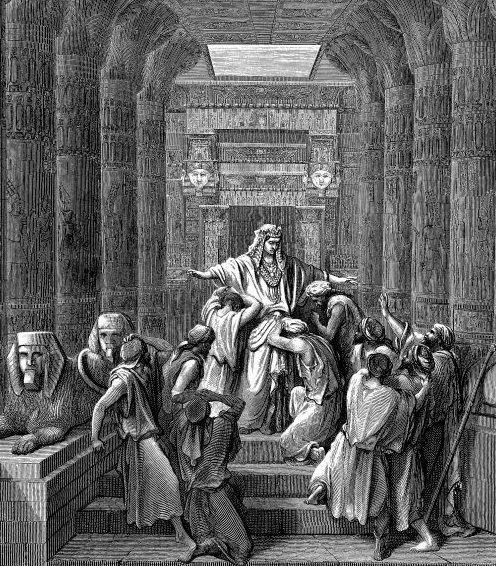
    Joseph Makes Himself Known to His Brothers (Gen. 45:1)
  • The Covenant with Jacob (Gen. 28:10-36:43)

    The Covenant with Jacob (Gen. 28:10-36:43)

    The Jacob narrative is bookended by his time in Bethel.  It is in Bethel, when he is fleeing from his brother Esau that he receives a vision of a ladder between Heaven and Earth on which angels of God were ascending and descending (Gen. 28:12).  Most commentators understand this not as a ladder as we would typically think of it today, but rather as a ziggurat, like the people of Babel tried to build.  Christ would later use such an image to describe Himself when He says, “Most assuredly, I say to you, hereafter you shall see Heaven open, and the angels of God ascending and descending upon the Son of Man” (John 1:51).  This is a curious image, but its meaning is straightforward: It is the sole gateway between Heaven and Earth, the sole connection between God and Man.  Jacob did not realize it when he first came to the place, but he was in the presence of the Holy; we often do not think about it, but in coming to Christ we too are coming into the presence of the Holy.  Such a realization should spur one to fear, awe, and worship, just as it did Jacob.

    It is at Bethel where the LORD reiterates His covenant promise to Jacob: “I am the LORD God of Abraham your father and the God of Isaac; the land on which you lie I will give to you and your descendants.  Also your descendants shall be as the dust of the earth; you shall spread abroad to the west and to the east, to the north and to the south; and in you and in your seed all the families of the earth shall be blessed.  Behold, I am with you and will keep you wherever you go, and will bring you back to this land; for I will not leave you until I have done what I have spoken to you” (Gen. 28:13-15).  Notice the similarities here with God’s promise to Abraham in Gen. 12:1-3.  There is not only the land promise and the promise of numerous descendants, but also the promise that God will be with Jacob wherever he goes.  It is God’s presence that is the final fruit of the covenant relationship.  Jacob responds by setting up and consecrating a memorial pillar and taking a vow that if God does indeed stay with him, provides for him, and brings him home safely, then he will make the LORD his God (28:20-21).

    Commentators make much of the fact that Jacob is turning an unconditional promise on God’s part to a conditional bargain, but the fact of the matter is that God works with His people where they are at; the chapters that follow show how God fulfilled Jacob’s vow.  While there is strife in Jacob’s family between his wives and concubines, God nonetheless blesses Jacob with twelve sons and a daughter and makes him successful in his work in Laban’s household.  God’s protection is manifest in three incidents after Jacob and his family flee from Laban.  First, God intervenes directly with Laban who is in hot pursuit of Jacob and his family and warns Laban in a dream not to harm Jacob (31:24).  The subsequent covenant Jacob makes with Laban secures his freedom from Laban’s household (31:43-58).  Second, as Jacob returns to the Promised Land, he is met by the same angels he saw earlier at Bethel (32:1), and God protects him from the wrath of his brother Esau (ch. 33).  Third, once Jacob returns to Canaan, the LORD protects the covenant family from assimilation with the surrounding peoples through the incident with the rape of Dinah.  In that case, Simeon and Levi wrought brutal vengeance on Shechem for their sister’s rape placed God’s people at enmity with the inhabitants of the land, yet Jacob’s fears that they would be killed did not materialize (34:30, 35:5).

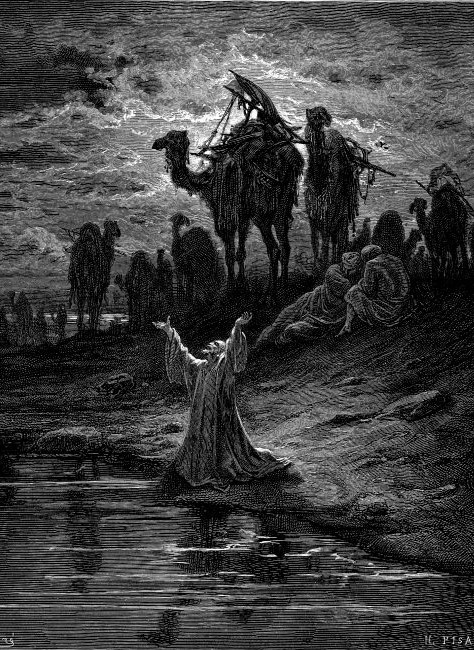
    Jacob learned hesed, covenantal love during his sojourn in Padan Aram.  Laban’s deceitfulness was not only a rebuke to Jacob’s own earlier deceitfulness, but became the means by which he came to develop covenantal faithfulness to the LORD.  That Jacob has indeed learned hesed can be seen in how he attributed blessings and protection he has received to the LORD in his argument with Laban (31:41-42), in his confession of faith to the LORD and prayer for deliverance (32:9-12), and in his wrestling with God (32:22-32). Moreover, Jacob’s faithfulness to God is based not only on what he has seen God do, but also who he has learned that the LORD is.  One way ancient kings exercised authority was to rename their vassals, and here we Jacob renamed Israel (“Prince with God”) in 32:28.  The LORD is sovereign.  In addition, the LORD possesses real power, unlike Laban’s household gods impotent to do anything and sat upon by a deceitful, menstruating woman (31:19, 26-35).  The fact that Laban could not find his household gods was God’s protection to his covenant people.  The LORD is superior to all other gods.  It should not be surprising then to see Jacob return to Bethel, where he made his original vow, build an altar to the LORD, and bury the idols among his family and entourage (35:2-4).  God’s fulfillment of Jacob’s vow is confirmed by God’s covenant renewal: “Your name shall not be called Jacob anymore, but Israel shall be your name… I am God Almighty.  Be fruitful and multiply; a nation and a company of nations shall proceed from you, and kings shall come from your body.  The land which I gave to Abraham and Isaac I give to you; and to your descendants after you I give this land” (35:10-12). The LORD would be known henceforth as the God of Abraham, Isaac, and Jacob.

    The Prayer of Jacob by the Jabbock River (Gen. 32:11)
  • The Continuation of the Covenant Under Isaac (Gen. 24:1-28:9)

    The Continuation of the Covenant Under Isaac (Gen. 24:1-28:9)

    The literary division of Genesis along the lines of generations (Heb. toledot) goes from 25:19 until the end of ch. 35, but narratively the focus shifts at 28:10 from Isaac and his immediate family to his son Jacob in particular.  In the Genesis narrative, the account of Jacob provides the pivotal connection between the patriarchal period and the Exodus generation, since it is with Jacob that the people of God go from being just a family to being a nation.  It was Jacob’s family that would go into Egypt during the famine; it would be the nation of Israel that would come out in the Exodus.  Nevertheless, although Genesis gives greater attention to Jacob—almost half of the book—the short account of Isaac is still important in showing how God’s covenant promises were conveyed to Jacob.  Three themes related to the covenant can be discerned in chapters 23 to 28: (1) How God protected the promised seed of Abraham; (2) The continual need for covenantal love to the LORD, shown negatively by the failures of His people; (3) How God extended and confirmed His covenantal promises to His people nonetheless.

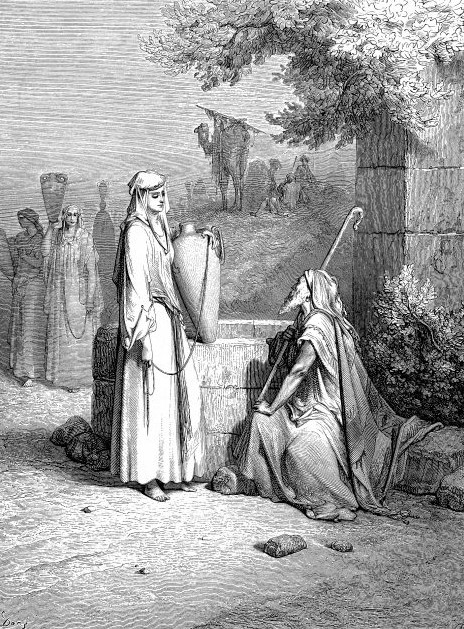
    The continuation and protection of the chosen seed.  Much of the Abrahamic narrative is focused on the coming of an heir through whom God’s covenant promises would be conveyed, and that heir was Isaac.  Once Isaac was born and especially in his brush with almost being sacrificed, God’s protecting hand remained upon him.  That protection continued in his life and conveyed to his son Jacob.  The godly seed risked being lost because of intermarriage with the pagan nations amongst whom Isaac and his family lived.  Abraham probably recognized this, which was why he was adamant that his son neither marry into the Canaanites nor return to the land of Haran which Abraham left.  The beautiful account in Genesis ch. 24 of Abraham’s servant finding Rebekah, a wife for Isaac, shows God’s providential working through the entire episode.  Rebekah, like Sarah before her, was barren until the LORD opened her womb with twins.  The sovereignty of the LORD was evident in His revelation that the older child would serve the younger (25:23), a pattern that God would follow repeatedly throughout the remainder of biblical history.  God intervened when Isaac was in Gerar, to prevent another Abimelech from taking Rebekah into his harem given that Isaac followed his father’s sinful pattern of declaring her to be his sister, not his wife (26:6-11).  The risk to the godly line was highlighted in the narrative by the negative example of Esau (26:34-35).  Esau’s direct threat to Jacob, through whom God’s promise would come, was thwarted by Rebekah’s justification desire that Jacob not succumb to marrying women of the land but to find a wife from among her own family (27:46-28:5).

    The continuing need for covenantal faithfulness.  Isaac and his family, like Abraham, had to learn covenantal faithfulness.  Despite God’s deliverances of Isaac, Isaac still trusted in his own connivance when he was in Gerar, rather than in the protection of the LORD (26:9).  Moreover, even though Rebekah had been told that of her sons, the older would serve the younger, Isaac favored Esau over Jacob for little more than personal reasons (25:27-28).  Esau, in fact, was indifferent to the covenant promises of God, as evident in how he despised his birthright (25:29-34).  Rebekah and Jacob were not much better than Isaac, in that while they did value the promises of God, they sought to attain those promises through their own efforts, rather than in trusting in God.  This is clearly displayed in the deception that they exercise toward Isaac to secure his patriarchal blessing for Jacob (27:1-29).  Jacob, in his experience of fleeing to and then twenty years later returning from Padan Aram would be the only one who would develop the kind of covenantal faithfulness that his grandfather Abraham exhibited, as would be seen in subsequent chapters.

    The extension and confirmation of God’s promises.  Despite this lack of covenantal loyalty, within these chapters one sees the echoes of God’s covenant promise is in the blessing that Rebekah’s family gave her as she left to become Isaac’s wife (24:60).  The LORD extends the covenant promise to Isaac during a famine, when he tells Isaac to stay in the land despite the famine, and that in so doing and in keeping God’s statutes and laws as Abraham had done, He would multiply Isaac’s offspring and bless the nations of the world through him (26:1-5).  This harkens back to God’s original promise to Abraham in 12:1-3.  The most obvious extension of God’s promises is in Jacob’s acquisition of the birthright of the firstborn (25:29-34) and then in Isaac’s subsequent blessing upon Jacob (27:27-29).  The writer of the epistle of the Hebrews points to this sole act as the justification for including Isaac in the testimonies of faith (Heb. 11:20).  Less obvious but also important are certain acts that help secure the patriarch’s legal claims to the land.  This is the significance of the covenants Abraham and Isaac made with the Abimelechs (21:22-34 and 26:12-33), as well as the extensive discussion of why Abraham bought the land from Ephron the Hittite to bury Sarah (ch. 23).  These transactions established a legal basis for Abraham and Isaac to the land, and such legal recognition was an indirect confirmation that God’s promise to give Abraham’s offspring would be fulfilled.

    Eliezer and Rebekah (Gen. 24:16)
  • The Covenant with Abraham (Gen. 12-22)

    The Covenant with Abraham (Gen. 12-22)

    There are multiple episodes in the development of God’s covenant with Abraham, but they should be treated as all part of one covenant.  In international diplomacy, the sum total of multiple agreements between two covenant-making parties—larger agreements and smaller ones, formal and informal, and precedents set in the history of relations between two parties—is known as a “treaty regime.”  This is important to recognize because there is a tendency oftentimes to view things in a reductionist manner, for example, separating God’s promise in 12:1-3 from the covenant-making ceremony in ch. 15, and that from the sign and confirmation of the covenant in chs. 17 and 22.  Such reductionism lends itself to seeing the separate events as potentially contradictory, rather than as building upon each other.  What we see here in chs. 12-17 (and really, through ch. 22) is the development of God’s covenantal regime with Abraham, and this is at the core of God forming a people for Himself.  The Apostle Paul, in his letter to the Galatians, saw a continuity between the promises given to Abraham and those under the Mosaic covenant which would come 430 years later (Gal. 3:15-18).

    God’s promises to Abraham in 12:1-3 are foundational to the Abrahamic covenant, even though the actual covenant-making ceremony does not come until ch. 15.  God gives Abraham a command to leave his country and family and travel to a land He will show him, so as to be wholly committed to the LORD.  The imperative comes with three promises: (1) God will make Abraham a great nation (v. 12:2a); (2) He will bless Abraham personally and make his name great (12:2b); (3) He will make Abram a blessing to all the families of the world, blessing those who bless him and cursing those who curse him (12:2c-3).  The third promise is the means by which the first two promises will come to fruition.  The narratives that follow up to ch. 15 show the beginning of the fulfillment of that promise.  Despite Abraham’s lack of faith while in Egypt, for example, even Pharaoh realizes that he would receive a curse if he took Abraham’s wife Sarah into his harem, and instead sends Abraham and Sarah away with a blessing (12:10-17).  The separation of Abram and Lot and Abram’s subsequent rescue of Lot in chs. 13-14 shows not only Abraham’s growing greatness and blessing, but also how others benefit from that blessing (e.g. Lot) or seek it (e.g. the king of Sodom).  Abraham’s interaction with Melchizedek, the king of Salem, shows that Abraham is fully aware of the fact that the blessing he has received comes from the LORD alone (14:18-24).  In the New Testament, the writer of the letter to the Hebrews, drawing on this passage and Psalm 110:4, recognizes Melchizedek as a foreshadowing of One who is both a king and a priest of God Most High, namely Christ Jesus Himself (Heb. 5:5-11).  The Seed of Abraham would be the One who would bless all the families of the world.

    The account of Abraham reaches its climax with his testing in ch. 22, and the narrative arc of chapters 12-22 revolve around the theme of God producing a seed through whom Abraham and the world would be blessed, while at the same time building Abraham’s faith and covenantal loyalty to God Himself.  The focal point of these chapters is the covenant-making ceremony in ch. 15.  The dialogue between God and Abraham preceding (indeed, prompting) the ceremony itself is rather curious and needs to be read closely and carefully.  The LORD states that He Himself is Abraham’s inheritance (15:1), that is, communion with Him is Abraham’s ultimate reward.  This touches off a dialogue about what inheritance actually entails, revolving around heirs and land, since Abraham has no naturally-born children and, despite having sizable flocks and herds, has been nomadic, not actually possessing any land.  Harkening back to His promise to Abraham in 12:1-3 and even to Eve in 3:15, the LORD underscores His promise of a specific offspring from Abraham and the multitude that would come from that seed (15:4-5).  Abraham accepts this by faith.  Echoing 12:1 and 13:14-17, the LORD then reiterates the promise of the land.  It is at that point that Abraham asks for assurance that this will indeed come to pass, which results in the covenant-making ceremony.

    It is vital to recognize that the land promise was always intertwined with and subordinate to the promise of a people, and that the promise of a people was not an end in itself, but was subordinate to ultimate communion with God.  God’s promise to Abraham that “I am your shield, your exceedingly great reward” (15:1) is a promise to us as well as the spiritual heirs of Abraham.  The first question of both the Westminster Larger and Shorter Catechisms capture this sentiment in declaring that “The chief end of man is to glorify God and enjoy Him forever.”  Keeping this in mind properly contextualizes the land promise, since some Christians get too focused on specific territory occupied now by the state of Israel, while others try to draw too fine a distinction between God’s promises of a people and His promises of the land.  In this ancient world it was common for a suzerain king to gift lands to faithful vassals as a reward for their faithfulness.  It was widely understood that such grants were implicitly conditional in that the vassals could retain those lands only insofar as they remained faithful; if they became unfaithful, the land grant could and probably would be revoked.  The land promise, therefore, has a threefold significance: (1) it is a reward for Abraham’s faith in trusting God’s promise of a people; (2) it is a down payment on the promise of a people; and (3) it would be a place where God’s would have communion with that people.  The terms of the covenant are focused on God redeeming a people for Himself (15:13-16).  Later in the biblical narrative it will be shown that the LORD did redeem Abraham’s seed in the Exodus and give them the land, but because of their unfaithfulness their right to dwell in the land was revoked.  God’s promise of a people redeemed to Himself, however, remains constant throughout Scripture.  Our communion with Him now is not in the land, but through His Holy Spirit.

    The formality of the covenant was a solemn legal assurance to Abraham of God’s promises.  The covenant-making ceremony of Genesis 15 is an archetypal example of such a ceremony, albeit with an important twist.  In making a covenant, the two parties would take a number of sacrificial animals, divide them in two, and lay them on opposite sides of a short pathway.  The titles of the two parties would be declared, with whatever preambular declaration was appropriate summarizing the state of their relations to that point.  In this case, only the LORD’s title is given: “I am the LORD that brought you out of Ur of the Chaldeans, to give you this land to inherit it” (15:7).  The terms of the covenant would then be stated specifying the obligations of the two sides, and then they would swear an oath, with the gods as their witnesses, and proceed to walk down the pathway of the slain animals.  Symbolically, the slain animals represented the self-maledictory curses of the covenant; the parties were saying in effect “May the gods do unto us as we have done to these animals—divided and dismembered—if we violate this covenant.”  It is from this symbolism that the Hebrew phrase for “making a covenant” literally means, “to cut a covenant.”  The twist with this particular ceremony, however, is that it is only God Himself—as represented by the smoking oven and flaming torch—that passes between the slain animals (15:17).  In this, God is saying that for any violation of the covenant by either side, He alone will absorb the curse of the covenant.  While the LORD cannot and will not violate the covenant because He is perfect and unchanging, for the sins of the people He will take on death.  This is an amazing act of grace that ultimately would be fulfilled in the Person and Work of Christ Jesus.

    Although Abraham believed that the LORD would provide Him with offspring and give him the land as an inheritance, he still needed to learn that God would supply the means to those ends.  This is the narrative arc of Genesis chs. 16-22.  Abraham and Sarah tried to grasp the promise through their own efforts in ch. 16, when Abraham took Sarah’s handmaid Hagar and fathered a child by her, Ishmael.  The LORD made it clear, however, that he is not the child through whom God’s covenant promises will be fulfilled.  God renewed His covenantal vows in  17:1-8, telling Abraham that the promised seed will be a son named Isaac, which Sarah will bear a year hence (17:15-21).  He stipulated that as part of the covenant the male children and menfolk within Abraham’s house would need to circumcised, which Abraham readily did (17:9-14, 23-27).  A few months later, the LORD, in the form of three mysterious men, appeared and reiterated the promise that Sarah will bear the promised son, Isaac.  More than that, the LORD takes Abraham into His confidence to reveal to him His plan to bring judgment upon Sodom.  In the exchange that followed as Abraham essentially bargained for the lives of his nephew Lot and his family, Abraham learned the character of the God whom He served, that the LORD was righteous, just and merciful, as well as powerful (ch.18).  Lot’s negative example and sorry end in ch. 19 highlighted the importance of God’s people being covenantally consecrated to the LORD, rather than co-opted and conformed to the world.  Shortly thereafter, Abraham and his household relocates to Gerar and he once again stumbles in his faith, trying to secure his safety from the local king Abimelech by claiming that Sarah is his sister (ch. 20).  Had this not been checked by the LORD, it would have brought into question the legitimacy of Isaac’s parentage (and hence, God’s promise) had Abimelech took Sarah into his harem.  When Isaac finally is born, God further preserves the life of Isaac by moving Sarah to send Hagar and Ishmael away, lest Ishmael become a threat to Isaac (21:8-21).

    Through all these experiences, Abraham not only grew in faith in trusting the LORD, but grew in covenantal love to the LORD.  The term for this in the Old Testament is hesed, and the richness of the concept does not translate neatly into English.  Hesed is the term used most often in the Old Testament for love and goes well beyond our contemporary connotations of the notion of love.  Translators of the Bible have used terms like “lovingkindness,” “steadfast love,” or “mercy” to try and capture the concept.  In a covenantal framework, a suzerain would expect his vassal to grow in loyalty, trust, faithfulness, and devotion to him over time.  It is not a sentimental love per se, although that may be present.  Rather, it is a steadfast, sacrificial, persevering devotion that exists and persists regardless of circumstances.  The concept underlies the ultimate call to God’s people in Scripture in Deut. 6:4-5: “Hear, O Israel: The LORD our God, the LORD is one!  You shall love the LORD your God with all your heart, with all your soul, and with all your strength.”  Christ identifies this as greatest commandment in Mark 12:29-30 and Luke 10:27.  Abraham learned hesed, so much so that when God puts him to the test in Gen. ch. 22 and asks him to sacrifice this long-desired son who would fulfill God’s covenant, his willingness to do so was not a blind leap of faith.  Rather, Abraham had seen God’s faithfulness and hesed throughout the years, even when he himself lacked faith, and consequently he believed that God would do something to save Isaac.  Hence, the writer to the Hebrews can say, “By faith Abraham, when he was tested, offered up Isaac, and he who had received the promises offered up his only begotten son, of whom it was said, ‘In Isaac your seed shall be called,’ concluding that God was able to raise him up, even from the dead, from which he also received him in a figurative sense” (Heb. 11:17-19).  Isaac was the seed through whom the promise would come, but also pointed to Christ, who would be offered up by God for the sins of the world and literally raised from the dead afterwards.  The hesed of Abraham is the same hesed God’s people are called to.

    Abraham and Isaac Ascend Mount Moriah