
From Elijah to Elisha
I. Summary of Jehoshaphat’s Reign (1 Kings 22:44-50)
41 And Jehoshaphat the son of Asa began to reign over Judah in the fourth year of Ahab king of Israel. 42 Jehoshaphat was thirty and five years old when he began to reign; and he reigned twenty and five years in Jerusalem. And his mother’s name was Azubah the daughter of Shilhi. 43 And he walked in all the ways of Asa his father; he turned not aside from it, doing that which was right in the eyes of the Lord: nevertheless the high places were not taken away; for the people offered and burnt incense yet in the high places. 44 And Jehoshaphat made peace with the king of Israel. 45 Now the rest of the acts of Jehoshaphat, and his might that he shewed, and how he warred, are they not written in the book of the chronicles of the kings of Judah? 46 And the remnant of *the sodomites, which remained in the days of his father Asa, he took out of the land. 47 There was then no king in Edom: a deputy was king. 48 Jehoshaphat made ships of Tharshish to go to Ophir for gold: but they went not; for the ships were broken at Ezion-geber. 49 Then said Ahaziah the son of Ahab unto Jehoshaphat, Let my servants go with thy servants in the ships. But Jehoshaphat would not. 50 And *Jehoshaphat slept with his fathers, and was buried with his fathers in the city of David his father: and Jehoram his son reigned in his stead.
By way of summary, Jehoshaphat was a king of Judah, the son of Asa, and generally a good king. He starts reigning at age 35 and rules 25 years. He like Asa, is a reformer king, who worked to do justice and appoint righteous priests and Levites as judges. Judah’s territory extends as far south as Ezion Geber, as in Solomon’s reign, and he even builds a fleet to sail to Ophir as Solomon did. Edom is not in revolt but is a vassal kingdom to Judah again. Judah is almost at the heights which existed under Solomon, which explains why Jehoshaphat reaches out to Israel—he is trying to reestablish that golden era. Unfortunately, he is going to do the same thing as Solomon, that is, start with godliness and fall into syncretism, uniting godliness and ungodliness. This takes the form of his reaching out to Ahab to form an alliance, which he likely sealed with the marriage of Jehoshaphat’s son Jehoram to Ahab’s daughter Athaliah. In 2 Chronicles 19:2-3, a seer sent by the Lord confronts Jehoshaphat over this deadly alliance.
2 And Jehu the son of Hanani the seer went out to meet him, and said to king Jehoshaphat, “Shouldest thou help the ungodly and love them that hate the LORD? Therefore is wrath upon thee from before the Lord. 3Nevertheless good things are found in thee, in that thou hast taken away the groves out of the land, and hast prepared thine heart to seek God.
In reading this as Christians, Hanani’s question poses a challenge for us, since he clearly implies that we should not help the wicked or love those who hate the LORD. Yet, how should we reconcile that with Christ’s command to love our enemies and do good to those who persecute us (Matt. 5:44-47)? We should not set Hanani’s comment in opposition to the Lord’s. In thinking about this we need to be discerning in terms of who we are to love, to what ends, and what exactly do we mean by “love.” We can love someone in terms of wanting what is best for them, in accordance with what God has said is best for all people. What they want and what God wants, however, may be separate things. A man in an adulterous affair may want his mistress, but genuine love for him would seek for him to break off the affair. While we are to love even our enemies, we also need to be cognizant of who God’s enemies are. Our enemies are not necessarily God’s enemies, and we should not support those who have consciously set themselves in opposition to God’s authority and kingdom. Indeed, we should be faithful to God first and foremost, even contrary to such individuals.
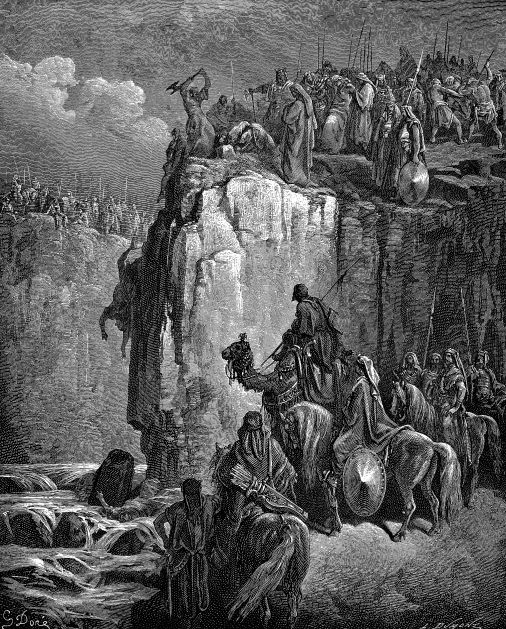
In this regard, Jehoshaphat lacked discernment in dealing with the Ahab’s house. First Kings 22:48-49 and 2 Chronicles 20:35 describe a joint venture that Jehoshaphat made with Ahaziah, Ahab’s son, to build ships for a trade expedition to Ophir. The LORD, however, sent another prophet to tell Jehoshaphat that his works would be smashed for allying with Ahaziah. In 1 Kings 22:49 then states that Jehoshaphat would not permit Ahaziah to join in on his trade expedition to Ophir, denying them the wealth that would have surely been split between them. The Lord then smashes the merchant ships in a storm, true to his word. God’s people are warned about building bonds with hypocrites and evil men, as poor company corrupts good morals: 4 I have not sat with vain persons, neither will I go in with dissemblers. 5 I have hated the congregation of evil doers; and will not sit with the wicked. 6 I will wash mine hands in innocency: So will I compass thine altar, O Lord. Jehoshaphat tried to pretend he could ignore the sins of evil men because doing so would result in more prosperity. God shut that down, since holiness of the nation is the goal, not prosperity through sin.
II. Ahaziah of Israel’s Reign (1 Kings 22:51-2 Kings 1:18)
So, with that quick summary of Jehoshaphat, let u roll back in time to where we were at the end of last lesson. We still have Jehoshaphat in Judah, Jezebel is queen mother in Israel, and Ahaziah takes over the throne of Israel upon the death of his father Ahab, around 853 BC.
51 *Ahaziah the son of Ahab began to reign over Israel in Samaria the seventeenth year of Jehoshaphat king of Judah, and reigned two years over Israel. 52 And he did evil in the sight of the Lord, and walked in the way of his father, and in the way of his mother, and in the way of Jeroboam the son of Nebat, who made Israel to sin: 53For he served Baal, and worshipped him, and provoked to anger the Lord God of Israel, according to all that his father had done.
Previous kings of Israel have been referred to as walking in the way of their fathers, or more frequently, in the way of Jeroboam, “who made Israel sin.” Ahab, however, was an exception he surpassed Jeroboam in sin. Ahaziah, his son, walks in the way of his father and mother, as well as Jeroboam. Jezebel here is a new addition to this list. Even in the past when we assumed the mother of the king, like Rehoboam’s mother, was pagan, this is the first reference we have to her being evil. Indeed, evil enough to warrant inclusion alongside Jeroboam and Ahab in their sins. Jezebel is not getting let off the hook for what she has done. In many ways, Jezebel is worse than Ahab. When Ahab was cowed after Mt. Carmel, it was she who threatened to kill Elijah. When Ahab was sulking about not being able to get Naboth’s Garden, it was she who laid the charge of false blasphemy at Naboth’s feet, subverted God’s law, and had him executed. Ahab humbled himself before God when Elijah pronounced that the curse would fall on him and destroy his family. Jezebel did not. There is a reason the name “Jezebel” has been an insult in the past. Ahaziah follows in her path, bowing down to Baal in worship. Because Ahab humbled himself before God, God postponed the enactment of judgement on the house of Ahab until after Ahab’s death.
1 Then Moab rebelled against Israel after the death of Ahab. 2 And Ahaziah fell down through a lattice in his upper chamber that was in Samaria, and was sick: and he sent messengers, and said unto them, Go, inquire of Baal-zebub the god of Ekron whether I shall recover of this disease.
Even from the first verse, we see things starting to unravel. The first verse said that Moab is in rebellion against Israel, and the next loss is that Ahaziah falls through a lattice. This can also be translated as fall through railing, a reference to Deuteronomic Law. Deuteronomy 22:8 commands Israelites to build railings on their roofs, so that people cannot fall off of them. “When you build a new house, then you shall make a parapet for your roof, that you may not bring guilt of bloodshed on your household if anyone falls from it” (NKJV). If Ahaziah thinks he can shelter himself from God behind his strong castle walls, he is dead wrong (emphasis on the dead). After Ahaziah falls/injures himself, he calls upon messengers to ask Baal-Zebub, the god of Ekron (a Phoenician coastal city), if he will recover. He did not wish to know what he could do to get better, only to know his fortune. His accident happened in his palace, not on the battlefield against Moab. This, combined with the fact that he has no heir, suggests a king profoundly disinterested in his duties.
It is not certain who this Baal-Zebub is, as this is only time in the Old Testament that this name is mentioned. Some scholars think it is Baal or a different aspect of Baal, and it has already been noted that Ahaziah worshipped Baal. Others think that this is an intentional mocking of Baal using a misspelling, since Baal-zebub means “Lord of Flies/Dung”) versus Baal-zebul, which means the Lord of Heavens. This particular verse draws a lot of attention because Jesus identifies the prince of demons (Satan) in Matthew 12:24 (|| Mark 3:22 || Luke 11:15) by a name very similar to this. What is important in this context is that Ahaziah is not reaching out to God, but rather, he is reaching out to a deity other than the LORD and of a completely separate city which he does not even rule over. And so, God sends Elijah to intercept the messengers of Ahaziah sent to pray to Ekron, and give them a message for Ahaziah.
3 But the angel of the Lord said to Elijah the Tishbite, Arise, go up to meet the messengers of the king of Samaria, and say unto them, Is it not because there is not a God in Israel, that ye go to inquire of Baal-zebub the god of Ekron? 4 Now therefore thus saith the Lord, Thou shalt not come down from that bed on which thou art gone up, but shalt surely die. And Elijah departed. 5 And when the messengers turned back unto him, he said unto them, Why are ye now turned back? 6 And they said unto him, There came a man up to meet us, and said unto us, Go, turn again unto the king that sent you, and say unto him, Thus saith the Lord, Is it not because there is not a God in Israel, that thou sendest to inquire of Baal-zebub the god of Ekron? therefore thou shalt not come down from that bed on which thou art gone up, but shalt surely die. 7 And he said unto them, What manner of man was he which came up to meet you, and told you these words? 8 And they answered him, He was an hairy man, and girt with a girdle of leather about his loins. And he said, It is Elijah the Tishbite.
Ahaziah probably groaned at hearing that not only was Elijah still alive, he was being a thorn in his side as much as he had been to his fathers. He may also have been mindful of the fact that everything Elijah prophesied came come true. So now Ahaziah knows he is dying. In a last desperate stroke of revenge, he sends fifty men to go fetch Elijah, get him off the mountain and bring him to Ahaziah (and probably kill him). And so when they threaten him, Elijah calls down fire from Heaven, burning them all away. The Puritan Matthew Henry points out in his commentary that Elijah did this “not to secure himself, nor to avenge himself, but to prove his mission, and to reveal the wrath of God from heaven against the ungodliness and unrighteousness of men.” Ahaziah sent another fifty men, and when they threaten Elijah, he also has them consumed. Elijah is not retrieved until a third group of fifty men comes, led by a captain who crawled on his knees before Elijah and begs him not to kill him and his men. “Have respect for my life and the lives of these fifty men, your servants.” An angel of the Lord told Elijah that he can trust these men, and Elijah does. He is escorted into the halls of Ahaziah by an honor guard, and he pronounced the judgement of God upon Ahaziah. Ahaziah died, having only reigned two years. With no son as his heir, Ahaziah’s brother Joram took the throne in 852 BC.
III. The Transition from Elijah to Elisha (2 Kings 2:1-18)
Elijah is back at full strength. In Chapter 19 we saw him waver, flee from Israel and Jezebel, but subsequently again pronounced judgement on Ahab. And here, we see him boldly calling down fire, walking into the fortress of his enemy surrounded by hostile soldiers, and pronouncing death and judgment upon Ahaziah, as he did his father. Elijah has his mojo back. This begs the question as to why Elijah did not call down such fire upon Ahab and Jezebel when they first threatened his life, after the battle of Mt. Carmel. Why was Elijah no longer afraid now? Or a better question, why was Elijah afraid in the first place? One possibility, of course, is the inconsistency and weakness of man. We are given tremendous promises by God, but it is sometimes hard to focus on those promises and ignore the fears pressing right up against us. Like Peter who walked a handful of steps on water, and yet his faith faltered in the face of the storm, such that he fell into the sea. Beyond this, however, there may have been unmet expectations. Elijah’s expectations, his dream of national renewal were dashed after Jezebel’s threat. And his crushed spirit was so caught up in that, he could not remember God or His promises. But now, Elijah is back for one final chapter. Second Kings Chapter 2 is about the transference of the prophetic office from Elijah to Elisha.
2 And it came to pass, when the Lord would take up Elijah into heaven by a whirlwind, that Elijah went with Elisha from Gilgal. 2 And Elijah said unto Elisha, Tarry here, I pray thee; for the Lord hath sent me to Beth-el. And Elisha said unto him, As the Lord liveth, and as thy soul liveth, I will not leave thee. So they went down to Beth-el. 3 And the sons of the prophets that were at Beth-el came forth to Elisha, and said unto him, Knowest thou that the Lord will take away thy master from thy head to day? And he said, Yea, I know it; hold ye your peace. 4 And Elijah said unto him, Elisha, tarry here, I pray thee; for the Lord hath sent me to Jericho. And he said, As the Lord liveth, and as thy soul liveth, I will not leave thee. So they came to Jericho. 5 And the sons of the prophets that were at Jericho came to Elisha, and said unto him, Knowest thou that the Lord will take away thy master from thy head to day? And he answered, Yea, I know it; hold ye your peace. 6 And Elijah said unto him, Tarry, I pray thee, here; for the Lord hath sent me to Jordan. And he said, As the Lord liveth, and as thy soul liveth, I will not leave thee. And they two went on. 7 And fifty men of the sons of the prophets went, and stood to view afar off: and they two stood by Jordan. 8 And Elijah took his mantle, and wrapped it together, and smote the waters, and they were divided hither and thither, so that they two went over on dry ground. 9 And it came to pass, when they were gone over, that Elijah said unto Elisha, Ask what I shall do for thee, before I be taken away from thee. And Elisha said, I pray thee, let a double portion of thy spirit be upon me. 10 And he said, Thou hast asked a hard thing: nevertheless, if thou see me when I am taken from thee, it shall be so unto thee; but if not, it shall not be so. 11 And it came to pass, as they still went on, and talked, that, behold, there appeared a chariot of fire, and horses of fire, and parted them both asunder; and Elijah went up by a whirlwind into heaven.
This passage opens with saying that that it was time for Elijah to depart, not by death and burial in the ground, but by taking Elijah via “whirlwind.” What this exactly means—and views differ—the importance of this chapter is the functional death of Elijah. The Lord is going to take him away from Elisha. Elijah tells Elisha three times to stay as he goes away, once at Bethel, once at Jericho, once at the banks of the Jordan. Elisha refuses each time, insisting on accompanying Elijah to the very end. “As the LORD lives, and as your soul lives, I will not leave you!” Elijah once complained about how he alone was left. Now, he cannot get rid of this guy Elisha. God answers prayers! Like a son tries to follow his father around and do what he does, Elisha is set on following after Elijah. Elijah may be trying to spare Elisha the pain of seeing him taken from him. This is hard for Elisha, as evidenced when the “sons of the prophets” ask Elisha “Do you know that God is taking Elijah away from you today?” and Elisha’s response is basically “Yes. Shut up!” Elijah and Elisha continue across the Jordan alone, which Elijah parts by striking it with his cloak, like Moses with his staff did the Red Sea. Then Elijah asks Elisha what gift he can give him before his departure. Elisha asks only for a double portion of the same Spirit that dwelt within Elijah. This is a big ask. Solomon’s request for wisdom looks tiny reasonable compared to this. This also is in line with the “adopted son” dynamic we see between these two. The double portion is the right of the firstborn son, his inheritance, and Elisha requests this of Elijah. The recognition of varying degrees of the Holy Spirit within people is true, particularly in gifts of the Spirit, as Christ gives the gift of the Spirit to whom he desires. 7 But unto every one of us is given grace according to the measure of gift of Christ. 8 Wherefore he saith: When He ascended up on high, He led captivity captive, and gave gifts to men” (Ephesians 4:7-8). We are the adopted sons of God, like Elisha was the adopted son of Elijah. We are granted the gifts of inheritance given to Christ, as we are co-heirs with him. Jesus gave the best gifts of all: His Holy Spirit, His Righteousness, His glory. Through our union with him, we will have all of these everlasting, unto eternity.
However, blessings do not come without responsibility. Elijah himself said to Elisha that Elisha asked for a hard thing. To those who much is given, much will be expected. They continued talking until a chariot of fire with flaming steeds separated the two of them, and a whirlwind caught Elijah up into the sky.
12 And Elisha saw it, and he cried, My father, my father, the chariot of Israel, and the horsemen thereof. And he saw him no more: and he took hold of his own clothes, and rent them in two pieces. 13 He took up also the mantle of Elijah that fell from him, and went back, and stood by the bank of Jordan; 14 And he took the mantle of Elijah that fell from him, and smote the waters, and said, Where is the Lord God of Elijah? and when he also had smitten the waters, they parted hither and thither: and Elisha went over. 15 And when the sons of the prophets which were to view at Jericho saw him, they said, The spirit of Elijah doth rest on Elisha. And they came to meet him, and bowed themselves to the ground before him. 16 And they said unto him, Behold now, there be with thy servants fifty strong men; let them go, we pray thee, and seek thy master: lest peradventure the Spirit of the Lord hath taken him up, and cast him upon some mountain, or into some valley. And he said, Ye shall not send. 17 And when they urged him till he was ashamed, he said, Send. They sent therefore fifty men; and they sought three days, but found him not. 18 And when they came again to him, (for he tarried at Jericho,) he said unto them, Did I not say unto you, Go not? (2 Kings 2:12-18)

Elisha calls out to Elijah, calling him his father, and the chariot of Israel, the chariot representing the military power and might of Israel. Elijah was a warrior for the faith, and this marks the end of his ministry, up to and including his priestly robes, AKA his mantle, falling to the ground and remaining there with Elisha. Elisha will never see him again, he knows it. When the sons of the prophets went out searching for Elisha, he told them not to, for he knew they would not find him. Elijah is gone, and now the mantle of responsibility lies before Elisha. Elisha takes it up, both literally and figuratively.
He could have left the mantle by the river. He could have gone home to his farm and his oxen. He could have spared himself a lot of toil and pain, left the nation to its own devices, and lived a peaceful life. But he did not. He chose the hard path because that was the path he had been called to follow by God. And to signify this, his first miracle was the same as Elijah’s last, parting the Jordan River as he re-enters the promised land, like the Israelites did so long ago, and like Moses parted the Red Sea.
IV. The Miracles of Elisha (2 Kings 2:19-25)
19 And the men of the city said unto Elisha, Behold, I pray thee, the situation of this city is pleasant, as my lord seeth: but the water is naught, and the ground barren. 20 And he said, Bring me a new cruse, and put salt therein. And they brought it to him. 21 And he went forth unto the spring of the waters, and cast the salt in there, and said, Thus saith the Lord, I have healed these waters; there shall not be from thence any more death or barren land. 22So the waters were healed unto this day, according to the saying of Elisha which he spake.
Many of Elisha’s miracles are similar to other figures in the Bible. He parts waters, heals lepers, multiplies food for the hungry, and raises the dead. In many of Elisha’s miracles as prophet, one can think forward to the coming of Christ, the last prophet, who does all Elisha does and more. Elisha is not just a clone of Elijah though. Elijah did eight miracles, whereas Elisha did 16 (a literal echo of “double portion” element). Elijah was very much an outcast character, wearing rough garments, dealing with individuals and not making many allies. Elisha, in his very first solo act, heals the water for a whole town and makes it good for drinking. He heals food and drink for others and provides for many more than a single family. He is his own man, and does many things Elijah did not, which is a good segue into our last section.
23 And he went up from thence unto Beth-el: and as he was going up by the way, there came forth little children out of the city, and mocked him, and said unto him, Go up, thou bald head; go up, thou bald head. 24 And he turned back, and looked on them, and cursed them in the name of the Lord. And there came forth two she bears out of the wood, and tare forty and two children of them. 25 And he went from thence to mount Carmel, and from thence he returned to Samaria.
Elisha continues on the road to Israel, and must pass through Bethel to do so. On his way there, he is confronted some “youths” who call him bald, and so Elisha casts “summon bears” who maul a bunch of them. We know Bethel as a city of sin- still containing that golden calf of Jeroboam.
Here is an instance where a lot of translations miss the ball. The KJV translates this “little children,” the NIV as “boys,” and the ESV as “small boys.” Grammatically, this is a fair translation, since the Hebrew word na’ar for “boy” can also mean anything from young adult to servant. Solomon uses the same word to describe himself when he prayed to God for wisdom. So it misses the mark to call these little children, when what is being depicted here is the immaturity of young men. What we have here is not a gaggle of preschoolers, it’s a gang of young men. The insults of these young men “go up, you baldhead,” are not merely calling him bald, but has multiple dimensions. Baldness was a sign of disease like leprosy, and the reference to “go up” was no doubt a reference to Elijah, who had been taken from Elisha. These young men are insulting and mocking God’s propjet, and so Elisha calls down a curse on them, which God immediately fulfills in the form of two bears. Elisha here is following the path of Joshua. He parts the Jordan river, enters Israel, and sends the local wildlife after the unbelievers. True to the covenant curses of Deuteronomy, the land itself is rising up against them. The metaphor for being torn apart by wild beasts is also found in messages of the minor prophets like Hosea, as symbolism for the destruction of a nation. As we will see in the next lesson, Elisha will continue to be God’s witness to a nation devolving into apostasy.


 Covenantide