Tag: Exodus

  • The Setting of Deuteronomy

    The Setting of Deuteronomy

    Deuteronomy 1:1-4

    These be the words which Moses spake unto all Israel on this side Jordan in the wilderness, in the plain over against the Red sea, between Paran, and Tophel, and Laban, and Hazeroth, and Dizahab. 2 (There are eleven days’ journey from Horeb by the way of mount Seir unto Kadesh Barnea.) 3 And it came to pass in the fortieth year, in the eleventh month, on the first day of the month, that Moses spake unto the children of Israel, according unto all that the LORD had given him in commandment unto them; 4 After he had slain Sihon the king of the Amorites, which dwelt in Heshbon, and Og the king of Bashan, which dwelt at Astaroth in Edrei:  (Deut. 1:1-4)

    I. On the Plains of Moab (Deut. 1:1-3)

    The Book of Deuteronomy has an inauspicious beginning relative to the grand narrative it encapsulates: “These be the words which Moses spake unto all Israel on this side Jordan in the wilderness, in the plain over against the Red sea, between Paran, and Tophel, and Laban, and Hazeroth, and Dizahab. (There are eleven days’ journey from Horeb by the way of mount Seir unto Kadesh Barnea.) 3 And it came to pass in the fortieth year, in the eleventh month, on the first day of the month, that Moses spake unto the children of Israel…” Even though modern archaeology has not identified all the locations listed in verse 1, the general vicinity is well-established as just north of the Dead Sea on the plateau of Moab in modern-day Jordan.  It is January 1406 BC, nearly forty years since the Lord their God led His people out of Egypt in the Exodus.  The people were poised to enter the Promised Land and would begin the conquest in a couple of months, on the fortieth anniversary of the Exodus (Josh. 5:10).

    In the Authorized Version (AV), verse two is punctuated as a parenthetical comment, but it brackets the redemptive history of the people of God described in the first four books of the Pentateuch.  According to the covenant He made with Abraham (Gen. 15:13-21), the Lord brought His people out of Egypt in the Exodus, to Horeb.  “Horeb” is an alternative term for Mount Sinai.  Sinai is where the Lord first called Moses to service in the encounter at the burning bush and where He led His people back to after the Exodus from Egypt.  It was at Sinai that the people faced the Lord with fear and trembling, who gave them His covenant for how they should live to reflect Him now that they had been saved.  It was at Sinai where they had almost been destroyed by that same God because of their apostasy with the Golden Calf.  It was at Sinai where Moses mediated for them and the Lord restored His covenantal relationship with after their sin.  And it was at Sinai where they then built the Tabernacle to Him.  The nation was at Sinai for just over a year, before the Lord commanded them to move out to the land which He promised their forefathers (Num. 10:11).

    Mount Seir is in the land of Edom, the descendants of Esau, Israel’s kin, which had already settled in the land which the Lord allotted to them.  The reference here in 1:2 is probably only to describe a common route of travel; the more significant reference is to Kadesh-barnea.  Kadesh-barnea was just south of the Negev, the southern part of the land of Canaan, and was to be the launching point for the conquest of Canaan.  It was from Kadesh-barnea that Moses sent the spies into the land, whose negative report about the people being giants and the land being fortified deterred the Israelites from following the Lord’s command to go up against it.  After Moses pronounced the Lord’s judgment on them for failing to trust Him, the people tried to invade the land in their own strength, only to be miserably routed.  Israel would stay at Kadesh-barnea for most of the next 38 years.  Moses’ sister Miriam would die there, his brother would die not far from there, and because of Moses’ own sin there of presumptuous against the Lord, the Lord declared that Moses himself would not be allowed to go into the land.  Kadesh-barnea and the vicinity around it was Israel’s wilderness wandering.

    II. The Words of the Mediator (1:1-3)

    “These be the words which Moses spake unto all Israel… according unto all that the LORD had given him in commandment unto them” (Deut. 1:1, 3).  Thus begins Deuteronomy.  Like every other book of the Pentateuch except Exodus, Deuteronomy begins with words being spoken, but unlike those other books, Moses for the first time is identified as the one speaking, rather than God.  This fact is noteworthy in light of the structure of Deuteronomy.  Since Deuteronomy is written as a covenant, these opening verses are the preamble to the covenant.  Normally in ancient Near Eastern covenants the preamble is where the suzerain is introduced with his titles and honors.  Moses, however, is not the suzerain nor is he given any titles.  This fact highlights Moses’ role as Mediator of the covenant, the representative of the Lord speaking to the people and the representative of the people standing before God (1:3).

    At 120 years old, Moses was at the end of his life and was personally prohibited from entering the Promised Land (Deut. 1:37, 3:26, 4:21, 34:4) because he failed to honor the Lord before the people: instead of speaking the Lord’s word to give the people water, he assumed to himself the prerogative of the Lord alone, struck the rock and said he was giving them water (Num. 20:9-13).  The Lord’s Mediator was obligated to be obedient to the Lord’s command and speak the Lord’s words alone.  Moses failed to do that, and that cost him.

    No doubt, Moses feared for the Israelites’ future without him as they entered the Promised Land.  He had been with them since the Exodus in all the years of their wandering and knew too well just how stubborn and rebellious they were.  Indeed, the last of the generation which had come out of Egypt in the Exodus as adults had died off a year or two earlier (2:14-16), the result of the Lord’s judgment on them after they refused to trust Him to fight their battles in conquering the Land.  Moses almost certainly knew he was not indispensable, since it was the Lord alone who saved and sustained His people.  Nevertheless, he had been the mediator between the people and the Lord for more than forty years; with his impending death the people still needed a mediator.

    III. The Covenant and the Transition

    It is in this setting that Moses wrote the Book of Deuteronomy.  He wrote it, curiously enough, in the form of a covenant.  In the ancient Near East, a covenant was a treaty.  It bound two sovereigns together by oaths of mutual loyalty, with stipulations of obligation on one or both parties, was incentivized by blessings and curses, sealed by a formal ratification ceremony and enforced by the gods.  In most cases, a covenant was between a suzerain overlord and a vassal king and was the legal means by which the suzerain bound the vassal to himself and regulated their relationship.  At the time Moses wrote Deuteronomy, the ancient Near East was experiencing a heyday of diplomacy, yet interestingly, the biblical covenants were unique in that they are the only examples from antiquity in which a god made a covenant with his people.  There is a genuine basis then for the rhetorical question Moses asks in Deut. 4:8, “And what nation is there so great, that hath statutes and judgments so righteous as all this law, which I set before you this day?

    That the Lord would make a covenant with His people seems strange in light of the fact that covenants were basically treaties.  Making a treaty seems on first glance to be too formal, too distancing.  At the same time, it was on the basis of the God’s covenant with Abraham that He brought His people out from Egypt with great judgments, sustained them in the wilderness and, at this point in biblical revelation, was about to bring them into the Promised Land.  The formality of the covenant was the very basis for the people’s assurance that the Lord would indeed follow through on his promises in light of their sins.

    Covenants typically were made whenever there was a significant development in the relationship between the two parties; Moses’ approaching death and Israel’s pending entry into the Promised Land constituted just such developments.  Ancient kings would often use covenants with other kings—and even with their own people—to secure legal recognition for their heir apparent.  That is true in the case of Deuteronomy, insofar as Moses is transitioning leadership of the nation to Joshua, son of Nun.  Joshua had been one of the men who spied out the land forty years earlier, but unlike all the others (save Caleb), he faithfully trusted God to deliver the land to Israel.  In Deuteronomy, however, this is leadership succession with a twist:  the covenant is not focused on Joshua per se, but on God.  While Joshua would lead the people into the Land, Moses was pointing the people to their true leader, namely the Lord Himself.  It is the Lord who promised them the land, the Lord who delivered them from Egypt, the Lord who sustained them in the wilderness, and the Lord who was already fighting their battles in conquering the land.  This was Moses’ last act as Mediator.  Note that this does not diminish Joshua’s (subordinate) authority but establishes it: ancient Near Eastern covenants typically presumed the vassal would be exclusively loyal to his suzerain and if the people were loyal to the Lord, then they were to be loyal to Joshua as well.

    Although Moses transferred his leadership to Joshua, he transferred his mediatorial responsibilities to the covenant itself.  It is the covenant that would be the standard to which God’s people would be held, and in adhering to the covenant the people would be reflecting their Lord.  This was the second time in the Israel’s history the nation was poised to enter the land the Lord promised to their forefathers.  The first time was when the nation was at Sinai, and the Lord made a covenant with them there, that He would be their God and they would be His people (Exod. 6:7 cf. Exod. 19:3-6).  The covenant on the plateau of Moab reflected the evolution in the relationship between Lord and His people.  At Sinai, the Lord had just delivered His people from Egypt, and they had not yet sinned against Him.  Shortly thereafter, they sinned in disbelief and were condemned to judgment in the wilderness.  The covenant, then, was one of renewal, now with the succeeding generation and reflective of the need for the Lord to be direct with His people because of their past experience sins against Him.  It is this covenant, which extends and builds on Sinai, that was to become the constitutional foundation for God’s relationship with His people.

    IV. The Defeater of Sihon and Og (1:4)

    The Lord is not absent from this passage, and verse four describes Him as the defeater of Sihon and Og.  “Defeater of Sihon and Og” does not seem like a terribly impressive title, but it was significant for God’s people at that time.  While in the broad schema of things these were relatively minor kings, in the context of God’s relationship with His people the defeat of these kings showed the Israelites that God was fulfilling His covenants with their forefathers, Abraham, Isaac, and Jacob, to fight their battles and bring His people into the land He promised them.  This title alone would have been sufficient basis for them to trust Him and be obedient to Him.  It would have been a source of confidence and a token that He would fulfill His covenantal promises.  He who made the heavens and the earth and all that is in them could also completely defeat their enemies and overcome the challenges immediately before them.  They needed to know that.

    V. Anticipating Christ

    Moses was a Mediator between the Lord and His People.  What does this mean and why is it important?  We often think of a mediator as a middleman trying to broker a deal between two parties.  That is not what Moses did.  Rather, he sought to represent God to the people and to intercede with God on behalf of the people.  In this he spoke the Lord’s words to the people of Israel and lifted up their needs and cries to the Lord Himself.  At times, Moses interposed himself between God and Israel, mostly to protect the people from the fullness of God’s wrath toward their sins.  With Moses’s pending death, the mediatorial role that he had played in making God and His standard known to Israel was transferred, not to Joshua, but to the testimony of the Law.  In that regard, the one can say that Deuteronomy really is a kind of last will and testament of Moses.  The intercessory role Moses had during his life would be assumed in the remainder of the Old Testament by judges (in the Judges period) and later by the prophets.

    Moses foreshadowed the mediatorial role that Christ Jesus would ultimately assume.  The Father would send His Son, our Lord Jesus Christ, the very Word of God (John 1:1), to make God known to men and intercede on behalf of His people.  His intercession, however, goes beyond what Moses ever did: Christ actually died in place of His people on the cross of Calvary.  That is the only thing that would once and for all turn away—propitiate—the Father’s wrath toward His people’s sin.  With His resurrection from the dead, Christ’s intercessory work continues, as He lifts up the prayers of God’s people to the Father continually, because He is seated at the right hand of the Father.  It is important for us to understand that because Christ Himself is our Mediator, we do not need some other intermediary to intercede for us with God, whether deceased saints, angels, or even the Church; we can approach Christ directly.  In fact, to set any of these things up as a mediator between us and God would be to turn to them for that which only Christ Jesus can provide.  If Moses’s mediatorial role points to Christ, then His words in Deuteronomy also find their fulfillment in Christ.  In this light, reading Deuteronomy is not a mere historical exercise of looking at rules from God.  Rather it is in understanding the heart of our Lord, who has saved a people for Himself and expects this people to honor Him in how they are to live.   Moses’s readers were poised to enter the Promised Land, where they would find their rest in the God who would dwell among them.  For us, we are looking for a heavenly Promised Land, where we will find our rest in union with Christ and eternal communion with Him.

  • “Who is the LORD, that I Should Obey His Voice?” (Exodus 4:29-6:27)

    In wrestling with God’s providence, one thing we particularly struggle with is God’s timing.  We want God to change things NOW, and we do not understand why God seems to be so laggard, so willing to let evils persist or even intensify without addressing them.  We need to remember that God is neither passive nor laggard.  How He is working is as important as what He intends to accomplish.

    We can see this in the first encounter Moses and Aaron had with the Israelites in Egypt and then with Pharaoh. The meeting with the Israelites went well; that with Pharaoh did not. When Moses engaged God at the burning bush, his three questions centered on the Israelites not heeding his voice, as had been the case forty years earlier when he sought to lead the Israelites. Yet Scripture records that “Moses and Aaron went and gathered together all the elders of the children of Israel. Then he did the signs in the sight of the people. So the people believed; and when they heard that the LORD had visited the children of Israel and that He looked on their affliction, then they bowed their heads and worshiped” (Exod. 4:29-31) That was easy.

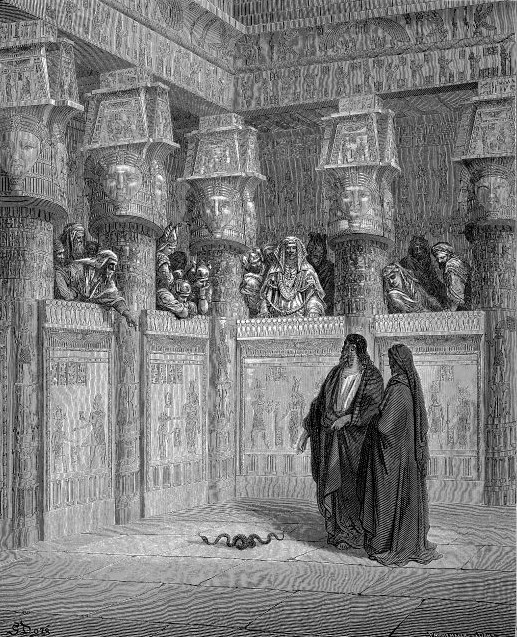
    When Moses and Aaron went to Pharaoh, they asked him to allow the Israelites to go three days journey into the wilderness (probably about a week round trip) to worship the LORD.  This was just as the LORD commanded (Exod. 5:1 cf. 3:18).  Pharaoh responded to the request contemptuously: “Who is the LORD that I should obey His voice to let Israel go?  I do not know the LORD, nor will I let Israel go” (Exod. 5:2).  Such a response was inevitable: Pharaoh led a civilization that by that point had been in existence for more than 1,500 years, and which held to an ideology centered on the permanence of the existing order of things.  Moreover, the LORD was not part of the pantheon of Egyptian gods, and Pharaoh himself was considered a near divinity.  From Pharaoh’s perspective, the request was absurd and reflected laziness on the part of the Israelites.  Thus, he increased their burdens.  The Israelites reacted with bitterness toward Moses and Aaron for getting them into the situation in the first place, and Moses and Aaron, in turn, cried out in anguish to God, asking why the people had not be freed.  They should not have been surprised though—God had told Moses beforehand that Pharaoh would refuse the request, indeed because the LORD Himself would harden Pharaoh’s heart (Exod. 4:21).  Things had turned out exactly as God said.  Freeing the Israelites was not going to be easy.

    The reaction Moses, Aaron, and the Israelites is typical of the expectation we often have that if we just say a short prayer or make some small deference to God, then he will make everything all better quickly, like a parent kissing a child’s scrape.  But that is not how the LORD typically works.  Why was the LORD making it harder?  Certainly the greater Pharaoh’s resistance to releasing the Israelites, the greater God’s glory when He does free them.  But that is probably not the full reason.  God is in the process of working on shaping people even as He is working toward a particular end result.

    First, Moses and Aaron needed to grow in trusting Him if they were going to lead the people.  Their initial response notwithstanding, the fact that God told them Pharaoh would resist their request and that that is exactly what came to pass strengthens the credibility of God’s word.  In the ensuing confrontation with Pharaoh, they do not come back to the LORD and make that same complaint again.

    Second, God is working on Pharaoh.  God’s purpose is not only in His glory, but He is bringing judgment upon Egypt.  Covenantally, God had promised to Abraham that He would bless those who bless His people and curse those who cursed His people.  Pharaoh and Egypt were convinced of their own superiority and their ability to act toward God and toward His people with impunity.  They were due for the LORD’s judgment and the harder Pharaoh’s heart became, the more clearly the righteousness of God’s judgment will be seen.  Through the confrontation with Pharaoh and Egypt, God is demonstrating His superiority over the kings of the earth who stand in resistance and rebellion toward Him.

    And that is a relevant lesson for God’s people as well.  While they acknowledged the LORD as their God, having been in Egypt as long as they had they probably saw Him as merely just one of a host of gods, albeit one who historically had been favorable toward them.  In this sense, they acted as if God was their mascot.  He was not.  Pharaoh’s rhetorical question was, in a sense, their question as well: Who is the LORD, that they should obey Him?  They needed to realize that that the LORD was the only true God, sovereign over all of creation—and for that reason, they should obey Him.  By making things harder, God was setting up the situation and shaping the attitudes of those participating in it.  With His people, He was shaping them to obey Him, and with His enemies He was showing Himself as the God to be feared.  The process God was working through met these supplementary goals.  As we struggle with things in our lives, the process that the LORD works through He is using to shape our attitudes as well, that we will truly become a people who will honor, glorify, and obey Him.

  • God’s Call Upon Moses (Exodus chs. 3-4)

    What would it be like to directly encounter God in person?  This question bears much more reflection than we are typically inclined to give it.  We live in a day and an age characterized by glibness and superficiality, and we are inclined to approach God with the same kind of casualness that we would approach our friends.  But that is clearly not the picture we get in these chapters of Moses’s first encounter with God.  There is mystery, unexpectedness, and even an element of fear present in this meeting.  The LORD defies our categories and conventionalities; we respond to His agenda, not He to ours.

    To say that Moses’s first encounter with the LORD was the turning point in his life is true, but fails to adequately capture the matter.  God revealed Himself to Moses in a profound way because He intended for Moses to play a central role in the greatest redemptive act He had done in human history to that point.  For Moses to carry the burdens he would have to carry, He needed to know that behind those things was a God whose awesomeness was unsurpassed.  How did God reveal Himself? 

    The Burning Bush

    As One working miraculous signs.  Moses’s encounter was prompted by the sight of a bush that was on fire but not consumed.  In a dry and arid environment, a bush that caught on fire would burn up quickly.  Not in this case.  That mystery is what prompted Moses to take a closer look.  This image was not unique to this occasion.  When the LORD made the covenant with Abraham, it was a smoking oven and a burning torch that passed through the severed carcasses to take on the obligations of the covenant (Gen. 15:17).  After Moses’s encounter at the burning bush, the LORD would lead His people out of Egypt in the form of pillar of cloud and fire (Exod. 13:21, cf. 14:19-20 & 24, 24:15-18, 40:34-38, Num. 14:14).  Both the cloud and the fire denote the presence of God without limiting Him to a particular form, but the latter points to His power; the former to His mysteriousness.  This is not a God we approach lightly.

    As One who is fundamentally divine.  God first manifests Himself as an “Angel of the LORD” in 3:2, but that quickly shifts to referring to the LORD as God Himself.  “Angel” simply means “messenger,” but it becomes quickly apparent that the messenger is none other than God Himself.  This happens in multiple places in the Old Testament, where the narrative begins by talking about an “Angel of the LORD” only to shift suddenly and talk about God explicitly (Gen. 16:7-11; Gen. 22:11-15; Num. 22:22-35; Judges 6:11-22; Judges 13:21; 2 Sam. 24:16; 1 Kings 19:7; 2 Kings 1:3, 15; 1 Chron. 21:12-30; Isa. 37:36; Zech. 1:11-12, 3:1-6).  With the clarity provided by the New Testament, we can see that this “Angel of the LORD” is no ordinary angel, but rather, is the pre-Incarnate Christ.

    As One in covenantal relationship to His People.  Three times in Exodus ch. 3 God identifies Himself as the “God of Abraham, the God of Isaac, and the God of Jacob” (3:6, 15, 16).  Indeed, it is because He covenantally bound to His people that He has heard their cries, is responding to their distress and will save them from their bondage so that they may have fellowship with Him in the land He promised to their forefathers.

    And, lastly, as He is in Himself.  Moses asks what he should tell the people when they ask for the name of God who is sending him.  Curiously, God responds by saying, “I AM WHO I AM,” and then He connects that to His covenantal relationship with the people by using the name, the “LORD God” (3:15).  In English Bibles, the name “LORD” (all capitals) represents the Hebrew “YHWH,” typically spelled Yahweh, and is related to the verb, “to be.”  The LORD’s declaration here makes this the covenantal name of God; it is the proper name by which  God’s people are to refer to Him.

    This is not what we would expect of a name, but it is deeply profound.  In connecting the name with the characterization that “I AM WHAT I AM,” God is giving His people several important revelations about Himself.  For a people who had lived among polytheists for over 400 years, He is not just one God among many, nor even just their God; rather, He is THE God, the only God.  This is vital for His people to know in the confrontation that He is moving toward with Pharaoh, who claimed to be divine.  He is the self-existent God, and as such, He is eternal and unchangeable.  Because this name is related to the verb “to be,” there is a variation on God’s name in the Book of Revelation that captures this notion succinctly: “Him who is and who was and who is to come” (Rev. 1:4).  There is nothing higher than Him.  The 11th century bishop Anselm of Canterbury (1033-1109 AD) once described God as that Being, greater than which cannot be conceived.  Given all this, while God has made Himself known to His people, these attributes make He is nevertheless incomprehensible: we can know Him, but we can never exhaust our knowledge of Him.  This is the God who was intent on dealing with the bondage and suffering of His people. 

    The LORD is doing more than just revealing things about Himself in this encounter with Moses; He is calling Moses to act as His agent, His Mediator for His people.  How does Moses respond?  The LORD that required that Moses approach Him as holy, as One worthy of reverence and awe (Exod. 3:5).  Moses responds, rightly, by hiding his face.  For a God who is higher than anything, He is not to be approached in a casual or flippant manner.  He is worthy honor and respect.  A point for us to reflect upon is whether we approach God with the awe, the honor, and the respect He deserves.

    Moses then begins a dialogue with God, which showed that he failed to have the prompt, faithful obedience and covenantal love (hesed) that marked Abraham at his best.  Moses raises two questions of God which are legitimate, but then makes three statements that increasingly show he really does not want to do what God is calling Him to do.  With each of these, God nonetheless responds with concrete measures of assurance:

    1. Who am I that I should go to Pharaoh and that I should bring the children of Israel out of Egypt?” (3:11).  God promises to be with Him, and signals as confirmation of His presence that He would return him to the mountain they were at (3:12).
    2. What shall I say to them when they ask what is God’s name?” (3:13).  As already discussed, this is where God reveals Himself as the I AM, who is the same God of Abraham, Isaac, and Jacob (3:14-17).
    3. But suppose they will not believe me or listen to my voice; suppose they say, ‘The LORD has not appeared to you’” (4:1).  God provides three miraculous signs to confirm His word to Moses: the serpent rod, the leperous hand, and turning water into blood (4:2-9).
    4. O, my Lord, I am not eloquent, neither before nor since You have spoken to your servant; but I a slow of speech and slow of tongue” (4:10).  God promises again to be with him and to give him the words to speak (4:11-12).
    5. O my Lord, please send by the hand of whomever else You may send” (4:13).  Though Moses’s recalcitrance angers the LORD, the LORD nevertheless promises to have Moses’s brother Aaron be his spokesman.  But He still commands Moses to lead (4:14-17).

    Arguing with God is a dangerous thing, but God shows forbearance and mercy.  This background, however, makes the contrast all the more stark a few verses later when we read, “And it came to pass on the way [to Egypt] at the encampment, that the LORD met him and sought o kill him” (4:24).  This is a curious statement: why would God want to do this?  And why was the act of Moses’s wife, Zipporah, satisfactory in making God stop this effort to kill Moses?  The text does not say why Moses had failed to do this, whether it was an oversight or carelessness, but in any event, God calls His people to covenantal faithfulness (hesed), that is, steadfast love.  If Moses was going to be a Mediator for God’s people with Pharaoh, then he needed to identify himself fully with that people.  Circumcision was the sign God had given to Abraham of citizenship in covenant community.  Moreover, Moses would become Israel’s law-giver, and as such, needed to be obedient to the law himself.  In the New Covenant, we see Jesus as Mediator fully identifying with His people in the Incarnation and being fully obedient to the Law, even unto death.  What Moses foreshadowed; Christ fulfilled.

    The task Moses was being called to was without any doubt a tall order.  God wanted Moses to approach the most powerful ruler of the day with the request that he let hundreds of thousands of slaves go, and even told Moses beforehand that Pharaoh would not comply (3:19, 4:21-23), so that God could display His glory in the ensuing confrontation.  This is a hard providence to accept, but accepting it requires trusting in the great God who stands behind His people and in the plan that He has formulated for their good.  And, as will be seen, God came through on all His promises in a great and mighty way.

  • From a Son of God to a Shepherd in the Wilderness (Exodus 2)

    In this chapter we have three vignettes of Moses’s life: how he was saved from the genocide being perpetrated against his people; his failed attempt at delivering his people, and his flight to Midian (today in northwestern Saudi Arabia).  Interestingly, when Stephen the Deacon recounts Moses’s role in redemptive history in Acts 7:17-43, he spends more time on this than on the Exodus and the forty years Moses led the people in the wilderness.  This is curious, since it is a truly anti-heroic narrative: Moses is saved by women at birth, fails at leading his people in Egypt, and in fleeing Egypt is reduced to helping shepherdesses in the wilderness.  The combination of these vignettes, however, highlight the glory of God in preparing Israel’s deliverer.

    The Pharaoh at the time of Moses’s birth most likely was Amenhotep I, the son of Ahmose, the founder of the 18th Dynasty, and the decree to kill the male children of the Hebrews probably was in effect only for a limited time.  Moses’s brother Aaron was three years older than him and was not affected, and there is no indication that the persecution either escalated or went on.  Moses was probably born in 1526 BC, the last year of Amenhotep I’s reign (r. 1546-1525), and when Thutmose I (r. 1525-1512) took over he probably ended the persecution; he would have enough to deal with in securing his position as Pharaoh without provoking a large alien ethnic group within his realm.

    Commentators have speculated that the daughter of Pharaoh who drew Moses from the water was Hatshepsut, who would later go on to exercise kingship in her own right (r. 1504-1483).  She certainly would have had the force of personality to defy Pharaoh’s edict, but depending on how one calculates the chronology, she may not have been much older than Moses himself, and thus unlikely to have adopted him.  In any event, Moses’s mother probably reared him for several years before presenting him to Pharaoh’s daughter, and in that time impressed upon him his covenantal heritage.

    When he became part of the Egyptian court, he would enter a new world.  In ancient Egypt, Pharaoh’s were considered nearly divine and typically were deified upon their death.  To be a member of the royal family, then, would almost be tantamount to being the son or daughter of a god.  In addition to being given the best education then possible, most of Moses’s mature years would be under Hatshepsut’s reign, which was marked by diplomatic embassies to Punt (modern day Somalia) and other parts of the Near East.  Moses certainly would have known about these trips and may even have participated in some.  That would have given him insight into how covenants functioned as treaties at time when diplomacy was beginning to flourish in the ancient Near East.

    One other thing in Hatshepsut’s reign may also have shaped him, indeed, may have radicalized him: Hatshepsut boasted in her official inscriptions that she finally eliminated the Hyksos as even an external threat.  Knowing that his people had flourished under the Hyksos and were now oppressed, he almost certainly had to have been disturbed by this boast.  It is probably in 1486 BC, then, that he killed the Egyptian who was beating one of the Hebrews.  Moses’s action certainly bespeaks a righteous indignation, but there may also have been some political calculation as well: if people saw him as a judge, then he could lead them and throw off the Egyptian yoke—except the people did not follow him.  Found out, his actions certainly would have been seen as treason by the royal court, which is why he fled.  The Pharaoh from whom Moses fled was probably Thutmose III, the long-ruling and greatest Pharaoh of the 18th Dynasty (r. 1504-1450), who died just before the Exodus (Exod. 2:23).

    While we can comprehend the fall from privilege that Moses experienced, the full depth of it is not readily obvious to most Western readers.  When we think of shepherds, we typically think of bucolic pastoralists, gently caring for white fluffy sheep.  In the ancient Near East and even to this day, however, shepherds engaged in tedious, hard labor in the heat and in the cold throughout the year, living as nomads on the edge of society.  By settled peoples, they were typically seen as neither committed to one place nor one king, and often only a step or two away from open brigandage.  Thus, Moses went from being almost as high as he could possibly be to being almost as low as he could go.  And even then, Reuel’s daughters did not think to invite Moses to come to their family’s tent until berated by their father, despite the help he rendered to them.

    Why did God have Moses go through what he did?  Moses was certainly destined to lead God’s people and God had prepared him expressly for that purpose, but it was God who promised to deliver His people.  For Him to receive the full glory for fulfilling His covenantal promise He needed Moses to be at a point where he was not trusting in himself or his abilities, but trusting in God.  Moreover, God used Moses to prefigure Christ Himself.  This is probably why Stephen spends so much time on Moses’s backstory in Acts ch. 7.  After recounting Moses’s background, Stephen says, “This is that Moses who said to the children of Israel, ‘The LORD your God will raise up for you a Prophet like me from your brethren.  Him you shall hear” (Acts 7:37).  The one that the Jews of Stephen’s day claimed to follow pointed them toward a deliverer better than himself.  Christ was not simply like a Son of God, He was the Son of God who Himself was fully God.  Ascending from the of the Father, He was humiliated in His life on earth, culminating in His death.  Humiliation, however, precedes glory, and just as Moses’s humiliation preceded the glory of the Exodus, so Christ’s humiliation in death preceded the glory of His resurrection on the third day.  To God alone be the glory!