Struggles within the House of Judah
I. The Revolt of Edom (2 Kings 8:16-24)
16 And in the fifth year of Joram the son of Ahab king of Israel, Jehoshaphat being then king of Judah, Jehoram the son of Jehoshaphat king of Judah began to reign. 17 Thirty and two years old was he when he began to reign; and he reigned eight years in Jerusalem. 18 And he walked in the way of the kings of Israel, as did the house of Ahab: for the daughter of Ahab was his wife: and he did evil in the sight of the Lord. 19Yet the Lord would not destroy Judah for David his servant’s sake, as he promised him to give him alway a light, and to his children. 20 In his days Edom revolted from under the hand of Judah, and made a king over themselves. 21So Joram went over to Zair, and all the chariots with him: and he rose by night, and smote the Edomites which compassed him about, and the captains of the chariots: and the people fled into their tents. 22Yet Edom revolted from under the hand of Judah unto this day. Then Libnah revolted at the same time. 23 And the rest of the acts of Joram, and all that he did, are they not written in the book of the chronicles of the kings of Judah? 24 And Joram slept with his fathers, and was buried with his fathers in the city of David: and Ahaziah his son reigned in his stead.
Jehoram of Judah and Jehoram/Joram of Israel were almost exact contemporaries, the start of their respective reigns differing only by four years. Recall that at the beginning of Joram’s reign he sought to punish his vassal state, Moab, for refusing to pay tribute, and that his allies in that expedition included Judah and Edom. The expedition was initially successful but ultimately failed and Moab became independent of Israel’s influence. Here we see that Edom, similarly, rebels against the overlordship of Judah, beginning a process of continual revolt against Judah’s influence. This revolt is also noted in 2 Chronicles 21:16-17:
16 Moreover the Lord stirred up against Jehoram the spirit of the Philistines, and of the Arabians, that were near the Ethiopians: 17 And they came up into Judah, and brake into it, and carried away all the substance that was found in the king’s house, and his sons also, and his wives; so that there was never a son left him, save Jehoahaz, the youngest of his sons.
Edom’s revolt was part of a multi-front war that resulted in Jerusalem getting sacked as well, probably around 848 BC, shortly after the accession of Jehoram to the throne. This is more than an incidental development and is addressed more explicitly in the prophetic book of Obadiah.
A few things are worth noting about Obadiah, which is the shortest book in the Old Testament. To begin with, scholars are divided about when to date the prophecy, with the majority (all critical and even most conservative scholars) favoring a late date around the time of the collapse of Judah, and a minority favoring an early date. In this instance, the minority may well have the better case. The majority case hinges on wording in Obadiah that is similar to that found in the later prophets, so the assumption is that Obadiah borrows from them. But that same argument could work in the other direction as well, in that it would be the later prophets who are borrowing from Obadiah. Several arguments favor an early date. First, there is the vagueness of the inscription. All of the prophetic books except Obadiah and Joel have an inscription that gives the prophet’s name, a bit about his family lineage, and what kings were reigning during his ministry. By the time of the latter prophets, that inscription becomes so formulaic that we can at time date the prophecy to the exact day it is given. If Obadiah and Joel were written late, then their departure from that formula is strikingly unusual. On the other hand, if Obadiah and Joel were written early it would make sense that the inscriptions be more general, since they were pioneering the practice of written prophecies. Second, there is a clear undercurrent in Obadiah’s prophecy of shock at Edom’s revolt. Edom had been a tributary state to the house of David since David’s time, more than a hundred years earlier, so Obadiah’s shock at Edom revolt would only be natural; by the time of the Exile, however, the unfaithfulness of Edom would have been well-established.
If we accept an early date for Obadiah as pertaining to this incident during Jehoram (of Judah)’s reign, then that enables us to better understand the significance of Obadiah’s prophecy. The prophecy, short as it is, is entirely an imprecation against Edom, calling for God’s judgment on the nation. Whatever one may think about the legitimacy of Edom being reduced to tributary status, the fact that it revolted did make it a covenantal violator and was thus legitimately to be judged. Obadiah is right to call for judgment in that regard. Moreover, it is clear that Judah itself cannot bring Edom back into covenantal conformity. Hence, the prophet has no other recourse but to call upon the LORD to enact justice. What God is doing through this incident and this prophecy, then, is an intrusion to begin lifting the eyes of His people from their narrow focus on their situation and help them to see the need for and reality of an eschatological judgment. We can see this in verse 15 in Obadiah, which speaks of a “Day of the LORD.” If we understand Obadiah to be the first of the writing prophets, then this would be the first reference to that motif and subsequent prophets will build on this over time. Here, the Day of the LORD is in a very narrow context, but the nation will come to understand in time that the Day of the LORD will apply to Israel and Judah, and eventually to all peoples of the world. In light of Christ, we understand the Day of the LORD as referring to the return of Christ and the Final Judgment on all unrepentant mankind. In the work that He did on the cross, Christ has spared His people the terrors of the Day of the LORD by taking the judgment due on them upon Himself; unrepentant mankind will not be so spared in the Final Judgment. Thus, this passage has eschatological significance.
II. The Usurpation of Athaliah (2 Kings 8:25-29, 11:1-3)
25 In the twelfth year of Joram the son of Ahab king of Israel did Ahaziah the son of Jehoram king of Judah begin to reign. 26 Two and twenty years old was Ahaziah when he began to reign; and he reigned one year in Jerusalem. And his mother’s name was Athaliah, the daughter of Omri king of Israel. 27 And he walked in the way of the house of Ahab, and did evil in the sight of the Lord, as did the house of Ahab: for he was the son in law of the house of Ahab. 28 And he went with Joram the son of Ahab to the war against Hazael king of Syria in Ramoth-gilead; and the Syrians wounded Joram. 29 And king Joram went back to be healed in Jezreel of the wounds which the Syrians had given him at Ramah, when he fought against Hazael king of Syria. And Ahaziah the son of Jehoram king of Judah went down to see Joram the son of Ahab in Jezreel, because he was sick.
And shortly thereafter in 2 Kings 11:
11 And when Athaliah the mother of Ahaziah saw that her son was dead, she arose and destroyed all the seed royal. 2 But Jehosheba, the daughter of king Joram, sister of Ahaziah, took Joash the son of Ahaziah, and stole him from among the king’s sons which were slain; and they hid him, even him and his nurse, in the bedchamber from Athaliah, so that he was not slain. 3 And he was with her hid in the house of the Lord six years. And Athaliah did reign over the land.
One of the confusing things about this particular period in the history is the similarity of the names, so some review of the dynastic lines will be useful here. As we have noted in previous lessons, Jehoshaphat of Judah (873-848 BC) and Ahab of Israel (874-853) were contemporaries, and it seems that there emerged an ideology in both royal houses to bring the two kingdoms back together through intermarriage. This was disastrous for Judah, because it meant that the idolatry of Israel was now finding its way into the house of David. Ahab was succeeded briefly by his son Ahaziah and then Jehoram (or Joram). Jehoshaphat of Judah was succeeded by his son, also named Jehoram. As noted, the two Jehorams were almost exact contemporaries. Jehoram of Judah married, Athaliah, a daughter of Ahab and a sister to Ahaziah of Israel (2 Kings 8:12). We know from 2 Chronicles 21:4 that upon his accession to the throne, he killed all his male siblings to eliminate any possible claimants to the throne. Jehoram of Judah had a son, also named Ahaziah, after his uncle on his mother’s side. When Jehu carried out his purge in Israel, he killed Ahaziah of Judah, along with 42 members of the royal house of Judah (2 Kings 10:12-14 cf. 2 Chronicles 22:8-9). So, the royal house of David was significantly depopulated. Athaliah, upon learning that her son Ahaziah had been killed by Jehu, then goes on a rampage to finish off the house of David entirely, killing her grandchildren and others, and assuming unchecked absolute power for herself. Unbeknownst to her, Ahaziah of Judah’s sister, Jehosheba, saves his infant son, along with his nursemaid. In doing so, she preserves the royal line of David from complete destruction and that infant, Jehoash, is kept safe in the Temple precincts by Jehosheba’s husband, the high priest Jehoiada. Remember that in 2 Samuel 7:16 God promised David he would have someone on the royal throne forever. To the country, it would seem that God’s promise had failed and the house of David had been extinguished.
This brings us to the prophecy of Joel. Like with Obadiah, the majority of scholars are inclined to date the prophecy of Joel late in the nation’s history, toward the end of Judah, again because of similarities of language between Joel and the later prophets. For the same reason as with Obadiah, the vagueness of the inscription suggests an earlier date, rather than a later one. The prophecy of Joel also assumes that there is no king on the throne of Judah. This period, during Athaliah’s reign (841-835 BC) is the only one that fits that particular circumstance prior to the Exile. During this time there was a drought and a locust plague, which were understood in the ancient world to be judgments of God. Listen to the words of Joel, especially for the references to the Day of the LORD. It is beyond the scope of this lesson and even this course to do a detailed examination of this prophecy, rich as it is. The picture it gives, however, is painted in stark contrasts: the corruption of the people; the desolation and destruction of God’s judgement, contrasted with the notes of the blessedness of His restoration that the prophecy ends on. This picture informs the later prophets in Judah’s history, and 2:28-32a is quoted directly by the Apostle Peter in his sermon on Pentecost. Pentecost, in fact, is the fulfillment of Joel’s prophecy, the initiation of God’s eschatological kingdom, albeit the complete fulfillment awaits our Lord’s return in His Second Advent.
III. The Restoration the True King (2 Kings 8:25-29, 11:4-21)
So, how did Athaliah’s reign end?
4 And the seventh year Jehoiada sent and fetched the rulers over hundreds, with the captains and the guard, and brought them to him into the house of the Lord, and made a covenant with them, and took an oath of them in the house of the Lord, and shewed them the king’s son. 5 And he commanded them, saying, This is the thing that ye shall do; A third part of you that enter in on the sabbath shall even be keepers of the watch of the king’s house; 6 And a third part shall be at the gate of Sur; and a third part at the gate behind the guard: so shall ye keep the watch of the house, that it be not broken down. 7 And two parts of all you that go forth on the sabbath, even they shall keep the watch of the house of the Lord about the king. 8 And ye shall compass the king round about, every man with his weapons in his hand: and he that cometh within the ranges, let him be slain: and be ye with the king as he goeth out and as he cometh in. 9 And the captains over the hundreds did according to all things that Jehoiada the priest commanded: and they took every man his men that were to come in on the sabbath, with them that should go out on the sabbath, and came to Jehoiada the priest. 10 And to the captains over hundreds did the priest give king David’s spears and shields, that were in the temple of the Lord. 11 And the guard stood, every man with his weapons in his hand, round about the king, from the right corner of the temple to the left corner of the temple, along by the altar and the temple. 12 And he brought forth the king’s son, and put the crown upon him, and gave him the testimony; and they made him king, and anointed him; and they clapped their hands, and said, God save the king.
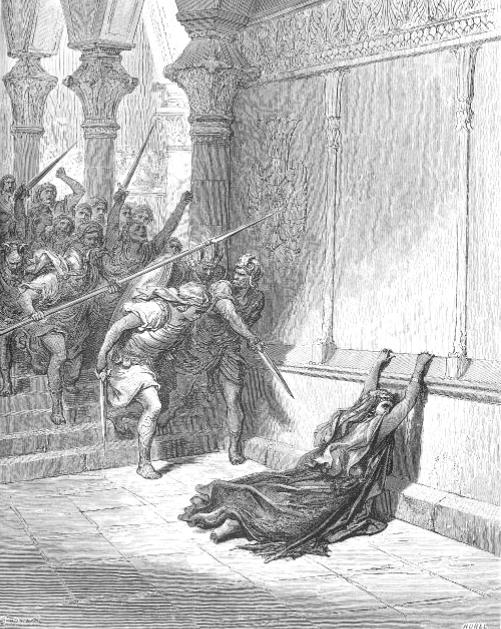
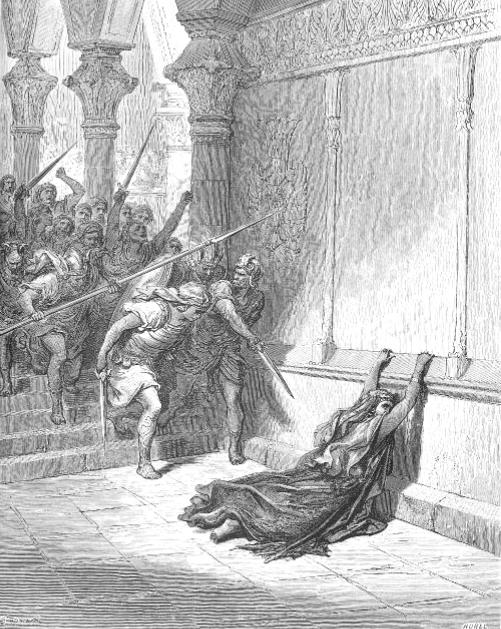
13 And when Athaliah heard the noise of the guard and of the people, she came to the people into the temple of the Lord. 14 And when she looked, behold, the king stood by a pillar, as the manner was, and the princes and the trumpeters by the king, and all the people of the land rejoiced, and blew with trumpets: and Athaliah rent her clothes, and cried, Treason, Treason. 15 But Jehoiada the priest commanded the captains of the hundreds, the officers of the host, and said unto them, Have her forth without the ranges: and him that followeth her kill with the sword. For the priest had said, Let her not be slain in the house of the Lord. 16 And they laid hands on her; and she went by the way by the which the horses came into the king’s house: and there was she slain.
17 And Jehoiada made a covenant between the Lord and the king and the people, that they should be the Lord’s people; between the king also and the people. 18 And all the people of the land went into the house of Baal, and brake it down; his altars and his images brake they in pieces thoroughly, and slew Mattan the priest of Baal before the altars. And the priest appointed officers over the house of the Lord. 19 And he took the rulers over hundreds, and the captains, and the guard, and all the people of the land; and they brought down the king from the house of the Lord, and came by the way of the gate of the guard to the king’s house. And he sat on the throne of the kings. 20 And all the people of the land rejoiced, and the city was in quiet: and they slew Athaliah with the sword beside the king’s house. 21 Seven years old was Jehoash when he began to reign.
The restoration and coronation of Jehoash (Joash) as king at the age of seven was a key inflection point for Judah just as Jehu’s purge was for the northern kingdom of Israel. Still, there are important differences between the two, namely that in Judah there was a recommitment to God’s covenant; in Israel, Jehu only tried to restore things back to the way they were under Jeroboam, which itself was an apostasy from the true worship of God. In Judah, the high priest Jehoiada facilitated a covenant of rededication between the military leaders and the LORD (2 Kings 11:4) and between the king, the people and the LORD (2 Kings 11:16). The latter, in particular, was accompanied by works of repentance. For Judah, Athaliah’s execution really did hold out the promise of a new beginning. As we will see in the next lesson and following, that new promise was not realized and Judah, in its own way, returned to the sins that had so nearly cost it its life.
What are some implications of this narrative?
One of the challenges in identifying political implications of these episodes is the fact that Israel was established as a theocratic state, and that brings with it a unique dynamic that does not easily translate into the 21st century American context. With that caveat, one implication is to be wary of anyone seeking unchecked power. Athaliah’s desire to wipe out the Davidic line is a prima facie example of this; such ambition can only end badly for God’s people. There is also the example of Jehosheba and Jehoiada, taking risks to ensure the preservation of David’s house in protecting Joash. As Christians, we may be called upon to take risks of our own and we need to prepare ourselves for that. We may also need to exercise patience in working things through. In this case, it was six years before Jehoiada had built up the necessary support within the society to make the restoration of Joash successful.
Let me turn now to some of the redemptive historical implications. First, the loss of Edom as a tributary state, Athaliah’s purge and subsequent tyranny, and the signs of judgment present in Joel’s prophecy served as a wake up call for Judah to return to covenantal faithfulness to the LORD. Moreover, these events and God’s prophetic word in the midst of them constituted an eschatological intrusion into Judah’s life, planting the seed that the nation needed to take seriously the prospect of covenantal judgment, but also prodding it realize that God’s covenantal plan was more ultimately significant than the day-to-day. From this point onward, the prophets would be developing the nation’s eschatological expectations so that it would be looking for a greater King and a greater Kingdom. These expectations would culminate of course in Christ, but they are also part of our expectations even today. We need to live in anticipation of God’s judgment, while appreciating that because of Christ the penalty on us has been removed. As with Judah, we need to be in repentance for our sins.
 Covenantide