Tag: PCA

  • Analysis of Overture 26 on Political Violence

    Analysis of Overture 26 on Political Violence

    It has been my intention for since returning from this year’s PCA General Assembly to do a more in-depth analysis of Overture 26, which was on the issue of political violence.  Even though GA voted it down, I think that given the levels of polarization in the United States at the moment this issue is one that we increasingly will face in the coming months and years.  For that reason alone, it merits more discussion and reflection.

    In the interest of full disclosure, this Overture was sent up by my presbytery, Potomac Presbytery, but I neither contributed to it as it was being drafted, nor voted for it in either Presbytery or in General Assembly.  The head of the Presbytery’s Mission to North America (MNA) committee invited thoughts and contributions from anyone in the Presbytery back in February when it was being drafted, and even after it had passed Presbytery in March he still invited feedback for ways that it could be improved, ways that could be proposed as amendments in the Overtures Committee at GA.  So, I will not complain that there were not opportunities for providing input; there most certainly were multiple opportunities.  I had two reasons, however, for not contributing.  First, in February and March, I was going through a period at work where I was consistently having to work very long days and what free time I had was consumed with other church-related duties, so I literally just did not have the bandwidth at the time to give this any considered thought.  Second, my intuitive feeling early on was that there were some more fundamental issues at stake I did not think it would be collegial or helpful to provide just minor wordsmithing that did not really get at the core of my concerns or to make vague suggestions for more fundamental revisions that would have been tantamount to “start over.”  So, I listened to the debate in Presbytery, I listened at GA, and with more time to think about things, here are my misgivings about the Overture.

    As I noted in my earlier post, my concerns were basically twofold: first, I felt we missed an opportunity to make a more definitive and necessary restatement of the Spirituality Doctrine given the circumstances we currently face regarding political violence, and second, there were issues in the way this was written which I think undercut its effectiveness.  Let me address each of these concerns in turn.

    First, the key challenge for this Overture was in defining what political violence is, succinctly, in the current political context.  Political violence can include such things as mob intimidation, assassinations, bombings, excessive or unauthorized use of force by government officials, riots, terrorism, and even outright war.  Overture 26 did not provide a definition of this up front regarding the focal point of the authors’ concerns, although they did try to capture some nuances in the “Whereas” clauses, mostly to differentiate the lawful use of force from unlawful uses.  This lack of specificity—which, in fairness, may have been driven by a legitimate desire to avoid the appearance of favoring one political side or the other—gave the Overture an overly abstract and disconnected quality.  This disconnect was reinforced by how limited the asks were in the resolves proper.  Basically, these came down to saying political violence is bad, we should follow Jesus, and pray for our country.  None of these asks should have been objectionable to either those on the Left or the Right, but they are sufficiently anodyne that it begs the question as to why we even need a formal resolution at all.  This lack of precision contributed to a certain surreal quality I observed in the debates in both Presbytery and GA, where much discussion time was spent addressing the question as to whether such an Overture, had it existed in 1776, would have inhibited the Founding Fathers of the United States from supporting independence from Great Britain—a debate over a hypothetical possibility for an event over 200 years ago.

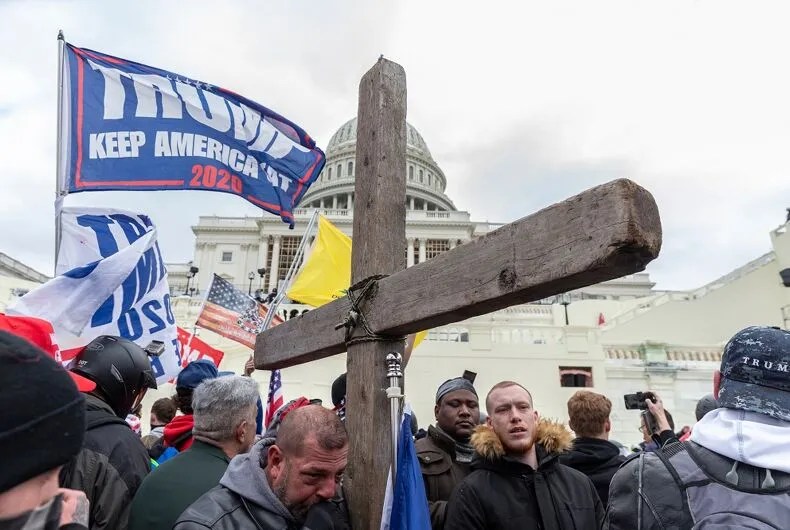
    The drafters of this Overture almost certainly were not focused on that.  Rather, the heart of their concerns probably was in “Whereas” clauses 11-14.  These almost certainly should have been bolstered further.  One does not have to look too hard to see concrete the dangers of our toxic polarization.  Within the past couple years–indeed, on some matters, even within the last few months–we have had assassination threats against our Supreme Court justices; riots and threats of riots; the practice of operatives of both the political Right and Left to disclose the personal information of Federal, state, and local officials so that angry mobs could surround their homes and intimidate them; fire bombings and hate vandalism of crisis pregnancy centers; and the list goes on.  There also has been efforts, mostly by those on the political Right, to appropriate symbols of Christianity into their advocacy of political violence (this is less an issue for the political Left, since the Left is generally less interested in Christianity altogether).  There has also been a trend among some churches to give platforms to political activists whose rhetoric calls for some kind of “resistance,” often armed.  From what I have seen and heard, this typically has been outside the PCA; I do not know to what extent PCA churches have done this, if at all.  And, as “Whereas” clause #13 acknowledges, there has been the practice for Christians on both the Right and the Left to ignore the violence of their own side while condemning that of the other.  In short, there is no shortage of real reasons to be concerned.

    In terms of how the Overture was written, my chief criticism beyond simply the lack of definition of political violence is the extensive use of “Whereas” clauses (there were 17 such clauses in the resolution).  To be sure, this Overture was written in a way that is consistent with the way overtures are typically formatted, but in this particular case, as a reader, I found myself getting lost in trying to follow the logic of the clauses.  Several of the clauses were trying to provide important, but ancillary distinctions, which obscured other clauses that were more pertinent justifications for why the overture was necessary.  It may have been more effective to have a fewer number of “whereas” clauses that were focused more directly on the premise for why the overture is necessary, reserving any important qualifications for a “rationale” statement to be appended to the overture after the “resolves.”  Such an approach would have allowed more flexibility for expressing nuance and have been clearer to the average reader.  The extensive number of clauses also created a higher expectation regarding the resolves, only to leave the reader feeling sold short given what was actually asked for.  A tighter, clearer, more focused Overture might have had a better chance of passage or at least raising the bar in terms of debate.

    So, what could have been done differently with the advantage of hindsight?  For this kind of an Overture, we needed to have a clearer focus on who the target audience should be. Here, the target audience would best be the denomination as a whole, both pastors and churches.  They can take specific actions, whereas making a statement to society writ large is only an exercise in virtue signaling; to be honest, society writ large could care less about what the PCA thinks about political violence.  With this audience in mind, a few concrete actions could be suggested.

    First, we need a tighter definition of what we mean by “political violence.”  This might well be hard to achieve, but without it, there will be endless debate about whether one thing or another actually constitutes political violence.  There has been a trend within the PCA over the years to refer such questions to denomination-wide Study Committees, but such an action would be expensive and there is real Study Committee fatigue within the denomination.  That said, I also think it might be more effective for Sessions and Presbyteries to give the question serious thought based on the circumstances they find themselves in locally.  Such definitions are likely to be more concrete and practical as opposed to abstract and academic.

    Second, we need to have a re-articulation of the Spirituality Doctrine for our pastors and congregants.  Most of our congregants are not familiar with this part of our theological heritage, and if they have heard of it at all they may associate it with historical misuses (e.g., how it was used to defend slavery or oppose the Civil Rights movement) than with the proper use of safeguarding the integrity of the church amidst a highly politicized environment.  (I provided my own articulation in a previous post). Beyond such an articulation within an Overture, it probably would be worth identifying, providing, and as needed, producing resources to our congregations to explain what the Spirituality Doctrine is, what its purpose is, and the principles behind it.  Education will help bring home why this is important for the Church.

    Lastly, following from this, we need to ask, what concrete things would help to safeguard the integrity of the church in our current situation?  One thing would be to encourage churches to refrain from allowing political organizations or activists who have called for or have endorsed political violence from using the church’s facilities or online platforms.  As has been repeatedly demonstrated with other issues, to give a platform to such organizations or speakers advocating or endorsing political violence is likely to be seen as tacitly or explicitly concurring with those views.  Taking this step would distance the PCA from the kinds of problems facing parts of evangelicalism right now.  Another thing that could be done is for church leaders to speak out against the appropriation of Christian symbols in political contexts where political violence is being advocated or practiced, regardless of who is doing the appropriating.  Finally, it may be worth encouraging Sessions and Presbyteries to articulate their own guidelines and principles on how the Church will engage on political issues and what the limits of such engagement might be.  That will help set expectations both of congregants and even community members.

    In closing, let me just say this: my criticisms here are not intended to be criticisms of my brothers in Potomac Presbytery who drafted and proposed Overture 26.  This is a difficult issue, but an important one, and one that I think we will continue to face for the foreseeable future.  I wish that were not the case.  Nor is my intention is not to puff myself up by saying I could have done things better.  As I noted at the outset of this post, there were opportunities to provide input but I was not able to avail myself of them at the time.  Because this is an issue that we are likely to face in the near term, my intention here is to provide what I hope is constructive feedback and advance mutual dialogue insofar as we revisit these issues in the future.

  • The 49th PCA General Assembly: A Readout

    The 49th PCA General Assembly: A Readout

    The Presbyterian Church in America (PCA) just completed its 49th General Assembly (GA) in Birmingham, Alabama, and as I did last year, I offer up my readout and analysis of what transpired for those who are interested.  I recognize that most people do not follow the ins and outs of presbytery or GA too closely and in my experience I have found that when I talk with my fellow congregants about these things the foremost questions I hear are “Are we staying orthodox?” and “Are we likely to split?”  So, in anticipation of those questions, I would say that coming out of this year’s General Assembly I believe we are still orthodox, and I do not think that we are likely to split at this time.  We are grappling with some serious issues and while working things through presbyterian courts is a slow, arduous process, my sense is that this GA was productive toward conservative ends.

    This image has an empty alt attribute; its file name is westin-birmingham-al.jpg

    The Sexuality Issue—The Main Issue

    As has been the case for the last few years, the issue of Same Sex Attraction (SSA) is probably the most serious one facing the PCA.  Will the PCA tolerate Side B Gay Christianity, which historically has been inevitably the door to accepting Side A Gay Christianity?  To define terms, “Side A” and “Side B” are two sides of a debate among Christians who identify as same sex attracted.  Both sides accept the notion of sexual orientation as being a largely unchangeable aspect of personal identity but differ in the implications they draw from this. 

    • Side A holds that same-sex attraction is innate, immutable, not sinful, and indeed, is how God made them. To hold this view, one has to dismiss or reject the fact that every single reference in Scripture to homosexuality or same-sex attraction is characterized in morally negative terms.  Because this position considers same-sex attraction as innate, immutable, and not sinful, there is therefore no problem to identifying oneself as a “Gay Christian;” it is morally neutral.  No one in the PCA holds this view.
    • Side B equivocates as to whether same-sex attraction is innate but accepts the idea that it is largely immutable and cannot be changed.  It equivocates as to whether it is sinful, with some saying it is and others saying that it is not sinful but “of sin” (i.e., it is something that is the result of the fall, like disease, but not a moral category).  It accepts God’s plan for sex is heterosexual monogamous marriage, and its adherents advocate for celibacy, believing that their orientation cannot change.
    • The Side B position is logically inconsistent and for that very reason is likely to shade over into Side A in time.  By accepting the idea that same-sex attraction is either sinful or “of sin” as well as being immutable, one implicitly says that God is the author of sin, that Christ’s work on the cross does not make a difference in atoning for such sin, and that the inward work of the Holy Spirit cannot bring about any sanctification (i.e., any renewal of our hearts or relief from sinful urges) in this area of a believer’s life.  The emphasis on celibacy apart from reliance on the Holy Spirit also leads to a kind of works righteousness.  So, although Side B does not reject biblical orthodoxy explicitly in the way that Side A does, it does undermine biblical orthodoxy albeit subtly.  At its root, this is a Gospel issue.
    • The biblically orthodox position, by contrast, is that same-sex attraction is a sin, it is not innate in a person and it is not immutable.  In other words, God did not make people same-sex attracted, and they can change through faith in Christ and the inward work of the Holy Spirit in mortifying sins.  Therefore, one should not claim as one’s identity to be “Same-Sex Attracted Christian” or a “Gay Christian.”  Our sin is not part of our identity; our identity is wholly in Christ and to claim otherwise is to denigrate our union with Christ.

    This Year’s Efforts to Address the Sexuality Issue

    Last year’s GA passed two resolutions (Overtures 2021-23 and 2021-37) that addressed the homosexuality issue as it related to ministerial qualifications and examination.  Overture 23 would have changed the PCA’s Book of Church Order (BCO) to add language that would disqualify from ministry men who (1) identified themselves by their sin as homosexual or SSA, (2) denied the sinfulness of fallen desires and the reality of progressive sanctification, and (3) failed to pursue Spirit-empowered victory over sin and temptation.  Overture 37 would have required presbyteries to examine candidates for ministerial or ruling office on these areas.  Because they involved changes to the BCO, which has constitutional status in the PCA, these resolutions had to be voted on by two-thirds of all the presbyteries.  They narrowly failed to pass the two-thirds bar.  This year, Overtures 29 and 31 aim at covering the same ground, but to improve their chances of passage in the presbyteries, they tried to address criticisms that last year’s overtures were too focused on sexuality issues; both of the current Overtures have been reworded to drop explicit reference to any particular sin.

    Overture 29 would add a new paragraph, 16-4, to the BCO’s chapter on “Church Orders—The Doctrine of Vocation,” which as amended reads

    Officers in the Presbyterian Church in American must be above reproach in their walk and Christlike in their character.  While officer bearers will see spiritual perfection only in glory, they will continue in this life to confess and to mortify remaining sins in light of God’s work of progressive sanctification.  Therefore, to be qualified for office, they must affirm the sinfulness of fallen desires, the reality and hope of progressive sanctification, and be committed to the pursuit of Spirit-empowered victory over their sinful temptations, inclinations, and actions.

    Some criticism was lodged against Overture 23 last year—the predecessor resolution to this year’s Overture 29—that this should be opposed because the proposed addition was not in the right place in the BCO, but I do not think that criticism is valid. If inward calling, good conscience, the manifest approbation of God’s people, the concurrence of a lawful court of the church (16-1), and appropriate giftedness (16-2) are necessary qualifications for ministry, then so too is one’s character. Indeed, godliness is listed in this chapter as well (16-3). Therefore, the proposed new paragraph (16-4) follows naturally.

    Overture 31 parallels last year’s Overture 37 in requiring that presbyteries should examine candidates for Gospel ministry (i.e., Teaching Elders) and sessions should examine candidates for Ruling Elders and Deacons for their character, particularly with regard to potentially notorious concerns.  Last year’s Overture 37 spelled out a range of notorious concerns, whereas this year’s Overture 31 does not.  Like with last year’s Overture 37, the examination requirement uses the same language for ministers, elders, and deacons, and places it as new sub-paragraphs in BCO 21-4 and 24-1.

    In the examination of the candidate’s personal character, the presbytery shall give specific attention to potential notorious concerns.  Careful attention must be given to his practical struggle against sins actions, as well as to persistent sinful desires.  The candidate must give clear testimony of reliance upon his union with Christ and the benefits thereof by the Holy Spirit, depending on this work of grace to make progress over sin (Psalm 103:2-5, Romans 8:29) and to bear fruit (Psalm 1:3, Gal. 5:22-23).  While imperfection will remain, when confessing sins and sinful temptations publicly, the candidate must exercise great care not to diminish the seriousness of those sins in the eyes of the congregation, as though they were matters of little consequence, but rather should testify to the work of the Holy Spirit in his progress in holiness (1 Cor. 6:9-11).

    Most all presbyteries, at least to some degree, examine the candidate’s character, but this is not formally enshrined in the BCO in the way that requirements for doctrinal fidelity are.  This resolution would rectify that omission and provide a baseline expectation across presbyteries as to key areas to focus in on, while still allowing latitude into how to conduct such inquiries.  Examining the character of men for ministry and church office is necessary, and experience has shown that the PCA is more likely to bring discipline against men for their personal conduct than for their teaching.  While such examination may disqualify some men from office, I think that for others who are still qualified for office it may well have the positive effect of identifying areas of struggle so that encouragement, support, accountability can be brought to bear early on, and problems are not allowed to fester in silence.

    Perhaps one of the biggest surprises of this year’s GA regarded Overture 15.  Overture 15, as amended, would add a new paragraph (7-4) to the BCO’s chapter, “Church Officers—General Classifications” to state that

    Men who describe themselves as homosexual, even those who describe themselves as homosexual and claim to practice celibacy by refraining from homosexual conduct, are disqualified from holding office in the Presbyterian Church in America.

    The Overture Committee, which reviews, debates, amends, and makes recommendations on all the overtures for the consideration of the General Assembly, originally recommended that this overture be answered through the acceptance of Overture 29.  A minority on the Overtures Committee made the recommendation that the Overture be approved outright, as amended.  This ended up carrying the day on the floor of General Assembly, especially after PCA elder statesman and respected theologian O. Palmer Robertson made an impassioned speech saying that the PCA needed to make a clear, strong statement opposing homosexuality.  The Overture passed by 54.41% to 45.59%.

    Where We Are At Now on This Issue

    It would be useful at this point to take a step back for a moment to assess how this fits in to what the denomination has done on the sexuality issue over the past few years.  In 2018, the GA elevated Chapter 59 of the BCO on “The Solemnization of Marriage” to have full constitutional authority and stipulated that PCA ministers can only perform marriages between a man and woman.  This was to give clear guidance to PCA military chaplains and others, given the legalization of same sex marriage following the US Supreme Court’s 2015 Obergefell decision.  In 2019, the GA commended the Nashville Statement, drafted by the evangelical Council on Biblical Manhood and Womanhood, to be a biblically faithful statement on sexuality; this included a section denying that homosexuality and transgenderism are consistent with God’s purposes.  The 2019 GA also authorized the creation of a study committee on human sexuality which produced a thoroughly researched, carefully nuanced, and well-received report in 2021 which has become the PCA’s definitive statement on the topic.  The Overtures last year and this year on character qualifications and examinations, culminating with Overture 15, are aimed at applying these standards to ministers and officer candidates.  So, on the official record, the PCA has come out strongly in favor of the orthodox formulation of biblical sexuality morality, and that should be encouraging.  At the same time, there is an open question as to how willing the PCA actually is to enforce on its ministers in practice what it is willing to assert in principle.  This question centers on the case of TE Greg Johnson, the pastor of Memorial Presbyterian Church in St. Louis, which hosted the 2018 Revoice conference advocating Side B Gay Christianity.

    Space and complexity preclude a review of the multiple cases surrounding Greg Johnson.  Johnson not only had his church host the Revoice conference in 2018, but he has endorsed subsequent Revoice conferences, has come out as SSA, and his personal statements about the PCA and sexuality both online and in a book published in 2021 have only fueled the controversy.  In 2020 his presbytery, Missouri Presbytery, investigated him and his church for sponsoring the 2018 Revoice conference, but, while finding errors of judgment, chose not to indict him for as being incompatible with the PCA’s standards.  Given his subsequent statements, other presbyteries have petitioned for the Standing Judicial Commission (SJC, i.e., the PCA’s Supreme Court) assume original jurisdiction over him (Overtures 2021-2 and 2021-25 last year and 36 and 37 this year).  Exercising the procedures for exerting original jurisdiction has highlighted issues with those provisions in the BCO, thereby prompting calls for revisions (Overtures 8 and 9).  In addition, the SJC’s handling of the Johnson-related cases that has come to it has raised questions as well.  In hearing one case on appeal, the SJC took the unusual step of re-opening the case record (originally deemed complete), deleting several hundred pages of material deemed extraneous, and then entering new information into the record regarding Johnson’s responses to 25 questions put to him by the SJC.  That prompted questions at this year’s GA to the Committee on Constitutional Business—the body that examines the minutes of the SJC–on why that decision was made.  Frustration with SJC was behind Overture 14, which aimed to greatly expand the SJC’s composition but ultimately failed.  Controversy around Johnson no doubt contributed to the desire of many commissioners at this year’s GA to pass such a definitive statement against homosexuality they did in Overture 15.  There are no signs this controversy will abate anytime soon.

    Looking forward, while Overture 15 does have the benefit of clarity, I expect it will run into headwinds in the presbyteries.  One thing I have observed about the debate within the PCA on this issue is that the non-conservative side has tended to eschew clarity and definitiveness in favor of generalities and nuance.  To be sure, I want to characterize their position fairly, but I find it hard to do so because it is difficult for me to discern what that position exactly is.  In the debates over last year’s Overtures 23 and 37, no one that I ever saw or am aware of made a case for Side B Gay Christianity; the objections raised were either technical ones about the appropriateness of the changes to the BCO or concerns about how definitive statements might be perceived within the denomination or by the surrounding culture.  Either way, it seems to me that these are more surface objections, incongruous with the insistence with which they were being put forth.  That suggests to me that the root concerns were still unstated.

    Similarly, this year three overtures (33, 34, and 35) were proposed by the non-conservative side addressing the sexuality issue and matter of character qualifications.  All three were fairly similar in approach, basically requiring only that candidates study last year’s Ad Interim Report on Human Sexuality and biblical teaching on the subject, that everyone pray for wisdom in navigating cultural contexts wisely, refrain from using certain terms as litmus tests and be temperate in public and private discourse on the matter.  All these recommendations are anodyne and do not address how to deal with the issue if a minister or candidate were to embrace Side B Gay Christianity explicitly.   GA did not debate these Overtures because the Overtures Committee sidestepped the issue by addressing them with reference to Overture 29.  So, a key thing to watch for in the coming months is whether the non-conservative side will be satisfied with the removal of explicit references to sexuality in Overtures 29 and 31 or whether it will continue raise process-oriented and/or perception objections.  If they do continue to make such objections, then I think that will be indicative of more fundamental concerns that heretofore have not been clearly articulated, possibly to include more latent sympathy for Side B Gay Christianity than has been stated openly.

    Other Issues

    Most of rest of the business of this year’s GA involved proposed changes to judicial procedures or administrative issues that probably will not be of interest to most congregants in the pews.  While these are in one sense “boring,” one thing that I have come to appreciate more and more about the presbyterian form of church government and about the PCA in particular is the existence of and commitment to due process.  The church is made up of courts and while they are not perfect, they are an important check against the arbitrary exercise of ecclesiastical power.  This is not to be taken for granted.  Christianity Today’s excellent podcast series last year on the Rise and Fall of Mars Hill highlights the kind of problems that can arise when there are no checks on pastoral leadership.

    In terms of other issues that came up, a few are worth noting.

    First, the Study (Ad Interim) Committee Report on Domestic Abuse and Sexual Assault officially delivered its report to this year’s GA.  The report is lengthy (over 200 pages) and so I have not had time to read through it all yet.  A cursory review, however, suggests that it has a lot of good pastoral advice on how to handle cases of domestic assault, sexual and leadership abuse, and probably will be good reference in the years to come.

    Second, the GA passed Overture 13, which petitioned the Federal Government to end abortion, and coincidentally on the following day the US Supreme Court officially released its decision in Dobbs v. Jackson Women’s Health Organization which overturned Roe v. Wade.  The PCA last made a statement on abortion in 1986 and providentially the PCA is again on the record in favor of life as the U.S. begins a new phase politically on this issue.  The GA also considered, but rejected, an overture condemning political violence (Overture 26).  I had opposed this overture for reasons that I want to discuss at greater length in another blog post, but the timeliness of the issue was not lost on anyone given that pro-choice activists were promising a “Night of Rage” to protest the Supreme Court’s decision in Dobbs.  Those of us flying back to the Washington D.C. area were wondering what we would face upon our return.

    Lastly, this year’s GA voted to withdraw from the National Association of Evangelicals (NAE).  Looking back over the events of GA, I am coming to think this may be more symbolically significant about where the PCA is at than the actual substance of the matter.

    The NAE was formed in 1942 as a lobbying organization in Washington D.C. for a range of evangelical denominations.  The PCA joined it in 1986, but in recent years the NAE has moved more toward the Left in its positions, including on issues of sexual orientation, gender identity, environmentalism  and social justice.  Some of these positions actually contradict the PCA’s confessional standards.  The PCA’s Interchurch Relations Committee (IRC) argued that participation in the NAE allows the PCA to have influence within the organization and with the other denominations who are a part of the NAE, but IRC appeared hard-pressed to describe any benefits beyond that or point to examples of where the denomination has actually exerted influence in the NAE.  The PCA is large enough at this point that it does not need the NAE to represent it in Washington, as it can speak for itself and has on numerous occasions.  Leaving the NAE would save the PCA money in membership fees, and individual churches who still wanted to be a part of the organization could still do so at individualized rates. 

    All of that said, overtures have been presented in the past to withdraw from NAE but were consistently voted down, so this year’s decision does mark a real turning point.  After the vote, last GA’s Moderator, L. Roy Taylor, lodged a formal protest against the decision to withdraw—his first ever in the PCA—which drew several signatories.  Taylor had been Chairman of the NAE’s board for 14 years, so this issue was personal to him.  I support the decision to leave the NAE and disagree with Taylor, but I respect Taylor as an honorable man who has long and faithfully served the PCA.  Besides his personal connections to the NAE, he represents that generation of PCA elders who aspired for the PCA to have an influential role in American society.  I think the promise of influence has been largely unrealized and, indeed, is probably unrealizable given that we are now living in a world that is demonstrably hostile to Christianity.  Thus, I do wonder if the vote on the NAE may reflect a generational transition as well, from the PCA’s earlier aspirations to be a more broadly evangelical denomination to one that is more self-consciously and faithfully Reformed.  That I think is the challenge before this up-and-coming generation of PCA elders, of which I include myself.

  • The 48th PCA General Assembly: A New Commissioner’s Readout

    The 48th PCA General Assembly: A New Commissioner’s Readout

    Part of the membership vows that we take—at least in my denomination, the Presbyterian Church in America (PCA)—are to “support the Church in its worship and work” (Vow #4) and to “study its purity and peace” (Vow #5) and for that reason it is important to know what is going on in the denomination.  Indeed, we not only have a responsibility to do this, but a privilege of being able to have an influence on where the denomination goes; it is not up to the whim of a pope, a bishop, or a pastor.  A focal point for what is going on in the denomination is what happens at General Assembly (GA), which this year was held in St. Louis, Missouri from June 28th to July 2nd. I was able to attend this year as a newly minted Ruling Elder, and the readout that follows is based on presentations I gave to my church last month, which I am happy share more broadly with those who may be interested to foster greater awareness.

    Even before the opening gavel, this was shaping up to be an important GA, since the PCA was not able to meet last year because of COVID and so had to make up two years’ worth of business in one year.  More significantly, however, for the past three years the PCA has been roiled by the issue of how to respond to same-sex attraction, stemming from the Revoice conference held in 2018 at Memorial Presbyterian Church, a PCA church in St. Louis.  More about that in a moment but suffice it to say that the Revoice issue raised the question for many as to whether the PCA would be faithful to historic biblical teaching on human sexuality.  This concern is probably what drove a large number of Teaching Elders (TEs – pastors) and Ruling Elder (REs) to attend: there were over 2,100 commissioners in attendance, which was an all-time high for the PCA and significantly more than the previous high of about 1,600 in 2019.

    What is General Assembly?

    As a Presbyterian Church, the PCA is connectional and has a graduated set of church courts.  All the Teaching and Ruling Elders of a local church comprise the “Session;” those of all the churches in a particular geographic region make up a Presbytery.  Each church in the PCA nationwide can send a Teaching Elder and at least two Ruling Elders to the General Assembly.  The General Assembly is the highest governing body in PCA.  The actual Assembly itself is part trade convention, part business meeting.  This year it was held in the America’s Center Convention Complex (this was the same complex, but a different area from where some US Olympic qualifying trials had been held the previous week).  GA provides a huge opportunity to connect or reconnect with people from across the denomination.  There are several alumni events associated with the major seminaries, such as RTS, Westminster or Greenville, and I personally got to meet up with people I knew from other churches, as well as attend the RTS alumni luncheon and the Westminster alumni dinner.  GA also had a large exhibition area where most major Reformed booksellers, a number of missions bodies, and several ministry support organizations had booths, along with some of the major standing committees within the PCA.  There were also a number of seminars held in the breakout rooms at the complex, geared mostly towards pastors.

    In terms of business, the major committees met early in the week, before GA was officially convened on Tuesday evening.  Chief among these committees was the Overtures Committee.  This is the heart of the deliberative aspect of GA.  Each presbytery can nominate two commissioners (a RE and a TE) to the Overtures Committee, which evaluated, amended, or made recommendations on the 47 overtures (petitions) sent to GA from the presbyteries.  Their work continued through the week.  GA was opened with a worship service on Tuesday evening, with the outgoing moderate, Howie Donahue, giving a good sermon/meditation on the topic of Heaven.  This was followed by various administrative actions basically aimed at how GA would work, certain overviews on the state of the PCA, and so forth.  Beginning late on Tuesday evening and continuing until Thursday were presentations and recommended motions from different committees and organizations in the PCA.  Worship services (with sermons) were held Wednesday and Thursday evenings as well.  The musical styles varied from service to service.  While a handful overtures were addressed during the respective committee reports to the full Assembly, most were reserved for the Overtures Committee report which effectively did not begin until after the worship service on Thursday evening.  In my opinion, this was a flaw in the scheduling, as it crunched the time available to really discuss the issues that were of most concern to the attendees.  Nevertheless, we got through the entire docket and, bleary-eyed, wrapped up deliberations by 1:00 am on Friday morning.

    The “Revoice” Controversy and Same-Sex Attraction

    Much of what GA did on the issue of same-sex attraction (SSA) can be a little confusing if looked at outside of the context of the last few years, so before speaking this GA’s actions immediately, let me first provide some theological and historical context to help make thing more understandable.

    Theologically, the biblically orthodox and historical position is that same-sex attraction is a sin, it is not innate in a person, and it is not immutable.  In other words, people are not born same-sex attracted and they can change through faith in Christ and through the inward work of the Holy Spirit in mortifying one’s sins.  Because of this, one should not claim as one’s identity to be “Same-Sex Attracted Christian” or a “Gay Christian.”  Our sin is not part of our identity; our identity is wholly in Christ and to claim otherwise is to denigrate our union with Christ.

    Over the last couple of decades, some Christians with same-sex attraction have not accepted the biblically orthodox position and there has been a dialogue between them characterized by what they have termed “Side A” and “Side B” positions.

    • Side A holds that same-sex attraction is innate, immutable, and not sinful; indeed, adherents to Side A would claim that is how God made them. To hold this view, however, one has to downplay or reject the fact that every single reference in Scripture to homosexuality or same-sex attraction is characterized in morally negative terms.  Because this position considers same-sex attraction as innate, immutable, and not sinful, there is therefore no problem to identifying oneself as a “Gay Christian;” it is morally neutral in the same way as calling oneself a Black Christian or an Asian Christian.
    • Side B is a more complex.  It equivocates as to whether same-sex attraction is innate but accepts the idea that it is largely immutable and cannot be changed.  It equivocates as to whether it is sinful, with some adherents saying it is and others saying it is not sinful but rather, it is “of sin” (i.e., it is something that is the result of the fall, like disease, but not necessarily a moral category).  It accepts a Roman Catholic notion of concupiscence which holds that having wrong desires is not sinful, only acting upon those desires is.  This contradicts the Lord’s own teaching in Matt. 6:27-28.  It accepts the notion God’s plan for sex is heterosexual monogamous marriage, and its adherents advocate for celibacy and “spiritual friendships” among same sex attracted persons, believing that their orientation cannot or is highly unlikely to ever change.  Adherents of the Side B view believe that whether or not one self-identifies as a “Gay Christian” is a purely pragmatic personal decision.

    The Side A position is logically consistent, but a clear rejection of Scriptural orthodoxy.  Nobody at this point in the PCA is advocating for a Side A position.  That said, the 2018 Revoice conference and successive Revoice conferences since then have been actively promoting Side B.  In my view, the Side B position is logically inconsistent and for that very reason is likely to shade over into Side A in time.

    • By accepting the idea that same-sex attraction is either sinful or “of sin” as well as being immutable, one implicitly says God is the author of sin, that Christ’s work on the cross does not make a difference in atoning for such sin, and that the inward work of the Holy Spirit cannot bring about any sanctification in this area of a believer’s life.  So, although it does not reject biblical orthodoxy explicitly in the way that Side A does, it undermines biblical orthodoxy to a significant degree.
    • By maintaining an emphasis on celibacy, Side B is in effect advocating a works righteousness; one must maintain celibacy on one’s own strength because the Holy Spirit cannot or will not bring about moral change within a person.  Moreover, existentially, it sets up a logical contradiction in a person’s life, to whit: “If God made me this way, then why did He command celibacy?”  From that question, one has to simply accept the command without question or else tend toward either denying the goodness of God or moving toward Side A.  In practice, individuals and churches that have embraced the Side B position almost invariably have moved to accept the Side A position within a few years, if they have not abandoned the faith outright.

    The debate between Side A and Side B broke into the PCA in 2018 because of the Revoice conference that was held at Memorial Presbyterian Church in St. Louis.  Revoice was a response by Side B advocates against the Nashville Statement, which was produced by the Coalition for Biblical Manhood and Womanhood in 2017.  Article 7 of the Nashville Statement says:

    WE AFFIRM that self-conception as male or female should be defined by God’s holy purposes in creation and redemption as revealed in Scripture. WE DENY that adopting a homosexual or transgender self-conception is consistent with God’s holy purposes in creation and redemption.

    Revoice’s mission statement, in contrast, purports

    To support and encourage gay, lesbian, bisexual, and other same-sex attracted Christians—as well as those who love them—so that all in the Church might be empowered to live in gospel unity while observing the historic Christian doctrine of marriage and sexuality.

    Memorial Presbyterian Church allowed Revoice to use its facility for the 2018 conference, although it did not come out and formally endorse the conference.  Nevertheless, the Senior Pastor of Memorial Presbyterian Church, Greg Johnson, expressed support for that and subsequent Revoice conferences, and in May 2019 he published an article in Christianity Today stating that he is same sex attracted.  As an initial response to Revoice, the 2019 General Assembly affirmed the Nashville Statement as biblically faithful and commissioned a study committee to articulate the PCA’s own theological and pastoral approach to issues of human sexuality.  Concerns voiced across the denomination about whether the Revoice conference portended an acceptance or endorsement within the PCA of the Side B position prompted Missouri Presbytery to do its own investigation of Johnson and of Memorial Presbyterian Church handling of the matter; it published its findings in December 2019 (updated subsequently in January 2020).

    • Missouri Presbytery found that while Revoice speakers used terminology that was often imprecise and could lead to being misconstrued, as a whole there was not serious theological error.  It also found that while Johnson and Memorial Presbyterian Church could have done more to engage Revoice’s leadership and to qualify the teachings more than they had done, but they were not wrong in hosting Revoice in principle.
    • These findings led three presbyteries to petition the General Assembly to assume original jurisdiction over both Johnson and Missouri Presbytery, charging that Johnson has allowed the teaching of serious error and that Missouri Presbytery did not handle its investigation appropriately.  As a result of these overtures, under the PCA’s Book of Church Order (BCO), the matter has been turned over to the Standing Judicial Council (SJC), essentially the supreme court of the PCA.  The SJC is still investigating the case.

    This background puts into context the overtures that came to this General Assembly.  Most significantly on this issue was Overture 38, which commend the Human Sexuality Report as “biblically faithful.”  This is the report that that the 2019 GA commissioned and has been publicly available for the past year.  This report goes a long way towards refuting the Side B position and affirming the biblically orthodox position, and its endorsement by the General Assembly is a key bulwark in the PCA standing faithfully to Christ on this issue.  The report contains twelve theological affirmations, each paralleled by pastoral guidance.  During GA, the report was officially presented through a joint video by Tim Keller and Kevin DeYoung, who were the lead authors of the report and who are respected by different constituencies within the PCA.  The video was little tedious—they read the preamble and each article, followed by discussion on what the article means—but it was effective in showing that there was not daylight between them on the historic, biblical position on sexuality.  The GA passed the Overture overwhelmingly.

    A second major overture was Overture 23 was a motion to amend the BCO chapter 16 (“Church Orders – The Doctrine of Vocation”) by adding the following new paragraph:

    16-4 Officers in the Presbyterian Church in America must be above reproach in their walk and Christlike in their character. Those who profess an identity (such as, but not limited to, “gay Christian,” “same sex attracted Christian,” “homosexual Christian,” or like terms) that undermines or contradicts their identity as new creations in Christ, either by denying the sinfulness of fallen desires (such as, but not limited to, same sex attraction), or by denying the reality and hope of progressive sanctification, or by failing to pursue Spirit-empowered victory over their sinful temptations, inclinations, and actions are not qualified for ordained office.

    This passed by a vote of 1438 to 417.  This is aimed at office-bearers in the PCA (i.e., Teaching and Ruling Elders and deacons), from whom we expect a higher character.  The key things to note are: (1) one cannot accept an identity as a same-sex attracted man; (2) one cannot deny that same-sex attractions are sin; and (3) one cannot deny the notion that one can be sanctified to make progress in overcoming such sins and in resisting temptations.  This cuts to the heart of the Side B position.

    The third key overture was Overture 37, which was a motion to amend BCO 21-4 and 24-1 by adding a paragraph “clarifying the moral requirements for church office.”  The BCO chapters referenced here regard the ordination and installation of minister (BCO 21) and elders and deacons (BCO 24).  The difference between Overtures 37 and 23 is that the latter is more specifically focused on examinations that must be done of ministerial and officer candidates.  The added language is as follows:

    In the examination of the candidate’s personal character, the presbytery shall give specific attention to potentially notorious concerns, such as but not limited to relational sins, sexual immorality (including homosexuality, child sexual abuse, fornication, and pornography), addictions, abusive behavior, racism, and financial mismanagement. Careful attention must be given to his practical struggle against sinful actions, as well as to persistent sinful desires. The candidate must give clear testimony of reliance upon his union with Christ and the benefits thereof by the Holy Spirit, depending on this work of grace to make progress over sin (Psalm 103:2-5, Romans 8:29) and to bear fruit (Psalm 1:3; Gal. 5:22-23). While imperfection will remain, he must not be known by reputation or self-profession according to his remaining sinfulness, but rather by the work of the Holy Spirit in Christ Jesus (1 Cor. 6:9-11). In order to maintain discretion and protect the honor of the pastoral office, Presbyteries are encouraged to appoint a committee to conduct detailed examinations of these matters and to give prayerful support to candidates.

    Overture 37 was passed by the Assembly by a vote of 1130 to 692.  What Overture 23 phrased negatively, Overture 37 phrased positively and in a manner broader than simply about sexuality.  Nevertheless, this was probably the most debated resolution in General Assembly.  Both resolutions, because they involve changes to the BCO, are now remanded to the presbyteries for approval.  Changes to the BCO are essentially changes to the constitution of the PCA.  Therefore, there needs to be a 2/3 approval of all the presbyteries (about 58 or 59 presbyteries) and then a simple majority vote of approval at the next General Assembly to be formally adopted. 

    This will probably be the most contentious issue in the coming year as these overtures go to the presbyteries for ratification.  I have heard arguments against them, both on the floor of GA and subsequently, and to be honest, I find them unpersuasive.  Some have argued, for example, that the language in Overtures 23 and 37 will deter men from acknowledging struggles with same sex attraction and cause young people to leave the church because they will see the PCA as “homophobic.”  That is certainly possible, but I think the concerns are exaggerated.  If the very fact of articulating biblical standards causes people to leave the church, then there is not much that can be done about that, since keeping silent about sin is too high a price to pay for keeping anyone in the church.  Moreover, the purpose of examining the character of officer candidates is precisely to get them to frankly acknowledge such notorious sins, insofar as they may exist, and to be able to give a credible testimony regarding how Christ and the indwelling of the Holy Spirit has made a difference in their lives.  Indeed, a credible testimony about the work of Christ in overcoming such sins would strengthen the candidate’s ability to minister to others.  I fail to see how this will be a deterrent.

    Some have argued that the examination requirements in Overture 37 are too vague and will impose an unnecessary burden on presbytery credentialing committees to sort out the criteria by which men are to be examined in terms of their character.  Certainly, credential committees will need to address specifics on a case-by-case basis, but the general principles articulated here seem to be exceedingly clear.  Lastly, some have asserted that approving Overtures 23 and 37 will actually ensconce Side B views within the PCA by not condemning them more explicitly.  This seems to me a completely bizarre argument, and I would not have mentioned it had it not been the fact that I have seen people actually put it forth.  I think that the Overtures as amended strike a reasonable balance between putting forth a clear standard while at the same time avoiding perfectionist demands.

    Like the majority of commissioners, I supported these overtures.  In my judgment, with these three overtures, the PCA has laid out a clear, biblically orthodox position on human sexuality, has addressed the pastoral issues involved in ministering to the sexually broken, and has laid down a standard of conduct that it expects of its officers who may have been struggling themselves with such issues.  Overtures 23 and 37 also highlight that this is not simply a matter of biblical ethics but is fundamentally a Gospel issue.  If an officer candidate characterizes his identity by a sinful orientation, denies such desires to be sinful, denies that the work of Christ atones for such sins and requires repenting of them, and/or denies that the Holy Spirit can progressively sanctify one of such sins, then he really is asserting the deficiency of the Gospel.  It best not to ordain such a man to Gospel ministry.

    Other Controversial Issues

    Although the sexuality issues were the most contentious at this past GA, they were not the only issues that were controversial.  There were proposals for forming new study committees on biblical ethics in digital media, white supremacy, and critical race theory, all of which were voted down.  The Sexuality Study Committee report is a good example of what a study committee should do—examine Scripture, our confessional documents, and the issue in question to provide pastoral guidance to churches on how to address certain matter where there is a considerable debate within the denomination on what to do.  They are not intended to be position papers on trendy issues.  The PCA has had a number of study committees in the past several years and there is considerable fatigue toward study committees right now within the denomination.  Moreover, study committees are expensive, running about $15,000 per year for each year they operate.  A separate overture (17) to limit how many study committees could be funded in a given year passed with controversy.

    The only other issue that engendered some debate were a bundle of three overtures (45, 46, and 48) responding to the attacks in Atlanta earlier this year against Asian American and Pacific Islanders (AAPI).  One of the Overtures went beyond standing in support of the AAPI community and condemning the violence of the shootings in Atlanta to imply that the PCA needed to examine itself for ways in which it might have contributed to attitudes of violence against the AAPI community.  This almost certainly would have been controversial.  The Overtures Committee recommended addressing the first two by reference to a statement the OC made toward the third:

    The Report of the Ad Interim Committee on Racial and Ethic Reconciliation to the 46th General Assembly speaks clearly to both the reality of the Imago Dei in all people and to the sin of racism, particularly when it affirms: a) the vision of the redeemed in Revelation 7:9-11, where are all nations and ethnicities are fulfilled in Christ; b) the image of God reflected in all people; and (c) the image of Christ reflected in His body.

    At the same time, we recognize the pain, and at times, violence, that the Asian American Pacific Islander (AAPI) community has experienced, particularly due to the events of the past year.  We express out grief together with our AAPI brothers and sisters over the pain and suffering that has occurred, whether this has happened due to unbiblical religious claims, racist pride, or any other cause.

    We, finally, assure our AAPI brothers and sisters of our love and support, and of our desire to walk together in ways that reflect the commitments of the Racial Reconciliation Report.

    This statement avoided affirming charges of indirect complicity on the part of the PCA in the violence against the AAPI community or a commitment to pursue social justice to rectify the issues that the AAPI community faces.  The resolution passed and the Assembly then had a time of prayer led by one of the Asian-American commissioners.

    The “Boring” Issues

    The issues surrounding Revoice and sexuality attraction were the ones garnering the most attention at this GA, but they were not the only things that GA discussed.  It is worth briefly touching on the less prominent matters discussed as well.  Overtures 1, 3 & 14, 5, 6 & 18, and 31 pertained to the nomination and ordination of pastors and officers and most involved proposed changes to the Book of Church Order (BCO) to clarify or correct certain process matters.  These were largely non-controversial.

    • Overture 1 was the only one submitted by Potomac Presbytery and would have required PCA chaplains to be accredited by the inter-denominational Presbyterian and Reformed Commission on Chaplains (PRCC).  This is currently optional and left up to individual presbyteries.  Doing this would strengthen the credentials of chaplains serving in the ministry, but it was voted down by the Assembly because it would undercut the deference to local presbyteries that has historically been part of the PCA.
    • Overtures 3 &14 involved changes to the Mission to the World (MTW) manual to bring it in line with current practice of not allowing women or unordained men serve in leadership positions with direct authority over ordained missionaries.  This received a much discussion, with the head of MTW actually arguing against the overtures, saying it was unnecessary, ambiguous and would complicate the MTW’s work by having GA involve itself directly in MTW’s operations.  These arguments were not convincing, however, given MTW’s existing policy and the fact that it is a standing committee of GA and thus subject to oversight.  GA approved the overture.

    Several overtures (12, 19-22, 27-29, 33-35, 40 and 41) involved amendments to the BCO to improve the process for handling disciplinary cases.  These overtures are probably driven by efforts to ensure fairness to all sides in dealing with cases like spousal or sexual abuse.  The sophistication of the overtures was generally quite high and gave me encouragement regarding the seriousness with which people across the PCA are dealing with these matters.  The overwhelming majority of these overtures were either deferred to the next General Assembly or referred back to presbyteries for further work.  They were not controversial per se, but they were complicated, and the Overtures Committee wanted more time to work through them carefully.  A handful of overtures (9, 10, 15, 17, 24 & 39, and 26) regarded the regulation of meetings and General Assembly operations.  This was a mixed bag.

    • Two overtures (9, 10) raised the threshold for what would qualify as a minority report in Assembly actions.  The PCA is committed to allowing minority views to be expressed in reports, but it is trying to make them more germane to the topics they are addressing and need to represent a more substantial opinion than just that of a handful of individuals.
    • Two overtures (24 and 39) aimed to reduce the fees that Ruling Elders have to pay to go to GA.  The PCA was intended to be a grassroots denomination in which REs would help safeguard the orthodoxy of the church, but RE attendance at GA has been low for some time.  This overture was voted down, largely because the remedy does not address the real issues depressing RE attendance.
    • One overture (15) would have banned electronic communications regarding voting at GA.  This was aimed at addressing a concern some conservatives have that the progressives in the denomination are coordinating their voting at GA using their smart phones.  This was poorly worded, unenforceable and, for that reason, rightly voted down on the floor.
    • One overture (26) would change the BCO to allow for telecommunication meetings.  This was driven by the situation caused in the past year by COVID and passed without controversy.

    What Does All This Stuff Mean for the “Peace and Purity” of the Denomination?

    All agree that the largest GA ever for the PCA was also decidedly conservative.  In my view, the outcome has for the moment averted a split in the PCA.  Had the votes gone the other way during GA, it probably would have been the final straw for many conservatives and would probably have fueled sentiment leading to a split in the denomination.  That said, while the outcome was one that the conservatives welcomed, I do not have the sense that anyone on the conservative side is doing an end zone dance or thinks that the issues addressed have been definitively resolved.  In the coming year, we need to be in prayer for wisdom for the denomination as it wrestles through these and other issues.  This is likely to be a particularly contentious time and it remains to be seen how things will turn out.