Tag: Solomon

  • Descent into Ungodliness (Lesson 4)

    Descent into Ungodliness (Lesson 4)

    Solomon’s Sins (1 Kings 9:10-11:43)

    This lesson was taught by Kyle Simmons

    I. The Kings Exchange Gifts: Of Gift Horses and Their Mouths (1 Kings 9:10-14)

    After the dedication of the temple, there is a brief aside in which Solomon, King of Israel, and Hiram, King of Tyre, exchange gifts. The work has been completed, both the Temple and the King’s House have been finished, of which Hiram was an integral part. One can see this in verse 11, “Now Hiram the king of Tyre had furnished Solomon with cedar trees and fir trees, and with gold, according to all his desire.

    As was custom in these days, Solomon bestowed a gift upon his fellow king as a measure of gratitude, and to continue good relations. However, in this case Solomon’s gift of 20 cities is not well received by Hiram. These 20 cities were located in the north of Israel, inland from the coastline, in land they had conquered from the Phoenicians, in the land of Galilee. In those days as in the days of Christ, nothing good was considered to come out of Galilee. Hiram himself named the land “Cabul”, a Phoenician derivation for “what is unpleasing”, for so he considered the land. And he said, What cities are these which thou hast given me, my brother? And he called them the land of Cabul unto this day(1 Kings 9:13)

    It is possible that Hiram either rejected these cities, or regifted them back to Solomon, as Solomon is said to have filled them with Israelites, according to 2 Chronicles 8:2. In return however, Hiram gifted to Solomon an exorbitant amount of gold—120 talents, which is near to 9,000 pounds of gold, the same amount the Queen of Sheba gave Solomon upon her visit a few chapters later. It is not as if this relationship was terribly soured, as Hiram still sent his sailors to crew Solomon’s fleet in the mouth of the Red Sea, at Ezion Geber (1 Kings 9:28). Even while insulting the cities, Hiram yet called Solomon his brother. In Hiram, we can see a figure who is not said to have any relation to God, save that he loves and blesses those that God has loved and blessed. That blessing brings great wealth and prosperity to Hiram and his city of Tyre, which survived independent for the next 600 years.

    A common theme throughout Scripture is that God’s grace can extend even to those who are not his people. This is true for God’s common grace, as it pours out on Israel and Gentile, saved and unsaved alike, bringing blessings of food, and rain, and children. It sees its fullest consummation in Jesus Christ, who through his death brought the Gentiles, those who were aliens and strangers to God, into the fold of the New Israel, the Church. They who were once not a people were made a people in the gracious wisdom of God.  See Genesis 12:3: “And I will bless them that bless thee, and curse him that curseth thee: and in thee shall all families of the earth be blessed.”

    II. Solomon’s Rule

    In this section, we can see the furthest extent of Solomon’s empire, and what the bulk of Solomon’s reign consisted of. When not meeting with foreign leaders, Solomon’s primary job was managing the wealth of his nation. True to his identity as a man of peace, Solomon leads no armies and conquers no foes. The sole reference to war in this chapter is waged by Pharoah on behalf of his daughter, who conquers Gezer and gives it to Solomon. This is not the only city Solomon builds up, there are several cities he builds in Judah, several “storage cities” for his chariots and horses, as well as any other building project he undertakes. Again, here we can see the wisdom of Solomon, who converts his short-term profits into long term investments- the gold into infrastructure and defenses for Israel and Judah, defenses that would serve them well into their chaotic future.

    Another important building project is the Southern Fleet, built at Ezion Geber. Israel in these days is at its furthest territorial extent, stretching all the way to this city on the Red Sea, via the vassal state of Edom. The fleet was crewed/led by Hiram of Tyre’s sailors, and made expeditions throughout the Persian Gulf, and perhaps beyond. The expedition to Ophir is mentioned as particularly lucrative (bringing 420 talents/63,000 pounds of gold), and likely represents the furthest extent of their reach. The modern-day location of Ophir is unknown, and speculations of its location range from the coast of Saudi Arabia (Genesis 10:29) to Somalia to India, the last being the preferred interpretation of Josephus and Jerome. This is due to the presence of ivory, gold, almug (sandalwood), monkeys, and peacocks, which are quite rare in the former two places and common in the last. In any case, it is likely through the port of Ezion Geber that the Queen of Sheba was carried news of Solomon’s wisdom, informing the next chapter.

    To build all this, Solomon needed a workforce. The text is explicit that of the people of Israel, he did not make forced laborers, but integrated them into his imperial military and bureaucracy. The only forced laborers were that of the remaining Canaanite peoples in the land, in accordance with the Mosaic Law’s slavery instructions. These Canaanites were the remnants of the tribes God had commanded that Israel destroy, but which Israel failed to do. As such, God sent an angel (and given the pronouns used, perhaps even the pre-incarnate Christ) to prophesy to the Israelites that these tribes will lead Israel into idolatry.

    But of the cities of these people, which the Lord thy God doth give thee for an inheritance, thou shalt save alive nothing that breatheth: But thou shalt utterly destroy them; namely, the Hittites, and the Amorites, the Canaanites, and the Perizzites, the Hivites, and the Jebusites; as the Lord thy God hath commanded thee:That they teach you not to do after all their abominations, which they have done unto their gods; so should ye sin against the Lord your God. (Deuteronomy 20:16-18)

    1And an angel of the Lord came up from Gilgal to Bochim, and said, I made you to go up out of Egypt, and have brought you unto the land which I sware unto your fathers; and I said, I will never break my covenant with you.And ye shall make no league with the inhabitants of this land; ye shall throw down their altars: but ye have not obeyed my voice: why have ye done this? Wherefore I also said, I will not drive them out from before you; but they shall be as thorns in your sides, and their gods shall be a snare unto you.And it came to pass, when the angel of the Lord spake these words unto all the children of Israel, that the people lifted up their voice, and wept. (Judges 2:1-4)

    20 And all the people that were left of the Amorites, Hittites, Perizzites, Hivites, and Jebusites, which were not of the children of Israel, 21 Their children that were left after them in the land, whom the children of Israel also were not able utterly to destroy, upon those did Solomon levy a tribute of bondservice unto this day. (1 Kings 10:20-21)

    These tribes primarily resided in the North, among the tribes of Dan, Asher, and Naphtali. It is in these regions that arise the worst of the pagan practices that afflict Israel in the years to come, including Jeroboam’s golden calves. The explicit naming of these tribes is meant to tell the original audience (no doubt familiar with their history) to remember and bring to mind the failure of the Israelites to fully obey God. Every time the pagan practices of idolatry afflict Israel, these tribes, and others around them, are their source. The author is drawing a direct line between the failure to follow God’s commands in the times of the Judges, and the failure to follow God’s commands in the times of the Kings. For the reader, this single sentence should call to mind the nature of God as a keeper of his promises, the perils of breaking God’s covenants, and the danger of tolerating false worship within the midst of the people.

    In our modern culture, there are countless commands and verses those who claim the name “Christian” find objectionable. Traditional stances on biblical sexuality, gender identity, and God’s Wrath are deeply unpopular in this day and age, leading many to ask that deadly question “Did God really say…?” But God’s commands are not evil or unjust, they are not meant to harm us, but are given for our good, our benefit, and our growth in holiness. We should carefully examine each of God’s commands in the light of wisdom, tradition, and most importantly the Holy Spirit. As with the Jewish reader of old, it is our responsibility to read Scripture and recognize that where God does speak, we must obey.

    III. The Queen of Sheba’s Visit and Solomon’s Great Wealth (10:1-25)

    In the Queen of Sheba’s visit, we again see the high point of Solomon’s reign. Like Hiram of Tyre, a foreign dignitary gives gifts and trade agreements to Solomon and is blessed in return. In Matthew 12:42 and Luke 11:31 she is even numbered by Christ among the faithful.

    The Queen of Sheba, (a land thought to be on the coast of Saudi Arabia), having heard of the wisdom of Solomon, came to test him, and to see if the tales of this king were true. She questions him continually, sees the wealth that God has provided, and the happiness of his servants, and is overwhelmed. Solomon’s wisdom was able to answer all her questions, answer all that was in her heart. And she marveled that the reports were not only true, “not the half was told to me”.

    She, like Hiram, gave Solomon 120 talents (9,000 lbs) of gold, spices, and precious stones. Almug wood and riches from Ophir are again mentioned here. In return, Solomon not only gave her what was her due according to royal generosity, but gave her whatever she asked, until she returned to Sheba.

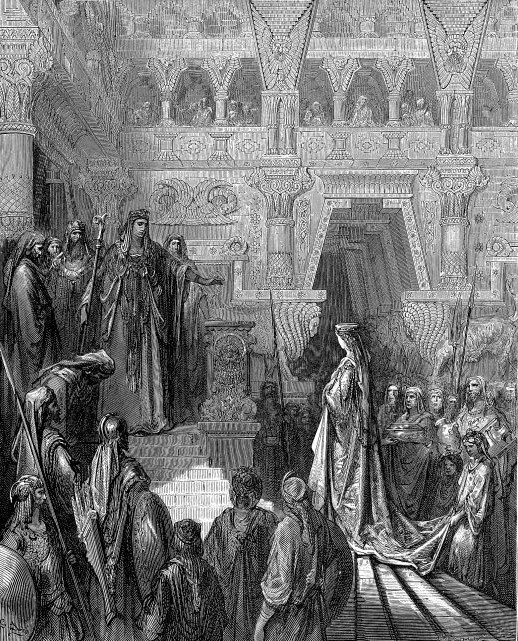
    Solomon Receiving the Queen of Sheba (Dore’)

    The Queen said this before she left:

    Blessed be the Lord thy God, which delighted in thee, to set thee on the throne of Israel: because the Lord loved Israel for ever, therefore made he thee king, to do judgment and justice. (1 Kings 10:9)

    Even the Gentile Queen of Sheba acknowledges God, and His everlasting love for Israel. And that this love for Israel is manifested through the election of a wise king, who enacts judgement and justice. The wealth of a nation is not singled out as a blessing by her, but that the nation, through its federal representative, is aimed towards righteousness. For not the first time, and certainly not the last time, we see the Author of 1&2 Kings repeatedly showing that the blessing and well-being of a nation is measured in its faithfulness, righteousness, and the following of God’s moral law.

    The last thing of note here is that this section, and the following summary of Solomon’s enormous wealth, is the acknowledgement of the high point of Israel. Both the spices of Sheba and the almug wood of Ophir are mentioned as “never again coming to Israel” after the reign of Solomon. Solomon is the majority of the nation’s GDP. The amount of gold coming to Solomon yearly was 666 talents (about 50,000 lbs), not even counting the trade tariffs and gifts from kings. He makes 500 massive shields of gold, a carved throne of ivory overlaid with gold, all his dishware is made of gold, merchant ships of Hiram bring him ivory, monkeys, and peacocks, and all men gather to hear his wisdom. But all of this is tied to Solomon, all this are gifts from God. And these gifts will dry up like puddles in the desert when Solomon strays from God, when God withdraws his favor, and when the nation falls into apostasy.

    IV. Solomon’s Fall (1 Kings 10:26-11:42)

    We mentioned previously the rules for kings from Deuteronomy—Don’t multiply gold, chariots and horses from Egypt, or wives. And now we see that Solomon is guilty of all of these to a greater or lesser extent. Chief among these mistakes was Solomon’s many wives.

    26 And Solomon gathered together chariots and horsemen: and he had a thousand and four hundred chariots, and twelve thousand horsemen, whom he bestowed in the cities for chariots, and with the king at Jerusalem. 27 And the king made silver to be in Jerusalem as stones, and cedars made he to be as the sycomore trees that are in the vale, for abundance.28 And Solomon had horses brought out of Egypt, and linen yarn: the king’s merchants received the linen yarn at a price. (1 Kings 10:26-28)

    But king Solomon loved many strange women, together with the daughter of Pharaoh, women of the Moabites, Ammonites, Edomites, Zidonians, and Hittites: 2 Of the nations concerning which the Lord said unto the children of Israel, Ye shall not go in to them, neither shall they come in unto you: for surely they will turn away your heart after their gods: Solomon clave unto these in love.3 And he had seven hundred wives, princesses, and three hundred concubines: and his wives turned away his heart.4 For it came to pass, when Solomon was old, that his wives turned away his heart after other gods: and his heart was not perfect with the Lord his God, as was the heart of David his father.5 For Solomon went after Ashtoreth the goddess of the Zidonians, and after Milcom the abomination of the Ammonites.6 And Solomon did evil in the sight of the Lord, and went not fully after the Lord, as did David his father.7 Then did Solomon build an high place for Chemosh, the abomination of Moab, in the hill that is before Jerusalem, and for Molech, the abomination of the children of Ammon. 8 And likewise did he for all his strange wives, which burnt incense and sacrificed unto their gods. (1 Kings 11:1-8)

    Solomon had 1,000 wives and concubines, from virtually every nation surrounding Israel: Sidon to the West, Moab to the East, Egypt and Edom to the South, Ammon, and Hattusa to the North. These wives brought their gods with them and turned away Solomon’s heart from God. He worshipped multiple gods, building each of them a high place on a hill, such that God was no longer the only God of Israel, he was only one of several.

    One may ask how Solomon, who was gifted so much wisdom, could possibly commit such actions as these. Marriage of foreign princesses was common way of making alliances in that day and age, as was seen with the daughter of Pharoah, true enough. Yet that is explicitly forbidden to the King, so the question remains. The text tells us the answer—it is mentioned twice that Solomon loved these women, and he loved them more than he loved God and God’s commandments. Over the years, these two loves came into conflict, and Solomon steadily chose to follow the way of idolatry. This will not be the last time that men of God are led astray by unbelieving wives, and it is hardly the first. To those men who struggle with sinning with women, this may prove to be of a small comfort: that even Solomon and all his wisdom, David and all his honor, and Samson in all his strength still struggled with the same sinful condition, and that the hope for men of all eras to be saved from our weakness is found in Christ alone.

    And yet, one might insist that there is a monumental difference between loving someone and giving into idolatry for them. One might ask how the tribal elders, the priests, and the common man allowed these places to be put up. This underestimates the creeping scope of sin, and the pressure of the cultural norms that surround us. This was not an overnight decision, but a slow and steady walking away from God over the course of 40 years.

    Most people don’t actually like to fight, to swim against the cultural tides. They want to live normal, peaceful lives. Be led, be told what is right and wrong, and live in agreement with those around us. Our nation today is a perfect example of that: it has changed drastically even over the course of my lifetime, not even thinking about some of yours. And this cultural pressure comes incrementally, not all at once. All Christians have family, friends, or coworkers who are unbelievers, and insist on things we believe to be untrue. And we wish to keep peace, prioritize the relationship despite that. But that peace demands things of us. There are a lot of people in America today who claim the name of Christian, and hold beliefs utterly antithetical to Christianity, because to believe otherwise would separate them from their parents, siblings, cousins, friends, husbands, or (like Solomon) wives. They consider those beliefs minutiae, and ask “What does it matter if we elect female pastors?” “What does it matter if we affirm gay marriage?” “What does it matter if we deny that Christ really rose from the grave?” “Why does it matter if we build an altar to Molech? You have your temple, let us have a small altar of our own?” Small things add up over time. Sin is a burning flame that ever consumes, and will never be content with any concession, never content to remain in its own small pocket. As the Puritan John Owens said “Be killing sin, or it will be killing you.”

    9 So the Lord became angry with Solomon, because his heart had turned from the Lord God of Israel, who had appeared to him twice, 10 and had commanded him concerning this thing, that he should not go after other gods; but he did not keep what the Lord had commanded. (1 Kings 11:9-10)

    The act of idolatry, more so than the polygamy, is what resulted in the tearing of the kingdom from the hands of Solomon. This building up the high places is one of special notice, because taking down these places will be the task of every king after Solomon, and nearly every single one will fail to do so.

    So, God promised to take the kingdom out from the hands of Solomon, and gave it into the hand of Solomon’s servant, with the exception of the tribe of Judah. Solomon would be spared the witness of the sundering of his kingdom, and it fall in the days of his son, Rehoboam.

    While the final sundering would not take place during the life of Solomon, the cracks began forming while he yet reigned. God raised up enemies of Solomon in Egypt, Edom, and Syria. In Edom, that kingdom to the Southeast, Hadad the Edomite began stirring up rebellion. Hadad had fled the male genocide of Edom during David’s reign, undertaken by Joab, and found shelter with Pharoah, who married him to his sister-in-law. Pharaoh thus had sons-in-law in two opposing nations and appears to be playing both sides to some extent. In Syria, God raised up Rezon, who sent raiding parties into Israel from the North.

    God also raised up Jeroboam, the son of Nebat, to rebel against the king. He was the foreman for the entire workforce of the tribes of Ephraim and Manasseh, two of the largest tribes, so he worked for Solomon’s building programs. God sent Ahijah the Shilonite, a prophet, to inform Jeroboam he would be the next king.

    29 Now it happened at that time, when Jeroboam went out of Jerusalem, that the prophet Ahijah the Shilonite met him on the way; and he had clothed himself with a new garment, and the two were alone in the field. 30 Then Ahijah took hold of the new garment that was on him, and tore it into twelve pieces. 31 And he said to Jeroboam, “Take for yourself ten pieces, for thus says the Lord, the God of Israel: ‘Behold, I will tear the kingdom out of the hand of Solomon and will give ten tribes to you 32 (but he shall have one tribe for the sake of My servant David, and for the sake of Jerusalem, the city which I have chosen out of all the tribes of Israel), 33 because they have forsaken Me, and worshiped Ashtoreth the goddess of the Sidonians, Chemosh the god of the Moabites, and Milcom the god of the people of Ammon, and have not walked in My ways to do what is right in My eyes and keep My statutes and My judgments, as did his father David. 34 However I will not take the whole kingdom out of his hand, because I have made him ruler all the days of his life for the sake of My servant David, whom I chose because he kept My commandments and My statutes. 35 But I will take the kingdom out of his son’s hand and give it to you—ten tribes. 36 And to his son I will give one tribe, that My servant David may always have a lamp before Me in Jerusalem, the city which I have chosen for Myself, to put My name there. 37 So I will take you, and you shall reign over all your heart desires, and you shall be king over Israel. 38 Then it shall be, if you heed all that I command you, walk in My ways, and do what is right in My sight, to keep My statutes and My commandments, as My servant David did, then I will be with you and build for you an enduring house, as I built for David, and will give Israel to you. 39 And I will afflict the descendants of David because of this, but not forever.’ ” (1 Kings 11:29-39)

    4 Now if you walk before Me as your father David walked, in integrity of heart and in uprightness, to do according to all that I have commanded you, and if you keep My statutes and My judgments, 5 then I will establish the throne of your kingdom over Israel forever, as I promised David your father, saying, ‘You shall not fail to have a man on the throne of Israel.’ (1 Kings 9:4-5)

    When we compare this promise to the previous promises of a lineage to David, a few differences stand out. He does not promise an everlasting kingdom to Jeroboam. In fact, he promises the opposite, that while Jeroboam’s house would be enduring, that the descendants of David would not be afflicted forever because of this. In the midst of sundering the kingdom, God promises the future reunification of the kingdom under the house of David, a reunification that would eventually come by way of the true Davidic King, Christ. Jeroboam will be king over the 10 tribes, but he will not have the same connection to God that the line of David did, because of God’s covenantal promises to David, and the coming of the future Messiah through that line. Solomon, hearing of what the prophet had said, tried to kill Jeroboam, who like Hadad fled to hide in Egypt. He would remain there until Solomon’s death.

    V. The End of Solomon’s Reign (1 Kings 11:43)

    Solomon died in in roughly 931 BC, 40 years after he became king. Solomon’s reign is unique among the kings of Israel. No other king will be given the amount of detail in their reign, from their succession to their end. No king will have been given so much, and Israel will never again prosper as they did under Solomon. Solomon had wisdom beyond compare, wealth beyond measure, territory beyond the imagination of any of his forebears. And yet when we read the subsequent chapters, it is not to Solomon and his day that the writers look back to. Solomon the wise, the builder of the Temple and the cities, who made silver as common as stones, is not the gold standard. It is David. David the warrior, whose reign was characterized by conflict on every side of Israel, David the adulterer and murderer. Because despite David’s sins, his heart was only ever inclined towards the Lord. And this is the standard by which Kings are truly to be measured. It is not by their wealth, it is not by their power, it is not by the number of women in their harem. It is by their love for the Lord that they are reckoned.

    Solomon’s heart was not wholly towards the Lord. While David’s love for God resulted in blessings for him and his seed, Solomon’s split affections set down the first stone on that long road towards the eventual destruction, of Israel. The true cost of our sins is often not seen in our lifetimes but is only seen in the lives of our sons and daughters.

    And yet for Solomon, despite his sins, and despite his wayward heart, we may have hope that he was saved. When Christ speaks of Solomon in Luke 11:31 and Matthew 12:42, he speaks of his greatness, not of a status as an apostate king. And more than that, the Book of Ecclesiastes, written by Solomon in his old age is a record of his regret and repentance. Solomon tasted of every pleasure this world had to offer, and yet in the end it was all nothing but vanity, swirling mist before him. His recognition of this reads not as an unrepentant sinner, but as a repentant man full of regrets, seeking to inform others not to make the mistakes he did.

    13 Let us hear the conclusion of the whole matter: Fear God, and keep his commandments: for this is the whole duty of man. 14 For God shall bring every work into judgment, with every secret thing, whether it be good, or whether it be evil. (Ecclesiastes 12:13-14)

    In the end, despite all his wisdom, Solomon was only a man. He was not the promised seed of David- that office was reserved for another. He fell into the same sin that millions more have fallen into: our fallen nature leads us to break covenant with God incessantly. And yet it cannot be said that Solomon was not responsible for his actions. God was exceedingly clear on his responsibilities through the communication of His Holy Spirit, through the prophets, and the Word of God. But wisdom and knowledge are not enough for holiness. Faith, love, and obedience to God in the uttermost is what is required.
  • Descent into Ungodliness (Lesson 3B)

    Descent into Ungodliness (Lesson 3B)

    I. The Dedication of the Temple (1 Kings 8:1-9:9)

    After the extended description of the construction of the Temple, the narrative shifts to the dedication of the Temple to the LORD.  Most commentators focus on Solomon’s prayer, but it is important to understand that this is not merely a prayer but is perhaps better understood as a covenant renewal or rededication ceremony.  We can see this more clearly if we go through the whole passage from 1Kings 8:1-9:9 carefully.

    The first thing to note is that covenants are made or renewed when there is a change in the relationship or some other significant development between the two parties to the covenant.  First Kings 8:1-11 establishes the development in this case, namely that Solomon brought the Ark of the Covenant from the City of David to the Temple to have it installed (1 Kings 8:2 cf. Lev. 23:34 and Deut. 16:13-15).  According to 1 Kings 6:38, construction on the Temple had finished eleven months earlier, so Solomon’s delay is directly tied to the Feast of Tabernacles.  Why this Feast?  The Feast was to be a remembrance of how the LORD sustained His people during their wanderings in the Wilderness.  Building tabernacles (or booths) was to be a reminder of when Israel lived in the Wilderness.  The Temple represented the end of Israel’s wanderings and the consummation of the LORD being present (permanently) among His people.  The fact that the carrying poles were withdrawn once the Ark was brought into the Holy of Holies reinforced this notion.  Moreover, as the priests exited the Holy of Holies, the cloud of the glory of the LORD filled the Temple.  This is evocative of when God’s presence filled the Tabernacle during after the Exodus (cf. Exod. 40:34-38).

    Covenants typically have a preamble describing the relationship between the two parties.  We can see this in 1 Kings 8:12-21:

    12Then spake Solomon, The Lord said that he would dwell in the thick darkness. 13 I have surely built thee an house to dwell in, a settled place for thee to abide in forever. 14 And the king turned his face about, and blessed all the congregation of Israel: (and all the congregation of Israel stood;) 15 And he said, Blessed be the Lord God of Israel, which spake with his mouth unto David my father, and hath with his hand fulfilled it, saying, 16 Since the day that I brought forth my people Israel out of Egypt, I chose no city out of all the tribes of Israel to build an house, that my name might be therein; but I chose David to be over my people Israel. 17 And it was in the heart of David my father to build an house for the name of the Lord God of Israel. 18 And the Lord said unto David my father, Whereas it was in thine heart to build an house unto my name, thou didst well that it was in thine heart. 19 Nevertheless thou shalt not build the house; but thy son that shall come forth out of thy loins, he shall build the house unto my name. 20 And the Lord hath performed his word that he spake, and I am risen up in the room of David my father, and sit on the throne of Israel, as the Lord promised, and have built an house for the name of the Lord God of Israel. 21 And I have set there a place for the ark, wherein is the covenant of the Lord, which he made with our fathers, when he brought them out of the land of Egypt.

    In this case, the preamble identifies the construction of the Temple as the fulfillment of God’s promises to David in the Davidic covenant. 

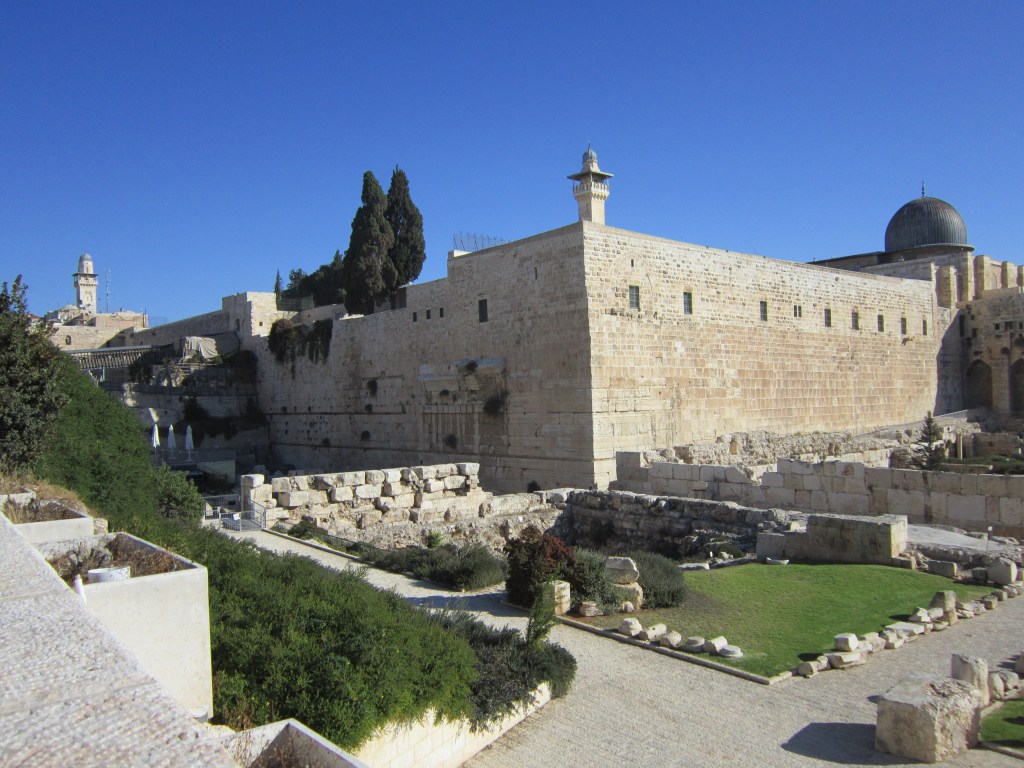
    The Wailing (Western) Wall, Jerusalem

    The next part of a covenant is the declaration of terms.  In this case, the terms are embedded in the main body of Solomon’s prayer.

    22 And Solomon stood before the altar of the Lord in the presence of all the congregation of Israel, and spread forth his hands toward heaven: 23 And he said,

    Lord God of Israel, There is no God like thee, in heaven above, or on earth beneath, who keepest covenant and mercy with thy servants that walk before thee with all their heart: 24 Who hast kept with thy servant David my father that thou promisedst him: thou spakest also with thy mouth, and hast fulfilled it with thine hand, as it is this day. 25 Therefore now, Lord God of Israel, keep with thy servant David my father that thou promisedst him, saying, There shall not fail thee a man in my sight to sit on the throne of Israel; so that thy children take heed to their way, that they walk before me as thou hast walked before me. 26 And now, O God of Israel, let thy word, I pray thee, be verified, which thou spakest unto thy servant David my father.

    27 But will God indeed dwell on the earth? behold, the heaven and heaven of heavens cannot contain thee; how much less this house that I have builded? 28 Yet have thou respect unto the prayer of thy servant, and to his supplication, O Lord my God, to hearken unto the cry and to the prayer, which thy servant prayeth before thee today: 29 That thine eyes may be open toward this house night and day, even toward the place of which thou hast said, My name shall be there: that thou mayest hearken unto the prayer which thy servant shall make toward this place. 30 And hearken thou to the supplication of thy servant, and of thy people Israel, when they shall pray toward this place: and hear thou in heaven thy dwelling place: and when thou hearest, forgive.

    Covenants often involve a declaration of the titles of the parties, which sets the basis for how they are to relate to one another.  In verses 22-30, Solomon does not focus on himself or the people, but rather, solely on God.  The LORD is a God who keeps covenant, shows mercy and made a covenant with Solomon’s father David.  Moreover, the Temple is not a structure that can contain God, since God is greater than the building dedicated to Him.  It is on these characteristics of God that Solomon asks the LORD to hear the prayers of His people offered up in the Temple.  The next part of the prayer highlights specific kinds of prayers that Solomon asks the LORD to hear:

    31 If any man trespass against his neighbour, and an oath be laid upon him to cause him to swear, and the oath come before thine altar in this house: 32 Then hear thou in heaven, and do, and judge thy servants, condemning the wicked, to bring his way upon his head; and justifying the righteous, to give him according to his righteousness.

    33 When thy people Israel be smitten down before the enemy, because they have sinned against thee, and shall turn again to thee, and confess thy name, and pray, and make supplication unto thee in this house: 34 Then hear thou in heaven, and forgive the sin of thy people Israel, and bring them again unto the land which thou gavest unto their fathers.

    35 When heaven is shut up, and there is no rain, because they have sinned against thee; if they pray toward this place, and confess thy name, and turn from their sin, when thou afflictest them: 36 Then hear thou in heaven, and forgive the sin of thy servants, and of thy people Israel, that thou teach them the good way wherein they should walk, and give rain upon thy land, which thou hast given to thy people for an inheritance.

    37If there be in the land famine, if there be pestilence, blasting, mildew, locust, or if there be caterpiller; if their enemy besiege them in the land of their cities; whatsoever plague, whatsoever sickness there be; 38 What prayer and supplication soever be made by any man, or by all thy people Israel, which shall know every man the plague of his own heart, and spread forth his hands toward this house: 39 Then hear thou in heaven thy dwelling place, and forgive, and do, and give to every man according to his ways, whose heart thou knowest; (for thou, even thou only, knowest the hearts of all the children of men;) 40 That they may fear thee all the days that they live in the land which thou gavest unto our fathers.

    41 Moreover concerning a stranger, that is not of thy people Israel, but cometh out of a far country for thy name’s sake; 42 (For they shall hear of thy great name, and of thy strong hand, and of thy stretched out arm;) when he shall come and pray toward this house; 43 Hear thou in heaven thy dwelling place, and do according to all that the stranger calleth to thee for: that all people of the earth may know thy name, to fear thee, as do thy people Israel; and that they may know that this house, which I have builded, is called by thy name.

    44 If thy people go out to battle against their enemy, whithersoever thou shalt send them, and shall pray unto the Lord toward the city which thou hast chosen, and toward the house that I have built for thy name: 45 Then hear thou in heaven their prayer and their supplication, and maintain their cause. 46 If they sin against thee, (for there is no man that sinneth not,) and thou be angry with them, and deliver them to the enemy, so that they carry them away captives unto the land of the enemy, far or near; 47 Yet if they shall bethink themselves in the land whither they were carried captives, and repent, and make supplication unto thee in the land of them that carried them captives, saying, We have sinned, and have done perversely, we have committed wickedness; 48 And so return unto thee with all their heart, and with all their soul, in the land of their enemies, which led them away captive, and pray unto thee toward their land, which thou gavest unto their fathers, the city which thou hast chosen, and the house which I have built for thy name: 49 Then hear thou their prayer and their supplication in heaven thy dwelling place, and maintain their cause, 50 And forgive thy people that have sinned against thee, and all their transgressions wherein they have transgressed against thee, and give them compassion before them who carried them captive, that they may have compassion on them: 51 For they be thy people, and thine inheritance, which thou broughtest forth out of Egypt, from the midst of the furnace of iron: 52 That thine eyes may be open unto the supplication of thy servant, and unto the supplication of thy people Israel, to hearken unto them in all that they call for unto thee. 53 For thou didst separate them from among all the people of the earth, to be thine inheritance, as thou spakest by the hand of Moses thy servant, when thou broughtest our fathers out of Egypt, O Lord God.

    To summarize, these are prayers (a) to do justice (8:31-32); (b) to deliver the people and forgive them when oppressed by an enemy (8:33-34); (c) to relent in bringing a drought against them and to enable them to walk in His ways and to fear Him (8:35-40); (d) to extend mercy to the stranger in the land (8:41-43), and lastly, (e) to maintain the cause of His people in battle (8:44-45), and if they sin against the LORD and are carried away but repent and return to Him, then Solomon asks that God would show compassion on them (8:46-53).  One can see in Israel’s subsequent history how God did honor such prayers of His people.

    As this is a prayer, Solomon concludes with a benediction which remembers God’s past faithfulness, His promises to be with His people, that He would be glorified and they obedient to his commandments (8:54-61).

    54 And it was so, that when Solomon had made an end of praying all this prayer and supplication unto the Lord, he arose from before the altar of the Lord, from kneeling on his knees with his hands spread up to heaven. 55 And he stood, and blessed all the congregation of Israel with a loud voice, saying, 56 Blessed be the Lord, that hath given rest unto his people Israel, according to all that he promised: there hath not failed one word of all his good promise, which he promised by the hand of Moses his servant. 57 The Lord our God be with us, as he was with our fathers: let him not leave us, nor forsake us: 58 That he may incline our hearts unto him, to walk in all his ways, and to keep his commandments, and his statutes, and his judgments, which he commanded our fathers. 59 And let these my words, wherewith I have made supplication before the Lord, be nigh unto the Lord our God day and night, that he maintain the cause of his servant, and the cause of his people Israel at all times, as the matter shall require: 60 That all the people of the earth may know that the Lord is God, and that there is none else. 61 Let your heart therefore be perfect with the Lord our God, to walk in his statutes, and to keep his commandments, as at this day.

    This is followed, in verses 62-66, with a huge number of sacrificial offerings on behalf of the king and the people.  Sacrifices in the Old Testament were appropriate to worship, which is certainly the context here, but there is also a covenantal significance to them.  In earlier times, a covenant would be concluded with vows taken between slaughtered animals, symbolizing that the gods were to do to the covenant-making parties what were done to the animals if the terms of the covenant were violated.  That would be followed with a fellowship meal to show that the parties were at peace with one another.  In this case, the sacrifices both made atonement for the people and symbolized their fellowship with the LORD, and this is confirmed by a great feast lasting two weeks.

    This covenant renewal ceremony is concluded with God’s response to Solomon’s prayer in 1 Kings 9:1-9:

    And it came to pass, when Solomon had finished the building of the house of the Lord, and the king’s house, and all Solomon’s desire which he was pleased to do, That the Lord appeared to Solomon the second time, as he had appeared unto him at Gibeon. And the Lord said unto him, I have heard thy prayer and thy supplication, that thou hast made before me: I have hallowed this house, which thou hast built, to put my name there forever; and mine eyes and mine heart shall be there perpetually. And if thou wilt walk before me, as David thy father walked, in integrity of heart, and in uprightness, to do according to all that I have commanded thee, and wilt keep my statutes and my judgments: Then I will establish the throne of thy kingdom upon Israel forever, as I promised to David thy father, saying, There shall not fail thee a man upon the throne of Israel. But if ye shall at all turn from following me, ye or your children, and will not keep my commandments and my statutes which I have set before you, but go and serve other gods, and worship them: Then will I cut off Israel out of the land which I have given them; and this house, which I have hallowed for my name, will I cast out of my sight; and Israel shall be a proverb and a byword among all people: And at this house, which is high, every one that passeth by it shall be astonished, and shall hiss; and they shall say, Why hath the Lord done thus unto this land, and to this house? And they shall answer, Because they forsook the Lord their God, who brought forth their fathers out of the land of Egypt, and have taken hold upon other gods, and have worshipped them, and served them: therefore hath the Lord brought upon them all this evil.

    The LORD’s response is to reiterate once again the command to walk with integrity before Him, to do what He has commanded.  If they do that, then the LORD promised to maintain a person on the throne perpetually, but if they did not do that, then He would cast off Israel for disobedience.  This is, in fact, what would come to pass.

    So how does this apply to us today?  The Temple became a motif throughout the rest of biblical history.  Ezekiel, writing to the Exiles, described how God’s presence left the Temple before its destruction because of the sins of the nation (Ezek. 10:18).  That highlighted that the covenant was broken.  Ezekiel also prophesied about an eschatological ideal Temple from which living water flowed (Ezek. chs. 40-47).  When the remnant came back from Exile, the people began to rebuild the temple in 536 BC as a sign of the reconstitution and rededication of the covenant community to the LORD (Ezra 3:8-13).  The people needed to be exhorted to finish the work by the prophets Haggai and Zechariah, and eventually what became known as Zerubbabel’s temple would be completed in 516 BC.  Its completion was both a matter of joy and bittersweetness, for it was a pale comparison to Solomon’s Temple (Ezra 5:12).  That Zerubbabel’s Temple would be subsumed into Herod’s grandiose Temple during the time of Christ.  But Christ indicated to the shock of His disciples that the time of the Temple had passed, and that that would be destroyed (Matt. 24:2).  In Paul’s writings, it is the Church that becomes the Temple.  After Pentecost, the LORD’s presence among His people is not in a particular building, but in the people themselves through the outpouring of the Holy Spirit.  Finally, in Revelation, we again see a Temple, but like Ezekiel’s eschatological ideal concept, this Temple encompasses God’s people and His presence is in it and in them (Rev. 21:9-27).  It is that union and communion we have with Christ that we are looking forward to.

  • Descent into Ungodliness (Lesson 3A)

    Descent into Ungodliness (Lesson 3A)

    I. Preparations for Constructing the Temple (1 Kings ch. 5)

    Previously, we looked at the early character of Solomon’s reign, and in particular, at how God granted Solomon’s request for wisdom in governing.  Wisdom for executing justice is an important virtue in a ruler.  We now turn to another attribute of kings, namely their ability to carry out massive building projects.  In addition to the character of their rule, ancient Near Eastern kings would typically obtain glory through warfare or building projects, and often both.  David left Solomon a favorable situation politically, with Israel domestically united, prosperous, and dominating the surrounding states.  Solomon himself recognized this in 1 Kings 5:2-5:

    And Solomon sent to Hiram, saying, 3Thou knowest how that David my father could not build an house unto the name of the Lord his God for the wars which were about him on every side, until the Lord put them under the soles of his feet. But now the Lord my God hath given me rest on every side, so that there is neither adversary nor evil occurrent. And, behold, I purpose to build an house unto the name of the Lord my God, as the Lord spake unto David my father, saying, Thy son, whom I will set upon thy throne in thy room, he shall build an house unto my name.

    In looking at the construction of the Temple, let us start by asking the question, what did Solomon need in order to build the Temple and how extensive was the effort he sought to undertook?

    • Peace and Time.  He needed peace within the country and surrounding it, since wars and instability would have necessitated taking resources and energy away from construction.  These projects would also take time; construction of the Temple alone lasted seven years (1 Kings 6:38) and of his own palace and other projects another 13 years.
    • Cooperative Relations with Other Countries.  He needed cooperative relations with countries who could supply the materials, and he had that in the person of Hiram of Tyre.  Tyre was a major trading country, and as such, had extensive commercial connections across the region.  In 1 Kings 5:12 we see that Solomon and Hiram had a formalized partnership to that effect.  The Hebrew word used here for treaty (NKJV, ESV) or league (AV) is the term that elsewhere in the Old Testament is translated covenant.
    • Resources.  He needed resources in terms of materials and people.  With regard to the former, he needed not only materials specifically for the Temple and other buildings, but also to trade for the services of Hiram’s nation.  Israel is not a heavily forested place, and so he would need cedar, fir, and other wood from what is modern day Lebanon, as well as quarried stones that would be suitable for such monumental architecture.  His payment to Hiram consisted of about 100,000 gallons of wheat and 100 gallons of pure oil a year for each year of construction (1 Kings 5:11).  The pure oil may not sound like much, but olive presses would produce multiple batches of oil of varying quality.  The first press would be the pure oil; subsequent presses would extract further oil, but of decreasing quality.  Thus, the 100 gallons would have been of the topmost quality, used for special and not everyday purchases.  In terms of personnel, Israel provided forced and conscripted labor of at least 153,600 individuals (2 Chronicles 2:17-18), including 30,000 men to help in harvesting trees (divided into three cadre, each working three-month rotations), 70,000 men involved in material transport; 80,000 stone cutters; and 3,300 supervisors (1 Kings 5:13-18).  No expense was being spared for these projects.
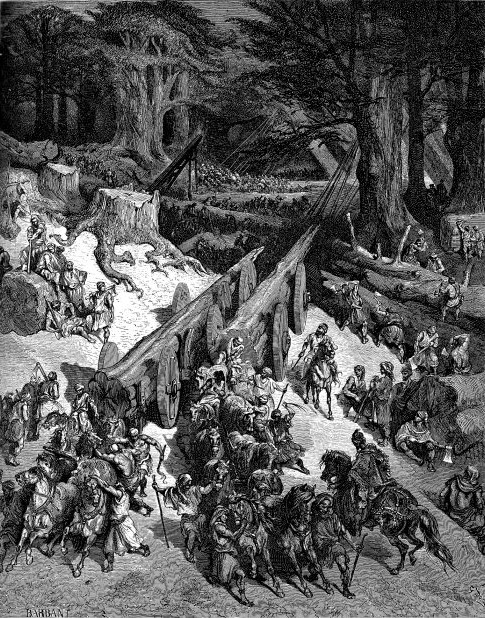
    Cutting Down Cedars for the Construction of the Temple (Dore)

    II. Constructing the Temple (1 Kings chs. 6-7)

    In chapters 6 and 7, we get a detailed description of the Temple itself.  The dimensions of the Temple are about double those of the Tabernacle (cf. Exod. 25:15-25, 34:36).  It was about 87.5 ft. long, 29.1 ft wide, and 43.75 ft. high.  By way of comparison, the Temple could just about fit inside the Lincoln Memorial.  That said, the Temple was made entirely of stone and wood, with hand carved ornamentation and pure gold inlay completely in the interior.  The ornateness would have been a contrast to the simplicity of the Tabernacle.  It would not have been secured by concrete, steel or metal fasteners, so the stone cutting had to be precise before the blocks were brought onsite, and Solomon hired a master metalsmith experienced in working with brass to do the ornamentation, as well as to supervise the construction of the external basins (1 Kings 7:13-14).  Given the dimensions, each basin could hold 230 gallons of water.  This was a sophisticated building project.  Construction on the Temple began in Solomon’s fourth regnal year, 966 BC, a date which we can conclusively establish based on the correlation of biblical and extra-biblical sources.

    The text of chapters 5-7 goes into extensive detail about the preparations for and construction of the Temple.  This raises the question as to why Jeremiah thought that would be especially important to the original audience for whom he was writing?  At least three reasons are likely:

    • First, it preserved a memory of the Temple for those in exile.  Jeremiah had prophesied that the Exile would last seventy years (Jer. 29:10), so by the end of the exile, most of the remnant would have no personal recollection of Solomon’s Temple.
    • Second, it highlighted the glory of God.  A building this ornate is needed for a God as great as Israel’s God.  By providing such extensive detail on the ornateness of the Temple, Jeremiah was indirectly highlighting the greatness of Israel’s LORD.
    • Third, it highlighted what Israel had lost.  The Temple was not simply a piece of monumental architecture; it was the focal point for the presence of God amidst His people.  With the destruction of the Temple, the remnant had to come to grips with the reality that they broke the covenant with their God.  By providing extensive detail of the Temple and elaborating on the necessary conditions for constructing it meant that it would highly unlikely that it would ever be replicated on the same level, as it would be too costly.  As a result, the faithful remnant had no other recourse but to return in repentance and trust in the LORD’s grace and mercy.

    Such an understanding illuminates the word of the LORD that came to Solomon in the midst of the Temple’s construction:

    6:11 And the word of the Lord came to Solomon, saying, 12 Concerning this house which thou art in building, if thou wilt walk in my statutes, and execute my judgments, and keep all my commandments to walk in them; then will I perform my word with thee, which I spake unto David thy father:13 And I will dwell among the children of Israel, and will not forsake my people Israel. (1 Kings 6:12-13)

    This is the second occasion when God speaks directly to Solomon.  Recall that when God granted Solomon wisdom to rule, He said, “3:14 And if thou wilt walk in my ways, to keep my statutes and my commandments, as thy father David did walk, then I will lengthen thy days” (1 Kings 3:14). Compare this, as well, with David’s guidance to Solomon on his deathbed:

    2:3And keep the charge of the LORD thy God, to walk in his ways, to keep his statutes, and his commandments, and his judgments, and his testimonies, as it is written in the law of Moses, that thou mayest prosper in all that thou doest, and whithersoever thou turnest thyself: 4that the LORD may continue his word which he spake concerning me, saying, If thy children take heed to their way, to walk before me in truth with all their heart and with all their soul, there shall not fail thee (said he) a man on the throne of Israel. (1 Kings 2:3-4)

    The common theme in these three passages is that Solomon (and, by extension, the people) are to walk in the ways of the LORD and keep His statutes and commandments, and if they do that, then the LORD will not forsake His people, will lengthen Solomon’s days, and preserve the throne of David.  This is the baseline requirement for keeping the covenant; Solomon, the kings after him, and the people failed to do this.  Israel’s subsequent history is an extended indictment for this failure.

    In the next post, we will look at Solomon’s dedication of the Temple.