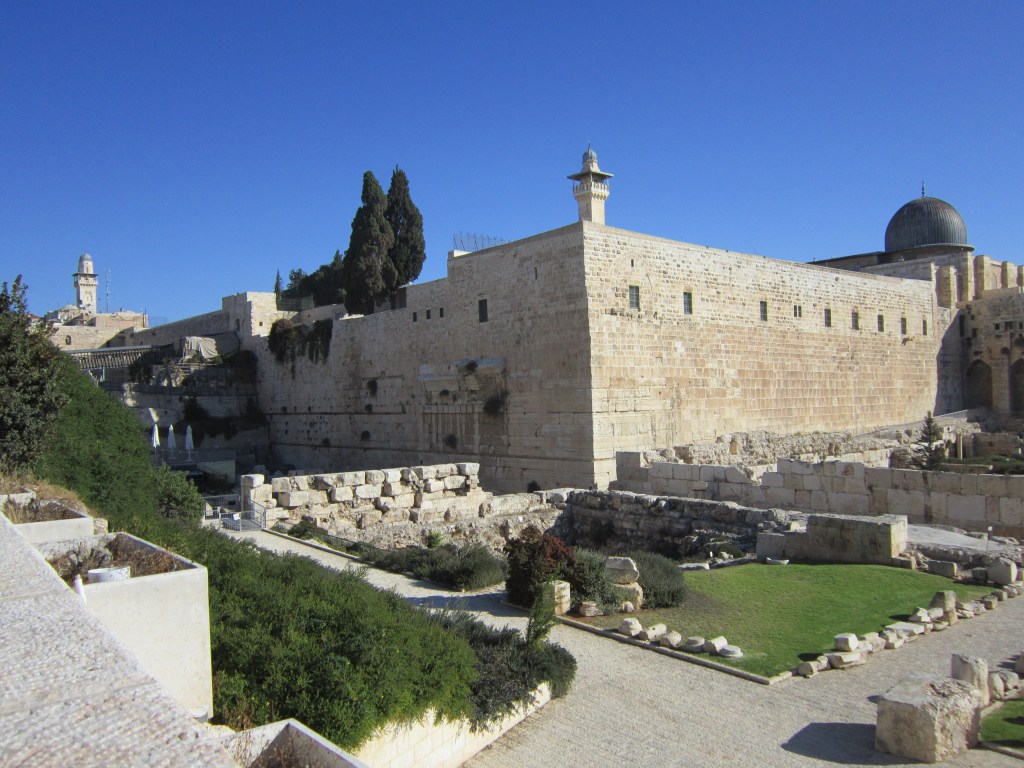
I. The Dedication of the Temple (1 Kings 8:1-9:9)
After the extended description of the construction of the Temple, the narrative shifts to the dedication of the Temple to the LORD. Most commentators focus on Solomon’s prayer, but it is important to understand that this is not merely a prayer but is perhaps better understood as a covenant renewal or rededication ceremony. We can see this more clearly if we go through the whole passage from 1Kings 8:1-9:9 carefully.
The first thing to note is that covenants are made or renewed when there is a change in the relationship or some other significant development between the two parties to the covenant. First Kings 8:1-11 establishes the development in this case, namely that Solomon brought the Ark of the Covenant from the City of David to the Temple to have it installed (1 Kings 8:2 cf. Lev. 23:34 and Deut. 16:13-15). According to 1 Kings 6:38, construction on the Temple had finished eleven months earlier, so Solomon’s delay is directly tied to the Feast of Tabernacles. Why this Feast? The Feast was to be a remembrance of how the LORD sustained His people during their wanderings in the Wilderness. Building tabernacles (or booths) was to be a reminder of when Israel lived in the Wilderness. The Temple represented the end of Israel’s wanderings and the consummation of the LORD being present (permanently) among His people. The fact that the carrying poles were withdrawn once the Ark was brought into the Holy of Holies reinforced this notion. Moreover, as the priests exited the Holy of Holies, the cloud of the glory of the LORD filled the Temple. This is evocative of when God’s presence filled the Tabernacle during after the Exodus (cf. Exod. 40:34-38).
Covenants typically have a preamble describing the relationship between the two parties. We can see this in 1 Kings 8:12-21:
12Then spake Solomon, The Lord said that he would dwell in the thick darkness. 13 I have surely built thee an house to dwell in, a settled place for thee to abide in forever. 14 And the king turned his face about, and blessed all the congregation of Israel: (and all the congregation of Israel stood;) 15 And he said, Blessed be the Lord God of Israel, which spake with his mouth unto David my father, and hath with his hand fulfilled it, saying, 16 Since the day that I brought forth my people Israel out of Egypt, I chose no city out of all the tribes of Israel to build an house, that my name might be therein; but I chose David to be over my people Israel. 17 And it was in the heart of David my father to build an house for the name of the Lord God of Israel. 18 And the Lord said unto David my father, Whereas it was in thine heart to build an house unto my name, thou didst well that it was in thine heart. 19 Nevertheless thou shalt not build the house; but thy son that shall come forth out of thy loins, he shall build the house unto my name. 20 And the Lord hath performed his word that he spake, and I am risen up in the room of David my father, and sit on the throne of Israel, as the Lord promised, and have built an house for the name of the Lord God of Israel. 21 And I have set there a place for the ark, wherein is the covenant of the Lord, which he made with our fathers, when he brought them out of the land of Egypt.
In this case, the preamble identifies the construction of the Temple as the fulfillment of God’s promises to David in the Davidic covenant.

The next part of a covenant is the declaration of terms. In this case, the terms are embedded in the main body of Solomon’s prayer.
22 And Solomon stood before the altar of the Lord in the presence of all the congregation of Israel, and spread forth his hands toward heaven: 23 And he said,
Lord God of Israel, There is no God like thee, in heaven above, or on earth beneath, who keepest covenant and mercy with thy servants that walk before thee with all their heart: 24 Who hast kept with thy servant David my father that thou promisedst him: thou spakest also with thy mouth, and hast fulfilled it with thine hand, as it is this day. 25 Therefore now, Lord God of Israel, keep with thy servant David my father that thou promisedst him, saying, †There shall not fail thee a man in my sight to sit on the throne of Israel; so that thy children take heed to their way, that they walk before me as thou hast walked before me. 26 And now, O God of Israel, let thy word, I pray thee, be verified, which thou spakest unto thy servant David my father.
27 But will God indeed dwell on the earth? behold, the heaven and heaven of heavens cannot contain thee; how much less this house that I have builded? 28 Yet have thou respect unto the prayer of thy servant, and to his supplication, O Lord my God, to hearken unto the cry and to the prayer, which thy servant prayeth before thee today: 29 That thine eyes may be open toward this house night and day, even toward the place of which thou hast said, My name shall be there: that thou mayest hearken unto the prayer which thy servant shall make toward this place. 30 And hearken thou to the supplication of thy servant, and of thy people Israel, when they shall pray toward this place: and hear thou in heaven thy dwelling place: and when thou hearest, forgive.
Covenants often involve a declaration of the titles of the parties, which sets the basis for how they are to relate to one another. In verses 22-30, Solomon does not focus on himself or the people, but rather, solely on God. The LORD is a God who keeps covenant, shows mercy and made a covenant with Solomon’s father David. Moreover, the Temple is not a structure that can contain God, since God is greater than the building dedicated to Him. It is on these characteristics of God that Solomon asks the LORD to hear the prayers of His people offered up in the Temple. The next part of the prayer highlights specific kinds of prayers that Solomon asks the LORD to hear:
31 If any man trespass against his neighbour, and an oath be laid upon him to cause him to swear, and the oath come before thine altar in this house: 32 Then hear thou in heaven, and do, and judge thy servants, condemning the wicked, to bring his way upon his head; and justifying the righteous, to give him according to his righteousness.
33 When thy people Israel be smitten down before the enemy, because they have sinned against thee, and shall turn again to thee, and confess thy name, and pray, and make supplication unto thee in this house: 34 Then hear thou in heaven, and forgive the sin of thy people Israel, and bring them again unto the land which thou gavest unto their fathers.
35 When heaven is shut up, and there is no rain, because they have sinned against thee; if they pray toward this place, and confess thy name, and turn from their sin, when thou afflictest them: 36 Then hear thou in heaven, and forgive the sin of thy servants, and of thy people Israel, that thou teach them the good way wherein they should walk, and give rain upon thy land, which thou hast given to thy people for an inheritance.
37If there be in the land famine, if there be pestilence, blasting, mildew, locust, or if there be caterpiller; if their enemy besiege them in the land of their cities; whatsoever plague, whatsoever sickness there be; 38 What prayer and supplication soever be made by any man, or by all thy people Israel, which shall know every man the plague of his own heart, and spread forth his hands toward this house: 39 Then hear thou in heaven thy dwelling place, and forgive, and do, and give to every man according to his ways, whose heart thou knowest; (for thou, even thou only, knowest the hearts of all the children of men;) 40 That they may fear thee all the days that they live in the land which thou gavest unto our fathers.
41 Moreover concerning a stranger, that is not of thy people Israel, but cometh out of a far country for thy name’s sake; 42 (For they shall hear of thy great name, and of thy strong hand, and of thy stretched out arm;) when he shall come and pray toward this house; 43 Hear thou in heaven thy dwelling place, and do according to all that the stranger calleth to thee for: that all people of the earth may know thy name, to fear thee, as do thy people Israel; and that they may know that this house, which I have builded, is called by thy name.
44 If thy people go out to battle against their enemy, whithersoever thou shalt send them, and shall pray unto the Lord toward the city which thou hast chosen, and toward the house that I have built for thy name: 45 Then hear thou in heaven their prayer and their supplication, and maintain their cause. 46 If they sin against thee, (for there is no man that sinneth not,) and thou be angry with them, and deliver them to the enemy, so that they carry them away captives unto the land of the enemy, far or near; 47 Yet if they shall bethink themselves in the land whither they were carried captives, and repent, and make supplication unto thee in the land of them that carried them captives, saying, We have sinned, and have done perversely, we have committed wickedness; 48 And so return unto thee with all their heart, and with all their soul, in the land of their enemies, which led them away captive, and pray unto thee toward their land, which thou gavest unto their fathers, the city which thou hast chosen, and the house which I have built for thy name: 49 Then hear thou their prayer and their supplication in heaven thy dwelling place, and maintain their cause, 50 And forgive thy people that have sinned against thee, and all their transgressions wherein they have transgressed against thee, and give them compassion before them who carried them captive, that they may have compassion on them: 51 For they be thy people, and thine inheritance, which thou broughtest forth out of Egypt, from the midst of the furnace of iron: 52 That thine eyes may be open unto the supplication of thy servant, and unto the supplication of thy people Israel, to hearken unto them in all that they call for unto thee. 53 For thou didst separate them from among all the people of the earth, to be thine inheritance, as thou spakest by the hand of Moses thy servant, when thou broughtest our fathers out of Egypt, O Lord God.
To summarize, these are prayers (a) to do justice (8:31-32); (b) to deliver the people and forgive them when oppressed by an enemy (8:33-34); (c) to relent in bringing a drought against them and to enable them to walk in His ways and to fear Him (8:35-40); (d) to extend mercy to the stranger in the land (8:41-43), and lastly, (e) to maintain the cause of His people in battle (8:44-45), and if they sin against the LORD and are carried away but repent and return to Him, then Solomon asks that God would show compassion on them (8:46-53). One can see in Israel’s subsequent history how God did honor such prayers of His people.
As this is a prayer, Solomon concludes with a benediction which remembers God’s past faithfulness, His promises to be with His people, that He would be glorified and they obedient to his commandments (8:54-61).
54 And it was so, that when Solomon had made an end of praying all this prayer and supplication unto the Lord, he arose from before the altar of the Lord, from kneeling on his knees with his hands spread up to heaven. 55 And he stood, and blessed all the congregation of Israel with a loud voice, saying, 56 Blessed be the Lord, that hath given rest unto his people Israel, according to all that he promised: there hath not failed one word of all his good promise, which he promised by the hand of Moses his servant. 57 The Lord our God be with us, as he was with our fathers: let him not leave us, nor forsake us: 58 That he may incline our hearts unto him, to walk in all his ways, and to keep his commandments, and his statutes, and his judgments, which he commanded our fathers. 59 And let these my words, wherewith I have made supplication before the Lord, be nigh unto the Lord our God day and night, that he maintain the cause of his servant, and the cause of his people Israel at all times, as the matter shall require: 60 That all the people of the earth may know that the Lord is God, and that there is none else. 61 Let your heart therefore be perfect with the Lord our God, to walk in his statutes, and to keep his commandments, as at this day.
This is followed, in verses 62-66, with a huge number of sacrificial offerings on behalf of the king and the people. Sacrifices in the Old Testament were appropriate to worship, which is certainly the context here, but there is also a covenantal significance to them. In earlier times, a covenant would be concluded with vows taken between slaughtered animals, symbolizing that the gods were to do to the covenant-making parties what were done to the animals if the terms of the covenant were violated. That would be followed with a fellowship meal to show that the parties were at peace with one another. In this case, the sacrifices both made atonement for the people and symbolized their fellowship with the LORD, and this is confirmed by a great feast lasting two weeks.
This covenant renewal ceremony is concluded with God’s response to Solomon’s prayer in 1 Kings 9:1-9:
And it came to pass, when Solomon had finished the building of the house of the Lord, and the king’s house, and all Solomon’s desire which he was pleased to do, 2 That the Lord appeared to Solomon the second time, as he had appeared unto him at Gibeon. 3 And the Lord said unto him, I have heard thy prayer and thy supplication, that thou hast made before me: I have hallowed this house, which thou hast built, to put my name there forever; and mine eyes and mine heart shall be there perpetually. 4 And if thou wilt walk before me, as David thy father walked, in integrity of heart, and in uprightness, to do according to all that I have commanded thee, and wilt keep my statutes and my judgments: 5 Then I will establish the throne of thy kingdom upon Israel forever, as I promised to David thy father, saying, There shall not fail thee a man upon the throne of Israel. 6 But if ye shall at all turn from following me, ye or your children, and will not keep my commandments and my statutes which I have set before you, but go and serve other gods, and worship them: 7 Then will I cut off Israel out of the land which I have given them; and this house, which I have hallowed for my name, will I cast out of my sight; and Israel shall be a proverb and a byword among all people: 8 And at this house, which is high, every one that passeth by it shall be astonished, and shall hiss; and they shall say, Why hath the Lord done thus unto this land, and to this house? 9 And they shall answer, Because they forsook the Lord their God, who brought forth their fathers out of the land of Egypt, and have taken hold upon other gods, and have worshipped them, and served them: therefore hath the Lord brought upon them all this evil.
The LORD’s response is to reiterate once again the command to walk with integrity before Him, to do what He has commanded. If they do that, then the LORD promised to maintain a person on the throne perpetually, but if they did not do that, then He would cast off Israel for disobedience. This is, in fact, what would come to pass.
So how does this apply to us today? The Temple became a motif throughout the rest of biblical history. Ezekiel, writing to the Exiles, described how God’s presence left the Temple before its destruction because of the sins of the nation (Ezek. 10:18). That highlighted that the covenant was broken. Ezekiel also prophesied about an eschatological ideal Temple from which living water flowed (Ezek. chs. 40-47). When the remnant came back from Exile, the people began to rebuild the temple in 536 BC as a sign of the reconstitution and rededication of the covenant community to the LORD (Ezra 3:8-13). The people needed to be exhorted to finish the work by the prophets Haggai and Zechariah, and eventually what became known as Zerubbabel’s temple would be completed in 516 BC. Its completion was both a matter of joy and bittersweetness, for it was a pale comparison to Solomon’s Temple (Ezra 5:12). That Zerubbabel’s Temple would be subsumed into Herod’s grandiose Temple during the time of Christ. But Christ indicated to the shock of His disciples that the time of the Temple had passed, and that that would be destroyed (Matt. 24:2). In Paul’s writings, it is the Church that becomes the Temple. After Pentecost, the LORD’s presence among His people is not in a particular building, but in the people themselves through the outpouring of the Holy Spirit. Finally, in Revelation, we again see a Temple, but like Ezekiel’s eschatological ideal concept, this Temple encompasses God’s people and His presence is in it and in them (Rev. 21:9-27). It is that union and communion we have with Christ that we are looking forward to.

 Covenantide