Tag: Theodicy

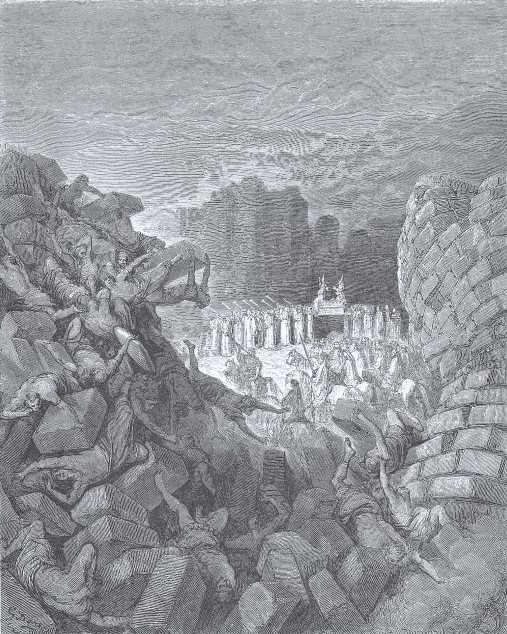
  • Holy War, Just War

    Holy War, Just War

    When you go near a city to fight against it, then proclaim an offer of peace to it.  And it shall be that if they accept your offer of peace, and open to you, then all the people who are found in it shall be placed under tribute to you, and serve you.   Now if the city will not make peace with you, but makes war against you, then you shall besiege it.  And when the LORD your God delivers it into your hands, you shall strike every male in it with the edge of the sword.  But the women, the little ones, the livestock, and all that is in the city, all its spoil, you shall plunder for yourself; and you shall eat the enemies’ plunder which the LORD your God gives you.  Thus you shall do to all the cities which are very far from you, which are not of the cities of these nations.  But of the cities of these peoples which the LORD your God gives you as an inheritance, you shall let nothing that breathes remain alive, but you shall utterly destroy them:  the Hittite and the Amorite and the Canaanite and the Perizzite and the Hivite and the Jebusite, just as the LORD your God has commanded you, lest they teach you to do according to all their abominations which they have done for their gods, and you sin against the LORD your God. (Deuteronomy 20:10-18 NKJV)

    What are we to make of this?

    On the face of it, what the Lord is commanding the Israelites to do to inhabitants of the Canaan is in modern terms ethnic cleansing (that is, removing an entire people group from their land) and genocide (destroying an entire people simply because they belong to that group).  Even the more “benign” treatment of captured cities outside of Canaan gives some pause in light of the Lord’s command to put all the men of the captured city to death.  Nor is this the only passage describing such violence.  In the account of the Flood (Genesis chapters 6-8) the Lord destroys the entire world for the depravity in it, save Noah’s family.  He disperses the nations of the world in response to the hubris of the Tower of Babel in Genesis 11, completely destroys the cities of Sodom and Gomorrah in Genesis chapters 18 and 19, and leaves Egypt in ruins as a result of the plagues that led up to the Exodus of the Israelites (see Ex. 10:7).  In Exodus 23:20-33,  He tells the Israelites that His Angel will completely destroy the people groups later repeated in Deuteronomy 20 so that Israel can occupy the land and that these peoples will not be a snare to them.  The law codes of Exodus and Leviticus are probably the earliest parts of Scripture, so this means that these statements go back to the earliest part of the biblical history.  In Numbers 33:50-56, these commands are repeated again on the plains of Moab, as Israel is planning to enter into the land which the Lord has promised.  Leading up to that point, in the precursor to what the Israelites would later do in Canaan, the “Lord’s vengeance was executed” on Midian and the Israelites killed all the men.  When Moses and Eleazar the high priest learned that women and children had been spared, they became angry and ordered the wives and male children of the Midianites to be killed as well (Num. 31:17).

    Clearly there is a pattern here.

    The critic of the Faith will point to these passages as prima facie evidence for the idea that if they are true and if God exists at all then He is neither good nor loving.  Conversely, such commands for violence seem to be utterly incompatible with both modern sensibilities and modern expectations of the benign character of Deity and seemingly can only mean that if God really exists then Scripture is not true.  And if Scripture is not wholly true, then that raises the obvious question as to what parts are true and what parts are untrue and on what grounds does one decide?  It is not hard to see in light of those questions that it is a short road from rejecting difficult parts of Scripture such as these to a more fundamental questioning of the Faith.  Thus, these holy war passages are not an easy question for Christians to face.  For the Christian, the passages go beyond the idea that the Lord permits evil to happen.  They seem to say the Lord is active in doing injustice and this puts God on the same level as Adolf Hitler, Josef Stalin, Pol Pot, Jean Kambanda,[1] Saddam Hussein and Slobodan Milosevic, which is an unpalatable conclusion.  That returns us to the earlier question of what we are to make of these passages.

    Excavation of a Wall of Jericho

    No Dichotomy and No Easy Way Out

    The natural inclination for many Christians is to posit some kind dichotomy between Jesus on the one hand and the passages of divine destruction in the Old Testament.  In this way, Jesus trumps the commands on warfare and they can be conveniently ignored.  Thus, some argue that these Old Testament passages reflect an early stage in Israel’s evolution which Jesus later superseded with His teaching on love and turning the other cheek.  The problem with this is that Scripture itself shows the Israelites were not as “primitive” as they are made out to be by this caricature.  The “primitive” Israelites had no stomach for the bloodiness of the holy war commands and they actually cut deals with their pagan Canaanite enemies rather than exterminate them as the Lord commanded.

    A variant of this is the idea that the Old Testament depicts the Lord as a God of wrath, whereas the New Testament reveals Him to really be a God of love.  This is simplistic and unsatisfactory, especially if one intends to take Scripture seriously.  Jesus, who talked about turning the other cheek in the Sermon on the Mount, said in the same sermon He did not come to abolish the Law but to fulfill it (Matt. 5:17).  His descriptions of Hell and of the pending Final Judgment—more frequent than that by anyone else in the New Testament (see Matt. 5:22-30, 10:28, 18:9, 23:15 & 33)—show that the wrath of God is not limited to the Old Testament alone.  Indeed, Jesus’ own death on the cross to propitiate God’s wrath is sufficient evidence of that.

    On the other hand, love and mercy are not the exclusive monopoly of the New Testament.  When the Lord put Moses in a cleft of a rock, passed by, and declared His name he described Himself as “merciful and gracious, longsuffering, and abounding in goodness and truth; keeping mercy for thousands, forgiving iniquity and transgression and sin, by no means clearing the guilty, visiting the iniquity of the fathers on the children and the children’s children to the third and fourth generation” (Ex. 34:6-7).  When Jesus was asked about the greatest commandment in the Law (Matt. 22:36), He quoted the Old Testament to show the Law was summed up in the command to love the Lord with all one’s heart, soul, and mind and to love one’s neighbor as oneself (Deut. 6:5, Lev. 19:18).  Again, this does not easily fit the stereotype of the Old Testament being of law and judgment and the New Testament being one of grace and forgiveness.  It is fair to say that the Lord is depicted as both loving and judging in the Old and New Testaments.

    The greatest challenge to positing a dichotomy between Jesus and these commands on holy war is how Scripture actually links the two.  The Apostle Luke records two of Jesus’ post-resurrection appearances and in them Christ gives His disciples insight into how Scripture is to be understood.  In both cases He says that all Scripture points to Himself (Luke 24:27, 44-45).  This, of course, must also include the holy war passages of the Old Testament as well.  Indeed, in the Ex. 23:20-33 passage mentioned earlier, the Lord tells Moses that He will send an Angel ahead of the Israelites to bring them into the Promised Land and defeat their enemies.  Although the identity of the Angel is not conclusive for scholars, He most likely is the pre-incarnate Christ.  The Lord, for example, says that this “Angel” is to be completely obeyed because God’s name is “in Him.”  Christ bears God’s name and, moreover, the Lord and the Angel are used interchangeably through the passage.  Joshua later encounters what is probably this same Person before the conquest of Jericho when he meets the Captain of the Lord’s army.  That this Captain is the pre-incarnate Christ is evident from the fact that he unhesitatingly accepts Joshua’s immediate response of worship (Jos. 6:13-15).  Elsewhere in Scripture, when homage is offered to angels they redirect that to God alone.  Not here though.  What all this means is that the shocking violence of the holy war passages probably had Christ Himself at the center—the same Christ who taught the Sermon on the Mount which so many pacifists take as their primary proof text.  There is no easy way out of the challenges these passages pose.

    Confronting the Personality and Power of God

    Without question, the holy war passages challenge our presuppositions about who God is.  This is evident in the most common reaction people have when they ask, “How could a loving God command these things?”  This question, however, makes a presumption about God’s character that first of all needs to be examined more closely.  God’s character is only known to us from what He has revealed in His Word.  The fullness and complexity of God’s Word should be a curb to the temptation to select a few attributes with which to create a caricature of God whose appropriateness we will then judge.  The question, “how could a loving God command these things?” however, tends in the direction of caricature with the fundamental assumption that God’s defining trait is love.  Admittedly, John the Apostle says “God is love” in his first epistle (1 John 4:16), and while this is a true statement according to Scripture, the fact of the matter is that God is not reducible to just that trait.

    Imagine, for example, describing one’s best friend or spouse solely with the term, “loyal.”  It may well be true, and it could even be an exemplary trait in that person.  But that term by itself is insufficient to answer questions about what motivates the person, what his likes and dislikes are, what experiences have shaped who he is or what aspirations he may have.  People are far more complex than can be summarized by a single personality trait.  Why, then, are we so inclined to think that the Lord—who is Three Persons in one Godhead—can be reduced simply to “love”?  The effect of this is to make God into a principle, not a Person.  This depersonalization makes it easier to write Him off.  If God is solely love, then it is not hard to conclude that “Love is god”—indeed, the conclusion follows tautologically.  Because there is ambiguity associated with defining what “love” is, it becomes all too easy to dismiss God because He does not match what we assume or want love to be.  As a result, for some individuals (certainly not all), the question of “how could a loving God command these things?” may well be a veil for what is really a more fundamental rejection of a judging God.

    Yet by what right do we have to judge God?  The question “How could a loving God command such things?” is too often merely an intellectual one.  The fact of the matter, however, is that if God is the Creator God of the heavens and Earth, then this Being—whatever His character—possesses a power that is well beyond our capabilities.  God, for His part, knows our very being to the utmost subatomic particles.  He could change the minutest thing to heal us or he could annihilate us completely.  This raw power is evident from nature.  Whether God is consistent or inconsistent with Himself, whether He is good or evil or whatnot is secondary to the fact that He is omnipotent and can hurt us.  God is a reality with whom we need to reckon on a personal level, not an abstraction for a dorm room bull session.

    To be sure, this is not to suggest that whatever God does is right simply by virtue of the fact that God does it.  God’s actions are consistent with His character, so if justness is part of God’s character (as it indeed is), then God will act justly in accordance with who He is.  The only way we can know God’s character is through what He has revealed in His Word.  The logical implication of this is that there are no legitimate grounds for dismissing God on the basis of His character if Scripture is not admitted to the discussion.  And if Scripture is admitted, then intellectual honesty must concede that the picture of God’s character is richer than cherry picking a few traits would portray.  The implication of these points is that we need to approach this topic with sobriety and humility.  It is not without reason that Scripture says the “Fear of the Lord is the beginning of wisdom” (Ps. 111:10, Job 28:28, Prov. 1:7 and 9:10).

    One last note with regard to invoking 1 John 4:16.  Although it sounds spiritual to reduce God to “love,” even the Apostle John would not have meant his statement to be taken in this way.  This John was the same John who started off as a disciple of John the Baptist.  In this, he no doubt shared the Baptist’s expectation of imminent eschatological judgment.  Remember, the Baptist called for his hearers to repent because “…even now the axe is laid to the root of the trees…” and judgment is near (Matt. 3:2, 10).  This same Apostle John and his brother received the nickname “Boanerges”—sons of thunder (Mark 3:16)—perhaps in part because of an incident recorded in Luke 9:51-56 in which they were prepared to call God’s wrath down on a Samaritan city that had disrespected Jesus.  This very John also was the one who penned the Book of Revelation, which features front and center God’s wrath and Final Judgment on the world, executed through Christ Jesus.  God’s judgment and God’s love clearly are not antithetical in John’s thinking.

    Defending the Covenant Lord’s Image

    If it is inappropriate to reduce God to merely being “love,” then perhaps there is a better way of phrasing the concern being raised here, especially for Christians genuinely wondering how to reconcile this with other aspects of God’s character.  To that end, one could well ask how it is that God, who imparted dignity to men by making them in His own image and who commanded His people to love their neighbors as themselves, would also command them to engage in a hideous attack on His own image bearers?  If God created man in His own image, then God’s love would seem to naturally follow.  Yet, the apparent unjustness of the holy war commandments is that they seem so unprovoked and so disproportionate.  How could God command this and not contradict His own character as being just?

    The issue of God’s image is at the heart of the matter posed by the holy war passages.  That said, what it means to have been made in the image of God is something that is poorly understood by most Christians.  Some, like Thomas Aquinas, make this a matter of man’s superior intelligence as distinguished from the lower animals.  Others, like Martin Luther, make this a matter of man’s moral character.  The Westminster Confession of Faith, drawing on Eph. 4:24 and Col. 3:10, captures both of these ideas in noting that man was “endued with knowledge, righteousness, and true holiness, after His [God’s] own image” (WCF IV.ii).  There is a richness in the notion of image which goes beyond these qualities, however, and which I would posit is fundamentally covenantal in its orientation.

    In ancient Near Eastern covenants, the suzerain king often would not only obligate the vassal king with upholding his political interests, but also with defending his name and honor.  For the vassal, this was a way of demonstrating his loyalty to the suzerain.  For the suzerain, it was a way of projecting his majesty and authority both within the vassal’s realm and beyond it to those regions not incorporated into the suzerain’s empire.  Thus, for the vassal to bear the image of the suzerain was not only something that is intrinsic to the individual, as in many theological formulations, but it is also reflective to the surrounding world.  To demonstrate their loyalty, vassal kings would not only swear allegiance to the suzerain, but would often adopt the suzerain’s gods, the suzerain’s governing practices, even the suzerain’s personal styles.  Imitation, of course, is the highest form of flattery.  One can see a perverted form of this in the Scriptural account of Ahaz’s relationship to the Assyrian Empire in 2 Kings 16:10-18 and 2 Chronicles  28:16-25.  There we see Ahaz willingly subordinating himself to the Assyrians in order to gain assistance against local threats.  As part of this, he went to Damascus—at that time occupied by the Assyrians—and among other things copied the altars the Assyrians used for worship.  Upon returning to Judah, he began instituting worship of Assyrian gods.  He did this not only to demonstrate his loyalty to his Assyrian overlords, but because he believed the Assyrian gods were stronger than the Lord.

    In the Lord’s relationship with His people, he expects them not only to uphold His name, but to reflect His character.  Indeed, this is embedded in the Law that He gave to Israel at Sinai and which was recapitulated forty years later on the plains of Moab.  As indicated by the First, Second, and Third Commandments of the Decalogue (Ex. 20:4-7), the Lord jealously defends His name and prerogative.  Not only does He refuse to be dishonored, but He determines how He will be honored and is exclusive in demanding His people’s loyalty to Himself.  That this is so can be seen in another verse that is often difficult for Christians to grasp, 2 Sam. 12:14.  This verse occurs after the prophet Nathan confronts King David over his sin with Bathsheba.  Although David repented, Nathan added, “However because by this deed you have given great occasion to the enemies of the Lord to blaspheme, the child also who is born to you shall surely die.”  To most readers, this seems unfair.  The baby born to Bathsheba did no wrong, so it is not clear why he should have to die for his parents’ sin.  Had the child lived, however, the gossipmongers among the court—and eventually the public more broadly—would have been keenly aware of the double standard between David’s professed faith and his actual actions.  The natural inclination would have been to consider the faith a charade or God, if He exists, to be impotent or inconsistent.  God would not let his Name be sullied like that—not to David’s court, not to the surrounding nations, and not even to the supernatural powers and principalities of this world.  What the leader did would in time encourage the people to mimic as well.  By causing the child to die, the Lord showed that above all, He would be honored and that he would jealously guard His name.

    The Sins of the Canaanites and the Justice of the Lord

    The Lord’s intention to defend His name and his image have direct bearing on what He was to do to the Canaanites.  In withholding His hand of grace, the Lord allowed them to pursue whatever lifestyle they chose.  To say that the worship they chose was depraved does not really provide a clear image to our minds and can be too easily dismissed as mere moralizing.  It is therefore worth looking briefly at Canaanite religion and society.

    Texts from the ancient Near Eastern city of Ugarit (modern day Syria) provide much insight into Canaanite religion beyond what is mentioned in the Bible.  The Canaanite pantheon was headed by a shadowy creator god named El.  The more prominent deity, however, was Baal, the storm god who controlled the rains necessary for agriculture.  According to the Ugaritic texts, Baal would yearly fight with the god of death, Mot, and lose, ushering in a period corresponding to the agricultural dry season.  Fertility would only be restored to the land by the annual sexual intercourse between Baal and Anath.  Anath is variously described by scholars as either Baal’s sister or the sister and wife of El and was renown for her vengefulness.  Baal’s other sexual consorts were Asherah and Astarte, also described as being both El’s wives and sisters.  Like Anath, they were goddesses associated with violence and war.  Although the Ugaritic texts do not explicitly state so, it is not hard to infer from them the prevalence of ritual male and female prostitution in the Canaanite religious system.  Numerous ancient figurines of nude female figures found throughout the Near East, combined with the foregoing cosmology and contrasting Scriptural prohibitions against such practices suggest that these things were prevalent throughout the region.  It is unclear from the Ugaritic texts whether human sacrifice was part of this system, although it most likely was.  Because Israel did not completely destroy the Canaanites, there was a persistence of Canaanite practices that were incorporated into the worship of Israel and the surrounding nations.  In 2 Kings 3:27, for example, the king of Moab offered his son as a burnt offering.  King Ahaz of Judah similarly sacrificed one of his sons (2 Kings 16:1-4), an unidentified brother of the good reformist king Hezekiah.  Hezekiah’s son Manasseh also offered human sacrifices of his sons (2 Chron. 33:6).

    This cosmology had to have an effect on Canaanite society on the personal and familial level as well.  The glorification of violence and the intrigues among the gods of the Canaanite pantheon had their parallel in the fundamental political disunity of Canaan.  If the gods were engaged in orgiastic and incestuous sexual practices, then it is not hard to conceive that people would emulate those things.  Indeed, it is foregone conclusion that they did so.  Incestuous relationships, fornication, and violence were all intertwined with personal advancement.  To get ahead in Canaanite society materially one needed the favor of the gods, which meant appeasing their anger (i.e. human sacrifice) and emulating their practices (incest, promiscuity).  We know from modern victims of child sexual abuse the lasting psychological traumas resulting from such abuse.  The abused, moreover, too often become abusers themselves.  We further know from modern sexual mores that, however much permissiveness is tolerated or encouraged by society, jealousies and insecurities abound with such practices on a personal level.  Emotional scarring, relational distrust, and familial rivalries resulting from these things literally tear apart families and turn them against themselves.  This would only be reinforced by the practice of human sacrifice.  It could not have encouraged family harmony to know that if the family fell on tough times then father would sacrifice one of the children to the gods.  Nor would it end there.  As Israel increasingly adopted syncretistic worship that incorporated these practices, the Lord’s prophets not only condemned them for these things, but for other evils emerged as well.  Efforts to get ahead by appeasing or manipulating the gods through such practice no doubt divided society into the haves and have nots, since success was deemed divinely endorsed.  Those who did not achieve success earned only contempt and their only recourse was to turn to the same debased practices.  This cycle only fostered injustices and oppression in society.

    This is the society that the Lord instructed the Israelites to destroy.  Such people, though not chosen by Yahweh, bore His image simply by virtue of being human.  Their behavior, however, was completely contrary to His character—indeed, it reflected a rejection of everything about who the Lord was and how He worked.  For Him to allow that to stand would have been to consider the desecration of His image as acceptable.  The Lord will defend His name and His image indeed, especially since He is the True Suzerain.  The sin of the Canaanites justified the Lord’s judgment if He was to vindicate His name.  The pervasiveness of Canaan’s religious system throughout all of society also explains the command to bring judgment not only on the men, but also on the women and children of the society as well.  In our understandable focus on individual responsibility we often forget the strength of social networks.  To use modern parlance, the Canaanite religious system was totalitarian.  In Canaan, however—unlike, say, Nazi Germany in the twentieth century—this religious system had grown up over centuries rather than being imposed at once.  Because of this, it was more organic and thus more resilient in how it was interwoven into the social fabric.  For Israel to have spared anyone would have meant that the survivors would be intent on preserving their old ways and gaining revenge for their losses.  It is facile to suggest that Israel could have “converted” the survivors to the true faith—indeed, as Scripture shows, Israel did spare some Canaanites, but it was the Israelites, not the Canaanites, who adopted their enemies’ religious practices.

    The Lord was indeed just in bringing judgment down on the Canaanites, even as argued here, completely upon the society as a whole.  It should be noted, however, that even this is not without certain elements of mercy.  In the Exodus account of the holy war commands, God says that He will send a terror ahead of the advancing Israelites to drive out the peoples in Canaan and that the campaigns would be incremental (Ex. 23: 27-30).  Israel’s early victories and the likelihood that the inhabitants of Canaan eventually would have gotten wind of God’s command for their total destruction would have established a lasting fear among the inhabitants.  Prior to successive battles, this fear, combined with “God’s terror” (e.g. hornets, Ex. 23:28) would have produced a kind of psychological warfare to encourage the Canaanites to flee if they knew the Israelites were coming.  In the way that the Lord gave His commands, those who fled to cities outside of Canaan would have been covered by those regulations He gave Israel for how to treat the “faraway” cities; only those who remained would be subject to the command.  One sees echoes of this approach in the battles leading up to Israel’s entrance into the Promised Land, as well as in the guile of the Gibeonites (Josh. 9) who fooled the Israelites into thinking they were from a distant city to avert their destruction.  Psychological warfare thus could have mitigated the actual number of people killed.

    The Lord’s Ultimate Ends in the Destruction of Canaan

    The distinction between how Israel was to militarily treat the “faraway cities” vice the cities in Canaan serves to highlight the fact that the total destruction kind of warfare the Lord commanded for Israel in Canaan was not to be the normative practice for Israel for all time.  Presumably, if Israel had been fully obedient to the Lord in its conduct of battles in Canaan and all of the inhabitants were killed or driven out, then the only operative warfare regulations would have been those for the “faraway cities”—regulations consistent with customary ancient Near Eastern practices at the time.  The destruction of Canaan therefore was unique for that situation.  Because the ban on Canaan was unique though, it is important to remember that God’s agenda in this action was not limited to judgment upon Canaan.  The Lord, being a personal Being, was pursuing multiple agendas simultaneously.

    In using the Israelites as His instrument of judgment on the Canaanites, the Lord also was settling the Israelites into the land He promised to their forefathers.  Suzerains in the ancient Near East would often provide loyal vassal kings with land grants as a way of rewarding their past loyalty and to encourage their future loyalty.  Failure for the suzerain to follow through on a promised grant could be considered an abrogation of the covenant.  As the True Suzerain, the Lord was following through on His promises made originally to Abraham (Gen. 15:18).  More than that, however, the Lord was in the process of creating a people for Himself, and the land was emblematic in His people finding their ultimate blessedness in their sovereign Lord.  The land was a foreshadowing of the eschatological promise of enjoying the Lord forever, lost initially with Adam’s sin in Eden and which the Lord would eventually restore through the Seed of Eve prophesied in Genesis 3:15.

    The total destruction of Canaan fits into this in a practical way.  Had Israel followed the Lord’s commands, the nation would have had internal religious unity.  Such a unity, grounded in God’s law, would have had significant geopolitical implications.  Geographically, Israel straddled the primary north-south/east-west trade and invasion routes of the ancient Near East.  East of the river systems feeding into the Jordan River, the Sea of Galilee and the Dead Sea, the topography of the Near East becomes desert.  Thus, a unified Israel, faithful to her Lord would have been the lynchpin of the region—everyone would need to pass through the country to conduct trade in the region.  At the same time, no one could invade without enlisting Israel’s support or tacit acceptance.  By refusing alliances, Israel could have been an enforcer of the peace.  The social and cultural influence of the Lord’s Israelite Kingdom would have emanated out to the known world.  As it turned out in Israel’s actual history, the failure to rid the land of pagan influence did eventually become a snare that left the nation internally divided and ultimately led to its undoing.  The only time Israel even approximated the influence it could have had if it had been faithful to the Lord was under Solomon’s reign.  Indeed, Solomon’s forty-year reign (971-931 bc) was the only time in the nearly 1,000 year period covered by the Old Testament that the nation was internally united and free from external threats.  Second Chronicles chapters 8 and 9 describe the country as rich from trade, militarily significant, and chief among—and arguably a suzerain over—its neighbors.  Solomon’s wisdom from the Lord attracted people from far away, notably the Queen of Sheba.  However, Israel’s failure to eradicate Canaanite influence and Solomon’s willingness to indulge in pagan practices as part of his many marriages would eventually lead to the destruction of the entire nation.  As the Lord had judged the Canaanites for their sins, so too would He judge Israel for engaging in the same practices that so dishonored Him.  The Lord was consistent in his enmity towards those things that desecrated His image.

    If the conquest of Canaan anticipated the eschatological rest for the People of God, then judgment upon Canaan, harsh as it may seem, also anticipates God’s eschatological judgment on the world.  This only stands to reason.  As noted earlier, the Angel of the Lord mentioned in connection with the holy war passages in Exodus 23 and Deuteronomy 20 is likely to have been the pre-incarnate Christ.  Christ also, of course, is the slain Lamb in Revelation chapter 5 who approaches the throne of God and is able to open the seals of judgment.  Against Him the kings of the world will wage war (Rev. 17:14) and He will defeat them, leading the armies of Heaven, executing the wrath of God, and establishing His suzerainty (Rev. 19:11-19).  The Final Judgment, coming at the time of Christ’s return, will be total.  The completeness of this judgment is manifest from the laments given by the world over the destruction of the idolatrous world system, the Harlot of Babylon.  Only those written in the Lamb’s book of life will be allowed to enter into His eschatological rest (Rev. 21:27).

    The Final Judgment will bring full circle the pattern of judgment that the Lord has executed since the expulsion of Adam and Eve from Eden.  The judgment on Canaan seems harsh to modern ears because it is so bluntly explicit.  In the context of Scripture, however, it is actually more moderate than God’s earlier judgment in the Flood.  There God destroyed the entire world, save only Noah’s family.  One also should remember that the Lord’s judgment is refined throughout Scripture.  Following the Flood, in Genesis 11, the Lord disperses the nations.  In the Exodus He ruined a great nation, Egypt.  With the judgment on Canaan, He destroyed city states.  Later, He expelled first Israel and then Judah from the Land for their covenantal disobedience.  In Christ, all the world is again judged, but the full unmitigated force of God’s wrath is taken on by One only, Christ Himself.  In the Final Judgment, as with the Flood, all individuals outside of the covenant community will be judged.

    The refined scope of the Lord’s judgment is paralleled by the growth in God’s redeemed community.  Prior to the Flood, human institutions were so nascent that they provided no effective restraints on human behavior.  People really could be as bad as they wanted to be, and here it is not surprising to see the Lord’s harshest judgment.  In an age when great nations dominated the international scene, God judged the preeminent empire at the time, Pharonic Egypt.  In the course of that judgment, He created His own nation, Israel.  At the same time, when city states were beginning to coalesce elsewhere in the ancient world, He judged the city states of Canaan in part to give His people a homeland.  The destruction of Israel and Judah coincided with the growth of the ancient empires (Babylonian, Persian, Greek and ultimately Roman).  That destruction dispersed God’s people throughout the known world.  When Christ arrives, the international scene was unified by the Roman Empire, eventually allowing the proclamation of the Gospel to go to the ends of civilization.  It is no coincidence that in this period between the ascension and return of Christ, a time of the ingathering of the nations (John 4:35), civilization has become global and God’s people are being drawn from the ends of the world.  The significance of this parallelism between God’s increasingly refined judgment and the ushering in of the covenant community—and with Christ, of the Kingdom—is that in each phase of judgment God is simultaneously preparing the way for the Kingdom.

    What Does This Mean for Us Today?

    To pull together the various threads discussed so far into some closing thoughts, there are three questions that should be posed.  First, what do these holy war passages tell us about God?  Second, are they a biblical model for warfare today?  And lastly, if they are not such a model, then what do they have to say about a Christian perspective on war?

    In juxtaposing the judgment of the Lord with our assumptions about His loving and gracious nature, the holy war passages challenge us as Christians to think more deeply about the fact that God is not some cosmic force, but a Person and an omnipotent One at that.  Understanding who God is requires both a reverential fear for the sheer power that He possesses and a humility in appreciating the complexity of His personal character.  Without such an approach, the temptation would be to put God on the witness stand and set ourselves up as the judge of His character.  That is both arrogant and naïve.

    The destruction of the inhabitants of Canaan certainly demonstrated the Lord’s justice towards them, while simultaneously showing His grace to those who are His people.  Since the Lord is our covenant suzerain, our loyalty is to Him personally, not to an abstract principle.  This is all the more true since Jesus Himself was both the leader of the army of the Lord in the Old Testament as well as the Victorious One who will bring the Final Judgment at the end of time.  The fact that Christ is depicted meekly in the Gospels is consistent with the Father’s purpose at that time—to reconcile to the Father those the Father gave Christ, to inaugurate the Kingdom, and to initiate the ingathering of the nations that must precede the Final Judgment.  This underscores the fact that as a Person, the Lord does have an agenda and that agenda is bound up with having His image reflected through all of creation by His image bearers.

    The Lord’s defense of His image is not self-centered, but an acknowledgement of His perfection and aseity.  An analogy would be a company’s effort to defend its brand image.  If someone outside the company were to take the brand logo and use it on their own website to make money and engage in illegal activity, the company would be fully justified in taking the individual to court in a civil suit to restore their reputation and recover damages for the injury done to them.  The Lord, likewise, is justified in defending His image.  A difference between the analogy and the biblical reality, however, is that the degree of harm man has done to God’s image is far greater than that by an individual hijacking a company logo.  It is desecration, not just copyright infringement.  On a personal level, this should deepen the seriousness with which we view our sin.  The Lord judged the Israelites as well as the Canaanites.  As Christians, it is this wrath Christ bore for us.

    These holy war passages raise the temptation that if the Lord was so zealous to defend His name and image, should not Christians be similarly zealous and could not these passages serve as justification to do likewise.  This, of course, is the temptation of the Crusades.  Biblically speaking, however, the fact the Lord Himself provided that once the land was conquered the laws of war would revert to the then-prevailing international norm is sufficient evidence that this war of total destruction was never intended to be the norm.  Unlike the Muslim attitude towards Allah, while God requires us to honor His name He does not require us to do it by violent means.  The Lord will ultimately defend His name.  The danger for making this normative for Christians today is that human nature is still corrupted by the Fall.  God could execute such judgment perfectly because He is perfectly self-controlled.  If we take on decisions to be “agents of God’s wrath” we risk conflating His agenda with ours.

    This does not mean that the passage has no bearing on how we are to think of warfare today.  In considering the Canaanite society that the Lord commanded to be destroyed, it should be a spur to us to think about justice.  Canaanite society not only was desecrating the image of God, but it was also a nasty society to live in.  If we are to love our neighbor as well as the Lord, then we need to be outraged at how depravity dehumanizes people and wise to how such depravity becomes embedded in social networks.  The fact that the Lord authorized warfare and given the unchanging nature of His character means that warfare can be a just pursuit—a virtuous good rather than a necessary evil.  As Christ was a warrior, then we, like Him, need to have our means consistent to the ends we seek to achieve and the justice we hope to establish.  For us, those ends—and therefore the means for achieving them—will always be more limited.  When to declare war, on what grounds, and for what ends are all issues that we would need to look elsewhere in Scripture beyond the holy war passages for answers.

    Printable Version


    [1] Kambanda was the Prime Minister of Rwanda during the Rwandan genocide in 1994 and was later convicted for his role in it by the International Criminal Tribunal for Rwanda.
  • Are We Experiencing the Judgment of God?

    Are We Experiencing the Judgment of God?

    I started my previous posting with the observation by Jonah Goldberg back in April about how in the midst of this COVID-19 pandemic we are not hearing much talk of this being a “judgment of God.”  In that posting, I laid out my thoughts in general on how we are to view the sovereignty and activity of God in the midst of moral evil and natural woe, but here I want to come back to the specific question as to whether what we are seeing now reflects God exercising judgment on the United States and even the world at this time.  This question has nagged me for the last six months.  Consider the following:

    • As of mid-October, there has been about 37 million reported cases of COVID-19 worldwide, with the United States having the most reported cases, nearly 7.7 million.  The United States also leads in reported deaths, with about 214,000 deaths out of roughly 1,070,000 worldwide.[i]  That is, about 1 in 5 COVID-19 cases and deaths worldwide are American.  We have exceeded in absolute numbers the number of cases and deaths in India, which has four times more people and lower quality health care.
    • American media, being largely indifferent to what happens outside the United States, have not really focused all that much on the fact that the largest locust plague in literally decades has hit East Africa, the Arabian Peninsula and parts of India and Pakistan this year.  The UN’s Food and Agricultural Organization estimates that a second generation of locusts this year would likely result in acute food shortages in East Africa for up to 25 million people, with another possible 25 million experiencing food insecurity.[ii]
    This image has an empty alt attribute; its file name is locusts-in-kenya-fao.jpg
    Locusts Over Kenya, 2020
    • The longest economic expansion in American history (2009-20) ended in March, with a drop in real GDP of 31.7 percent by the end of the second quarter of this year.  Unemployment reached 15 percent in the spring, dropping back to a “mere” 7.9 percent by September, with 12.6 million people unemployed.  This is the second largest level of unemployment in US history since the Great Depression of the 1930s, and the economic situation is the worse it has been since 1982.[iii][iv]
    • As of September, this year’s Atlantic hurricane season is rivaling that of 2005, which was the most active on record and the year when Hurricane Katrina hit.  Although storms this year have not been as intense as those in 2005, this year has already seen 25 storms, and this season may surpass the 2005 record, since the 2005 season did not reach that number of storms until October 22 of that year.  These storms are caused in part by at or near record-setting sea surface temperatures.[v]
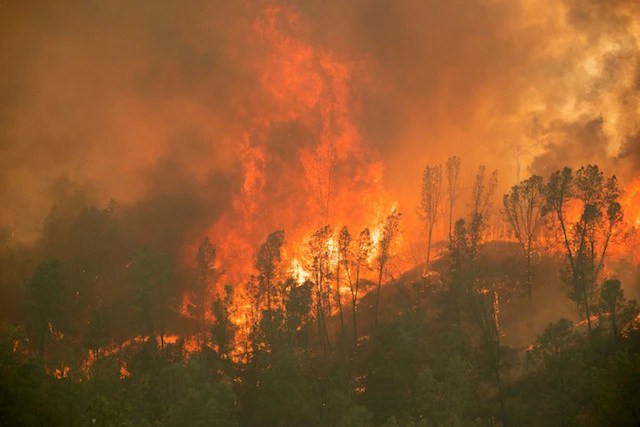
    • As of mid-October, wildfires in California have burned 4.04 million acres, the largest ever on record, and of the state’s top 20 largest wildfires historically, six were in August and September of this year, including the largest wildfire ever.  This fire season surpasses the “Big Blowup of 1910,” which was so destructive that it changed the way that the U.S. fought wildfires for the better part of a century.  Smoke from the fires in California, Oregon, and Washington State was so bad that it created haze on the East Coast of the United States.[vi][vii]
    • And all of this is independent of the fact that the U.S. now faces the deepest political divisions in at least 50 years.  We started the year with impeachment proceedings against the President, and partisanship has only deepened since then.  Daily protests against racial injustice across the country are stretching now into months, and commentators are talking about a “cold civil war” to engulf the nation after November regardless of the outcome of the elections.

    The list could go on.  In ordinary conversations we talk about 2020 as a wild or crazy year; one could even crassly call it a “dumpster fire.”  What is undeniable is that the scale, scope, and convergence of the problems we now face is well out of the ordinary.  If we truly believe what we profess as Christians that God is sovereign and is actively involved in the affairs of mankind, then the conclusion is inescapable that these things coming to pass is a result of His will.  It is not simply that God permits them to happen.  In His exercise of common grace toward all people, God sustains the world as we know it and constrains the exercise of moral evil and natural woe within certain boundaries so as to enable His Gospel to go forth to the peoples.  What we are seeing now represents a loosening of that sustenance and of those restraints.  This could only come about because either his sovereignty and power are weakening—an unbiblical notion that assumes that God is less than God and that chaos, not God is behind all things—or because it is His will for it to happen.  Yet, to reiterate what Goldberg pointed out, few—including Christians—are really talking about any of this being a judgment from God.  By contrast, when the last wave of the bubonic plague hit London between 1665-66 and the Great Fire gutted central parts of the city in 1666, pastors and theologians warned their congregants that these things were a judgment from God.  When we experience greater things on a national, transnational, and global scale, we get breezy articles in magazines and newspapers about how celebrities are finding “meaning” in the pandemic through vaguely spiritual platitudes.  Even conservative pastors and theologians today are going out of their way to dampen down the notion that these things represent any kind of judgment from God.

    This image has an empty alt attribute; its file name is hurricane-laura-aftermath.jpg
    Hurricane Laura Aftermath, August 2020

    Why are we so dismissive of the idea of God’s judgment?

    Part of the reason, no doubt, is the penchant for religious leaders to invoke “God’s judgment” to moralistically whip particular hobby horses.  In the immediate aftermath of 9/11, for example, Jerry Falwell Sr. and Pat Robertson said God allowed the attacks to happen because of abortion, homosexuality, secularism, and judicial activism in the United States, remarks that they quickly backed away from after incurring political backlash.[viii]  The theological problem with their perspective was in seeing how one got to the effect (i.e., the attacks) from the purported cause (i.e., abortion, homosexuality, etc.).  If “God’s judgment” requires a logical leap to see, then something is probably wrong with that reasoning.  Nevertheless, poor reasoning by some pastors and theologians does not negate the possibility of God exercising judgment on people: God Himself promised to bring judgments against His people for turning away from Him (Lev. ch. 26, Deut. 28:15-68) and he executed such judgments against them by sending them into Exile.  The writer of the Book of Hebrews also speaks of God disciplining His children with painful suffering (Heb. 12:5-6, quoting Prov. 3:11-12, cf. Rev. 3:19).  God’s ultimate judgments thus far in history, of course, are the Flood and the Cross.

    Reacting against simplistic correlations like what Falwell and Robertson made after 9/11, many theologians point to the fact that there is much unmerited suffering in the world and the Lord even told us to expect as much.  There is truth in this observation, to be sure. Scripturally, one can point to Job, to the Lord’s statement about the Galileans who were executed by Pilate or on whom the tower of Siloam fell (Luke 13:1-5), as well as to the man born blind from birth (John 9:1-3ff).  Theologians rightly note that the existence of such unmerited suffering means we should be cautious about declaring something to be “God’s judgment.”  That said, it must be pointed out that all these examples are ones of suffering by individuals or small groups.  If whole societies and nations are facing a convergence of pandemic, natural disasters, economic depression, and increased political strife, then does it not stand to reason that something a little more than individual misfortune is going on here?  The question has to be asked that if those things do not constitute some kind of judgment from God, then what would?  I am at a loss to describe what that could be.

    I think the deeper issue in why we tend to be so dismissive of the idea that we could be experiencing God’s judgment is that, regardless of what many people may formally confess religiously, even as Christians, they more often than not act as functional atheists.  Take, for example, House Speaker Nancy Pelosi’s remark to MSNBC on September 10 regarding the wildfires: “Mother Earth is angry.  She’s telling us — whether she’s telling us with hurricanes on the Gulf Coast, fires in the West, whatever it is … that the climate crisis is real and has an impact.”[ix]  The statement is foolish: she speaks as if creation is personified when it is not at all a sentient entity.  “Mother Nature” no more exists than the Tooth Fairy, and as a professing Roman Catholic Pelosi should know this.  God exists, however, He may well be angry.  But in this case, He has been written out of the equation.

    Pelosi’s reference to climate change implicitly points to another reason we dismiss the notion of God’s judgment and that is that we have a “God of the Gaps” mentality.  That is, we only invoke God if we cannot explain a phenomenon.  Wildfires and rampant hurricanes are thus due to climate change.  The coronavirus came from wet markets in Wuhan (or if you prefer discredited conspiracy theories, from bioweapons labs there).  Racial issues are due to systemic racism.  Political divisions are due to the incompetence and malignity of the political parties, amplified to the nth degree by social media.  Because we can identify these causes, we do not need for God for a hypothesis.  This also logically means that we see our salvation coming from our ability to address these causes.  Scientists, sociologists, and politicians are our saviors.  Climate change can be fixed by rejoining the Paris Treaty.  Racial frictions can be fixed by Critical Race Theory.  Economic downturn can be fixed by socialism.  The political dysfunction can be fixed by electing or re-electing the political party of your preference.  And with the coronavirus, our salvation comes not from God, but Regeneron, Pfizer, or Astra Zeneca.  When we get the vaccine, life will return to the status quo ante.  Or so we tell ourselves.

    This image has an empty alt attribute; its file name is california-wildfires-2020-jakarta-post.jpg
    California Wildfires

    And this is what worries me about our current predicament.  One does not have to probe too long or too deeply to realize that these modern “gods” in whom we are putting our faith will fail.  They will fail because they operate on faulty assumptions, are incomplete, self-contradictory, and/or presume a greater wisdom and ability on the part of mankind than heretofore has been shown by our species in all of recorded history.  They will fail, ultimately, because in being fixated on proximate causes they ignore the deeper reality of an absolute, self-contained, Triune Creator God who is behind all things and who, working through secondary causes, controls all things and has a purpose in all that comes to pass.  Too often in our churches and seminaries, we have absolved God of any notion of judgment because a God who has the authority to judge and is capable of judging does not fit the therapeutic God we want.  We want our autonomy from God, and we tell ourselves that the judging God of the Bible is reflective of a primitive stage in human development, one which we moderns have now transcended by our superior knowledge and technical skills.  Never mind, the fact that despite our better technology and ability to handle complexity, people are still morally the same in essence and no better than they ever have been since the Fall.  As the Apostle Paul said, quoting Ps. 14, “there is none that does good, no not one” (Rom. 3:12).

    The idea of God as judge suffers from caricature, not only from unbelievers but also from within the church itself.  A common image is that God declares arbitrary rules and then gets angry when people do not follow them.  This image seems to be beneath the dignity of a loving God, which is why it is so easy for moderns to dismiss it.  But that is not a biblical understanding of God as judge.  Biblically speaking, the first and foremost thing we must realize is that because God is Creator, all of creation is His domain and it is His right to judge mankind.  If you were to come into my house, berate my wife, harm my cat, and destroy my furniture it would not be unfair for me to judge you and throw you out my house, even using the police if needed.  Likewise, it is well within God’s power and right to judge man in His dominion.  God created man to both reflect His image to creation and to lead creation in glorifying God.  Man’s purpose was to be in a relational union and communion with God, but that was broken by the Fall and man’s entrance into sin.  In God’s redemptive work, He calls His people to love Him with all their heart, all their soul, and all their strength (Deut. 6:5, cf. Matt. 22:37).  Because communion with God Himself is man’s greatest good, anything less than loving God with all our heart, soul, and strength—especially in insisting on our autonomy from God—is no less than cosmic treason, meriting death.  This is the basis for God’s judgment.

    Turning back to our current situation, we may well be fundamentally misjudging the seriousness and duration of our predicament by fixating on the immediate causes and ignoring the ultimate cause, the judgment of God.  Current expectations are that once we get past the elections and get a vaccine for the coronavirus, then everything will return to normal.  I sincerely hope this is the case—but at the same time, I cannot help thinking that if this is from God, then it will go on long enough for God to make His point.  That may well be a lot longer than anyone would care for.  To take but one example: the current search for a vaccine assumes that the virus is fairly stable, more like SARS than the regular flu, and that vaccination would provide immunity for an extended period of time.  But if the virus begins to mutate at a rate like the regular flu and/or if immunity is only for a short duration of time, say only for six months, then we could be dealing with the pandemic for quite some time.  And God controls those variables.  In the Book of Acts, the respected Pharisee Gamaliel told his compatriots regarding the testimony of the Apostles that “if this plan or this work is of men, it will come to nothing; but if it is of God, you cannot overthrow it—lest you even be found to fight against God” (Acts 5:38-39).  Though Gamaliel was not a Christian, it behooves us to heed his wisdom even today.  If these things are from God, then we are fools to think they are merely temporary inconveniences that we can overcome by our own efforts.

    What, then, is the purpose of God in all this?  The common thread in the disasters we are now experiencing is that God exists and only He controls the circumstances we face.  As such, it follows that people should rightly fear and revere Him.  Christians and non-Christians alike are not doing that.  The Apostle Paul, writing to the Romans, aptly observed that, “the wrath of God is revealed from heaven against all ungodliness and unrighteousness of men, who suppress the truth in unrighteousness, because what may be known of God is manifest in them, for God has shown it to them.  For since the creation of the world His invisible attributes are clearly seen, being understood by the things that are made, even His eternal power and Godhead, so that they are without excuse, because, although they knew God, they did not glorify Him as God, nor were thankful, but became futile in their thoughts, and their foolish hearts were darkened” (Rom. 1:18-21).  In the woes we have been experiencing, God displays His eternal power and deity.  To whom?  It would be easy to conclude that He only does this to unbelievers, but Paul speaks of those who although they knew God, did not glorify Him nor were thankful to Him.  This description fits unbelievers as well as many believers.  Christians are often quick to point out the sins of unbelievers.  We want to believe that it is those who support abortion or homosexuality or the encroachment of the state whom God will judge.  It is the Sins of Other People.  Insofar as we reflect on our own sins, we often come up with things like we did not do enough to defend life or to uphold traditional marriage; they are sins of omission, more so than of commission.  To be sure, God will not let the sins of others pass unjudged, but we forget that God calls upon His people to be holy as He is holy (1 Peter 3:16 cf. Lev. 11:44), and the LORD is zealous for the honor of His name.  It is worth recalling that when David confessed his sin with Bathsheba, the prophet Nathan, under the inspiration of the LORD, pronounced God’s forgiveness and added this coda: “However, because by this deed [David’s adultery and murder] you have given great occasion to the enemies of the LORD to blaspheme, the child also who is born to you shall surely die” (2 Sam. 12:14).  And the child did die.  God does not mess around.  Can we as those who bear the name of Christ say that we as a people have not given the enemies of God cause to blaspheme His name?  Can we personally say we have sought to be holy before God?  Many churches say that “Grace Changes Everything” but all too often this simply becomes a limited view of God and a way of excusing a lack of change in our lives.

    According to Scripture, God’s judgment does not begin with the unbelievers, but with the believers.  The Apostle Peter said in his first letter that, “the time has come for judgment to begin at the house of God; and if it begins with us first, what will be the end of those who do not obey the gospel of God?” (1 Pet. 4:17).  This certainly was the case with Jonah.  When Jonah sought to flee from the LORD because he hated his Assyrian enemies so much that he preferred to flee rather than preach the fear of God to them, God brought a great storm against the ship Jonah was on.  The storm affected everyone on board, both Jonah and the pagan crewmembers, but God’s purpose was aimed squarely at Jonah (Jon. 1:1-16).  The pagans feared Jonah’s God, but Jonah himself was so hard-hearted that he preferred to die rather than give a gospel to the denizens of Nineveh.  He did not count on God using a large sea creature to swallow him up and thereby give him time to rethink his hard-heartedness.

    God is calling all people, Christian and non-Christian alike, to acknowledge their sins, to repent, and to fear Him.  Christ Himself said, “Do not be afraid of those who kill the body, and after that have no more that they can do.  But I will show you whom you should fear: Fear Him who, after He has killed, has power to cast into hell; yes, I say to you, fear Him!” (Luke 12:4-5).  Hell is a concept that Christians have been strenuously trying to remove from their theological vocabulary, but no one in Scripture talks more about Hell than Christ Himself.  Hell displays the righteousness, holiness, and true justice of God.  We want to think of God as love, and He is, but He is not reducible to merely that.  God’s love is perfect, but so also is God’s justice and His wrath.  God pronounced His name to Moses saying, “The LORD, the LORD God, merciful and gracious, longsuffering, and abounding in goodness and truth, keeping mercy for thousands, forgiving iniquity and transgression and sin, by no means clearing the guilty, visiting the iniquity of the fathers upon the children and the children’s children to the third and fourth generation” (Exod. 34:6-7).  God is indeed longsuffering, but that does not mean He will not act to uphold His name and advance His kingdom.  Only in repenting and accepting the mediatorial and atoning work of Christ does anyone avert this eternal judgment of God.  And for Christians, we must examine ourselves, repent of our sins against God and return to Him.  He will humble the proud but be with the broken and contrite (Ps. 31:23, Isa. 57:15).


    [i] Johns Hopkins Coronavirus Resource Dashboard, accessed on 26 Sept 2020 at https://coronavirus.jhu.edu/map.html

    [ii] David Njagi, “The Biblical Locust Plague of 2020,” the BBC’s Future Planet, accessed on 26 Sept 2020 at https://www.bbc.com/future/article/20200806-the-biblical-east-african-locust-plagues-of-2020, and Pranav Baskar, “Locusts are a plague of Biblical Scope in 2020.  Why?  And What Are They Exactly?” NPR, 14 June 2020, accessed on 26 Sept 2020 at https://www.npr.org/sections/goatsandsoda/2020/06/14/876002404/locusts-are-a-plague-of-biblical-scope-in-2020-why-and-what-are-they-exactly.

    [iii] Bureau of Labor Statistics, 2 October 2020, access online on 10 October 2020 at https://www.bls.gov/news.release/pdf/empsit.pdf.

    [iv] Center on Budget and Policy Priorities, accessed on 26 Sept 2020 at https://www.cbpp.org/research/economy/chart-book-tracking-the-post-great-recession-economy

    [v] Bob Henson, “Why the 2020 Atlantic Hurricane Season Has Spun Out of Control,” the Washington Post online, accessed on 26 Sept 2020 at https://www.washingtonpost.com/weather/2020/09/23/atlantic-hurricanes-record-2020/.

    [vi] Cal Fire Incidents Overview, accessed online at https://www.fire.ca.gov/incidents/ on 10 October 2020.

    [vii] Diana Leonard and Andrew Freedman, “Western Wildfires: An ‘Unprecedented, Climate-Change Fueled Event, Experts Say,” the Washington Post online, access on 26 Sept 2020 at https://www.washingtonpost.com/weather/2020/09/11/western-wildfires-climate-change/.

    [viii] Laurie Goostein, “AFTER THE ATTACKS: FINDING FAULT; Falwell’s Finger Pointing Inappropriate, Bush Says,” NYT, accessed online on 30 Sept 2020 at https://www.nytimes.com/2001/09/15/us/after-attacks-finding-fault-falwell-s-finger-pointing-inappropriate-bush-says.html

    [ix] Dom Callicchio, “Pelosi on Wildfires in California and the West: ‘Mother Earth is Angry.’” Fox News online, accessed on 30 Septmber 2020 at https://www.foxnews.com/politics/pelosi-on-wildfires-in-california-and-west-mother-earth-is-angry.

  • God, COVID-19, and Natural Woe

    God, COVID-19, and Natural Woe

    In early April 2020, Jonah Goldberg observed in The Dispatch that one thing we were not hearing much of in this time of COVID-19 is any discussion of theodicy, that is, the justification of the existence, power, and goodness of God in the face of evil.  It is an astute observation; in other times, there usually would be someone saying that this was “God’s judgment” for one or another thing; no one is saying that now.  Among the reasons Goldberg speculates behind this absence is the broad fact that religion is just not as important a factor in American life as it used to be.  This is true and well-documented, but I would go one step further: even among the religious, God is often not held in awe.  This is what makes the current situation so ironic.  For as much talk among Christians as there is about God’s sovereignty and goodness, it rarely goes much deeper than that.  More discussion is focused on debates over the legitimacy of curtailing worship services than on what COVID-19 tells us of God’s working through such woes.  We need a bigger vision of God, and with that, reasons to help us understand how He is operating in times like this.

    To be sure, “theodicy” is not an everyday word, so let me be practical: if we cannot understand how God works in circumstances producing suffering—even without knowing why He is doing things—then it will be difficult to trust Him.  In the end, platitudes cannot sustain us.  Suffering is such an experiential crucible that we cannot live without finding some kind of meaning in it.  Suffering will challenge our view of reality, of God, and of man, and, left to our own devices, it will lead us to distorted manmade views of God that ultimately fail to deliver hope.  Worse, it will drive us outright to despair and hopelessness.  The need to justify God in the face of suffering, then, is not and should not be merely an exercise for academics: if God is who the Bible describes Him as being, then we can only have hope if we have a biblically-based realism of God, of man, and of our circumstances.

    In saying this, I fully recognize that when someone is in the midst of suffering and crying out “Why?” then the first ministry response needs to be to actively listen and not necessarily rush in with a theological answer.  Even Job’s associates got this right in showing up, shutting up, sitting with him, and grieving with him for a time (Job 2:11-13).  There is also wisdom in recognizing that the significance of what one is suffering may not be immediately apparent; indeed it may become so only in time, perhaps a long time.  So, we need to mark our words carefully, and provide encouragement from the Gospel.  Still, at some point, suffering brings to the fore the questions of why this is happening and who God is, and ministry requires more thoughtful answers to undergird the comfort and truth of the Gospel.

    This image has an empty alt attribute; its file name is job-and-his-friends-job-2-dure-2.jpg
    Job Confronting His Friends (Dore’ Engraving)

    As a starting point, we need to recover a distinction which historically theologians have drawn between “moral evil” and “natural evil,” although for the latter the term “natural woe” is probably better.  The distinctions have largely disappeared from our modern lexicon, but they provide much-needed precision.  Put simply, moral evil is evil done directly or indirectly by people with intent.  Abuse, oppression, depravity, and violence are examples of moral evils.  People are specifically responsible for doing such things, and in Christian terms this is typically what we would call sin.  Natural woe, on the other hand, are those misfortunes for which people as moral actors are not culpable.  This would include such things like natural disasters and, of course, diseases like COVID-19.  People’s actions may exacerbate those things, but do not cause them.  Christians agree that both moral evil and natural woe came in with the Fall, but often confuse the relationship between the two, and thereby confuse how to judge whether God or man is responsible for what comes to pass.

    There are three positions Christians typically gravitate toward in understanding natural woe, and these positions differ in how they view God’s working, man’s responsibility, and the hope (or lack thereof) which they hold out.

    Man’s suffering is due largely to a lack of faith or good behavior.  This is a reward-retribution theology, that is, God rewards you if you do good things and punishes you if you do bad things.  This is the theology of Job’s associates in the Book of Job.  They thought that because he was suffering, he must have done something really wrong to merit what he was experiencing.  All suffering, whether moral evil or natural woe, is man’s fault directly.  God is only giving people what they deserve.  This view is straight moralism and is probably the default mode for most of humanity.  The most egregious form of this thinking among Christians is the so-called “Prosperity Gospel,” which holds that whatever you want, you are to “name it and claim it in the name of Jesus.”  This sees God as like Santa Claus—He exists to give us goodies and make us happy.  It sounds good until someone experiences suffering or loss, at which point the presence and persistence of suffering or grief is only explained by charging that the individual does not have enough faith or is somehow not pleasing God.  The “hope” that it holds out is try harder to do better and believe more fervently.  There is no comfort in this, especially if one feels that he or she cannot do any more than what they have done.

    This view is also fundamentally unbiblical.  The Prosperity Gospel clearly is a false Gospel (Gal. 1:6-10), but even more subtle forms of moralism tend in the same direction.  Biblically speaking, while there is truth to the idea that God rewards what is good and punishes what is wrong, Scripture also shows that suffering is not always the result of sins, and rewards are not always the result of good behavior.  This can be seen in Job (again), in the Psalms, and really, throughout the Bible.  Even our Lord Himself says that some who have died in particularly tragic ways were no worse sinners than others (Luke 13:1-5).  In Scripture, there is a reality and a dimension to suffering that transcends simplistic rewards and retribution.  Moreover, contrary to the Prosperity Gospel, the Bible also shows that God does not exist to make us happy.  Rather, He exists and acts radically independent of us and everything else.  When God reveals Himself to Job at the end of that book (chs. 38-41), He does not explain Job’s suffering nor promise comfort, but rather, through a series of rhetorical questions, asserts His sovereign greatness.  Job wisely responds not with counter questions, but with humility and repentance (Job 40:3-5, 42:1-6).  Likewise, we need to have an awe of God.

    Natural woe is the byproduct of God creating a world that respects man’s free will.  This is more sophisticated than the first position, and is popular among evangelical Christians today.  God has created the world to work according to fixed natural laws because that environment best facilitates man’s free choice.  It is only against the backdrop of a predictable universe with consistent consequences that our choices can have significance.  Thus, things like natural disasters follow the inexorable laws of nature, and God is not going to change that for our convenience.  Moreover, some things which people experience are not necessarily evil, even if they are painful or unpleasant, for example, falling down and breaking one’s arm.  Following from this, because God has given man free will, He will limit His own actions so as to avoid trampling man’s free will.  God didn’t cause these evils to happen but He can use them.  This view has a certain ring of plausibility to it, and no less an apologist than C. S. Lewis advocated for it.[1]  Still, this is not workable—indeed, I do not think it was workable even for Lewis.

    In Lewis’s 1955 autobiography, Surprised by Joy, he noted that he lost his faith in God at ten years of age when his mother died of cancer.  After he returned to the Christian faith as an adult, one of the first apologetical books he wrote was The Problem of Pain (1940), and there he propounded an explanation for natural woe akin to that given above.  In 1956, he married Joy Davidman Gresham, and when she died in 1960—ironically, of cancer, just as his mother had—Lewis went into a spiritual tailspin.  In 1961 he published pseudonymously the book, A Grief Observed, which consisted of private notebooks he kept while grieving.  A Grief Observed is essentially his primal scream at God, and shows how close he came to losing his faith.  That he did not lose faith is to God’s praise, but it is clear that the intellectual answer he gave earlier to the problem of natural woe in The Problem of Pain did nothing for him in grappling with the searing loss of his wife to the evil of cancer.

    Why does this view ultimately fail to give comfort?  For all of its intellectual sophistication, it is logically confused, overly abstract, and tries to exonerate both God and man ultimately by assuming a fundamental randomness in the universe.

    The theologians and pastors I have heard talk in this manner often blur the distinction between moral evil and natural woe by lumping everything under the view that, “We live in a fallen world.”  While this is true, it misses a fundamental point about culpability: moral evil is caused by men; natural woe is not.  People intuitively understand the notion that men do evil to one another.  They don’t understand why things like accidents, diseases, and natural disasters exist to harm people.  COVID-19 is not a moral actor.  The causality of the one is not the causality of the other, and conflating the two only begs more questions.

    This confusion is exacerbated by abstraction.  This view assumes that nature operates on autopilot and that God is not actively involved in overseeing, sustaining, or directing it.  In this regard, natural woe is merely a side effect or a random occurrence in the way that things work.  Indeed, this presupposition is so embedded in our consciousness that it may well explain why we have not seen much discussion of theodicy in the current COVID-19 pandemic: in the popular mind, “stuff happens.”  Considering natural woe as an unfortunate side effect, however, runs contrary to the reality of pain and suffering which we feel.  The suffering caused by losing one’s livelihood or home due to a natural disaster, or by physical pain from a terminal disease, or by the emotional pain of losing a loved one is serious pain.  It is not like breaking one’s arm.  Suggesting it is a “side effect” does not do justice to the depth of what we feel.  This may be a large part of the reason why Lewis’s own formulation did not work for him.  While seemingly sophisticated, it is emotionally distant.

    There is a deeper problem in positing the idea that natural woe is just randomness.  One can talk about a single random occurrence, and odd though it may be, it would not change our sense that there is a coherent universal order.  But there are so many natural woes in the world that if they are all attributable to random occurrences, then we are compelled to say that randomness and chaos are at the root of life.  And if randomness is behind all that we see and experience, then there is no assurance of any predictability, no coherence to life, and no purpose to give life meaning.  Can we really accept the logical consequences of such thoughts?  Can we really accept that our suffering or that of loved ones or the loss of others ultimately is meaningless?  In the anguish of our souls, I doubt we can.

    Moreover, if randomness is behind the natural woes we see, then that would be outside the purview, knowledge, and possibly even the control of God.  This is simply definitional: if it was within the purview, knowledge, and control of God, then it would not truly be random and the real question we would need to grapple with is why did God not prevent such natural woes in the first place or deal with them once they emerged?  The free will angle obscures this more fundamental question about the nature of God.  No one is clamoring to have a tornado wipe out their home or to get COVID-19; there is not a free will issue that God needs to respect.  People want God to intervene to prevent these woes, so why doesn’t He?  Because this view is man-centered, it cannot answer that question.  Moreover, the emphasis on God’s self-restraint leads to a view of God that makes Him out to be less than the absolute God of the Bible.

    And this gets us into the final reason why this view is problematic and that is that it presumes a God who is too small and too limited.  At best, one has the picture of a God who is inconsistent in dealing with natural woes.  In some cases, he heals people or spares them from greater suffering, and in other cases He doesn’t.  But what is the rationale for the difference?  If one takes this view to its logical conclusion then the notion of God restraining Himself to leave room for man’s free will eventually ends up with a Deistic God, a God who created things, but then left them to run of their own accord.  Such a result is logically necessary because at some point God would have to violate someone’s free will, and the only way He could avoid doing that is to do nothing at all.  At best, maybe such a God sympathizes deeply with our pain—but is such a passive God worthy of our worship?  Probably not.  This brings me to the last of the three positions to consider on natural woes.

    Natural woe is part of the sovereign plan of God.  The picture of a restrained, self-constrained, or passive God described above is not the picture of God we get from the Bible.  The Bible shows that God is more than willing to violate man’s free will when it suits Him.  Joseph’s brothers, for example, did not want Joseph to rule over them; Moses did not want to go to Egypt and confront Pharaoh; Paul on the road to Damascus sought the death of Christians.  In every case, God overruled their free wills for an overarching purpose He had in mind in which He would use them.  The Bible clearly shows that God is unceasingly active all the time in the lives of His creatures, and this is part of the reason why we pray to Him in the first place.  We expect that He can and will do things about the pain we are suffering or the grief we are feeling and that He has a purpose in it.  God is fully engaged with His creation, and that is a far more natural thing to expect than the Deistic notion that He created everything and then walked away from it for no particular reason.

    Many Christians recoil from this view, however, on the basis of two objections.  First, they feel that it reduces people to puppets with no free will, with God compelling every action we take, and, second, they feel it makes God the author of all our pain and of all evil.  Rightly understood, however, neither of these are true, and the keys to understanding this rest in appreciating both God’s use of secondary means and His overarching purposes.

    The doctrine of secondary means is often mentioned, rarely explained, and usually underappreciated.  But it is central in explaining the means through which God achieves His ends.  Think, for example, about how we interact with other people: if we want someone to do something, we can coerce or compel them, and sometimes we do that.  But that is not usually how we operate, and there are a range of other means we will use.  Positively, we could provide arguments to persuade them, invoke things to motivate them, and/or appeal to their emotions.  Negatively, we could warn them, rebuke them, or refrain from giving them support or encouragement for things we do not want them to do.  Depending on our relationship to the person—for example, if one were a parent, a teacher, or an employer—we could even widen or narrow the range of options they have for a given decision.  The better we know a person, the more subtle our engagement with them can be, and the more likely we will succeed in getting them to do what we want.  We will know what buttons to push, what to refrain from, and how far we can go.  None of that takes away from the fact that the decisions they make are still their own.  If we can do this in human interactions, then how much more can God do that, who knows us far more intimately than we know even ourselves?  He works with an infinite range of means, toward more overarching goals, over longer periods of time, with all people simultaneously.  Such complexity staggers our imagination, but begins to give us a glimpse into the plan of God.  At the same time, even from this faint glimpse we can see that it is far more realistic and interactive in engaging people than the caricatured view of God’s sovereignty that relies on coercion alone.  Indeed, it compels us to stand in humble awe of such a God.

    This understanding of secondary means also helps counter the charge that this all-encompassing view of God’s sovereignty makes God necessarily culpable for evil.  Here we need to provide some clarifications as to what precisely we are talking about.  Contemporary society has greatly debased the notion of culpability, such that anyone or anything contributing to an evil coming to pass is therefore responsible for that evil.  For example, some try to argue that if a gun seller sold a weapon to a teenager who used it in a school shooting, the gun seller should be held liable for the deaths resulting from that shooting.  But under the same logic, one could just as reasonably hold the victims responsible for their own deaths if they taunted, rebuffed, or ignored the shooter before the incident, thereby in his mind giving him justification for retaliating.  Intuitively, however, we know this is absurd and not right.  The person who actually committed an act is the one responsible for it, with his culpability mitigated or aggravated in degree by his motives and intent.  To say otherwise is to make everyone responsible in some way for everything, which in practical terms means no one is responsible for anything; that leaves the notion of culpability meaningless.

    In the case of moral evil, God’s permitting things to happen or not restraining them from happening does not mean that He causes them to happen.  God may allow us to sin, but will never compel us to sin.  If we sin, we do so because of the sinful desires within us.  With natural woes like COVID-19, however, God can be said to be culpable, since such woes are not caused by human actions, even as they may be exacerbated by them.  This fact brings matters to a head: if God is responsible, active, and can do something about that which is causing our pain and suffering, then why doesn’t He?  This is where we have to acknowledge that God is a free actor, indeed, the only truly free actor who is not dependent on anyone or anything.  As such, He is driven only by His purposes.

    And what are those purposes?  We variously think of God’s purposes as enforcing some cosmic rules, or fostering human flourishing in some vague sense, or even just to make us happy.  These are creation-centric purposes, as if God exists for our benefit.  Biblically understood, however, God’s purposes for man have God as their touchstone.  God created man to bear His image to creation and would be glorified in man leading creation to worship God.  This was to be a noble position, a position of honor, and man was to have communion with God.  Man, however, demanded his autonomy from God through the sin in Eden.  God’s glory will still be satisfied, but now it will be satisfied by the execution of His justice on the rebellion of some and the display of His mercy on others.  God’s goal, ultimately, is the coming of His Kingdom, in which man’s opposition is fully defeated, God’s rule is fully manifested, and God’s people are brought into full communion with Him, having been fully sanctified and purified.  All things, by the plan of God, are directed toward these eschatological ends.  As the Apostle Paul says in Romans, “And we know that all things work together for good to those who love God, to those who are called according to His purpose” (Rom. 8:28).  Christ’s death on the cross and resurrection from the dead is part of these “things.”  Through that, God’s people are reconciled to Himself. 

    But there is more in this as well.  God is sanctifying His people and fitting them for communion with Him in glory.  As part of this, the Westminster Confession of Faith’s chapter on providence (5.5) lists that among the reasons His people suffer is to enable them to see the hidden strength of the deceitfulness and corruption in their hearts, to chastise and humble them, to raise them to a more close and constant dependence on Himself, and to make them more watchful against future sin.

    More could be said, but this provides a context for natural woes.  Rather than being random side effects of the Fall, God uses these means to these ends.  In particular, He uses things like COVID-19 to draw the attention of men back to Himself in repentance, to break their stubborn will, to display His glory in overcoming such challenges, and to sanctify His people with whom He will commune forever.  Suffering under such hard providences will be difficult; it certainly will not be meaningless.

    That our suffering has meaning but only in God’s economy is the real crux of the issue.  I say this fully mindful of people I know who have suffered and even died from debilitating diseases and unexpected accidents over the years.  I think of one woman in college who while biking, lost control of her bicycle and when she hit the ground her heart stopped and she died.  I had another friend who while pregnant knew months before her due date that the baby she was carrying had a rare condition which ensured that the baby would not live more than a few hours after birth.  I think of another dear friend my own age, a dedicated serviceman, good athlete, and serious historian, who died of early onset Alzheimer’s.  There are still others who have suffered from cancer or other debilitating diseases.  There is nothing to suggest that they somehow merited their suffering.  Nor could I point them or others in the direction of a God who was so self-limited as to be effectively a bystander.  There is no hope or meaning in such a concept of God.

    The idea of a truly sovereign God who has incorporated pain and suffering into His plan and has a purpose for such things is a hard thing to accept.  To accept it requires humility, since the God that stands behind all reality is One who does not fit into our neat little boxes.  Nevertheless, such a God is One who truly offers hope for the afflicted.  Meaning comes from purpose and purpose must be personal.  An impersonal, random universe cannot supply meaning, since there is no ultimate end towards which things are directed.  If you are not a Christian and you are reading this, then I would encourage you to seriously examine what the basis is for any meaning you are clinging to and whether that hope is sure and unchanging.  Is hope that we invent for ourselves really satisfying?  My sense is no, because for hope to be real it must transcend us.  In the Christian vision of reality, God has purposes for our suffering that transcend our personal safety, comfort, or pleasure.  And if there is meaning in our suffering, then there is also meaning in what we have to live for.


    [1] C. S. Lewis, “Divine Omnipotence” in The Problem of Pain (New York: Simon and Schuster, 1996), 23-32.  This is as close as Lewis gets to the topic of natural woe.  Even in Lewis’s Mere Christianity, his focus is on explaining moral evil, not natural woe.