Lectionary Week 17, Covenantide 4
Confessional Readings
Of Justification
Westminster Confession of Faith 11
Westminster Larger Catechism 70-71
Westminster Shorter Catechism 33
Belgic Confession of Faith 23
Heidelberg Catechism 59, 61
Old Covenant Readings
Leviticus 1-7
New Covenant Readings
Mark 13-16
Psalms
(Of God’s Law) 119:129-176
Author. Repeatedly throughout Leviticus it is written, “The LORD said to Moses,” indicating that the contents were ultimately from the LORD and were given to Moses to write down (e.g., Lev. 1:1; 4:1; 5:16; 6:1, 8, 19, 24; 11:1; 12:1; 13:1; 14:1, 33; 15:1; 16:1; 19:1; 20:1; 21:1; 24:1 and 27:1).
Date. Leviticus begins immediately after God filled the Tabernacle with His presence in Exodus ch. 40, so the action is continuous with that of Exodus, and thus most of the book probably was written within the first year of the Exodus, about 1446-45 BC. The interrelatedness and the complexity of the laws described in this book would have necessitated having them written down early on in the life of the covenant community, and this is especially true given how the Golden Calf incident described in Exodus chs. 32-40 showed the people’s inclination to fashion false worship absent any divine guidance. Moses probably incorporated the narrative aspects of Leviticus (chs. 8-10 and 24:10-23) at the end of the Wilderness period in 1406 BC as he assembled the Pentateuch as a whole.
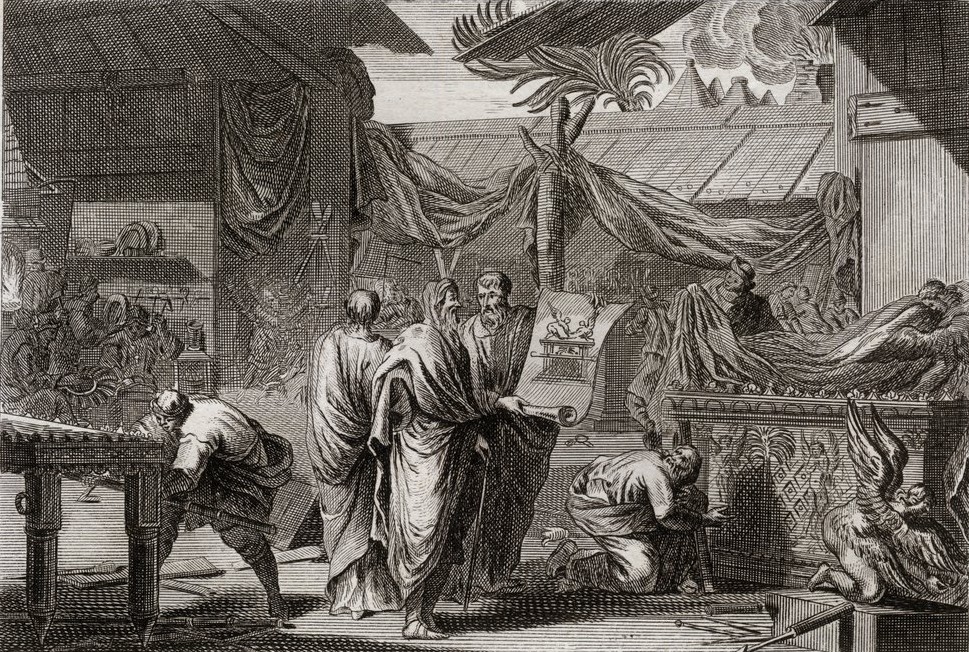
Covenantal Significance. Leviticus is best understood as the third part of the giving of the Law (Torah) at Sinai. God gave the first part, the Moral Law, in Exodus 20:1-17, with the people reacting appropriately with fear and trembling. This was closely followed by the Civil Law, in Exodus 21:2-23:19, followed by the ratification of this covenant in ch. 24. Starting in Exodus 25:1 and going through Leviticus ch. 25, God gave the Ceremonial Law, with the ratification aspects (i.e., blessings and curses) in ch. 26. The Reformed tradition has long identified the three types of Law, but seeing Leviticus as continuous with Exodus as described above provides the exegetical underpinning for this division.
Since Israel had been saved in the Exodus, the totality of the Law addresses the question of how the people are to live in covenant with their God in light of the salvation He wrought for them. Man was made in God’s image (Gen. 1:26-27), and those redeemed by God were to exhibit that restored image by being a kingdom of priests (Exod. 19:6). The Moral Law addresses the foundational ethical stipulations for individuals in reflecting God’s image. As a kingdom people, the Civil Law provided the foundation for justice and equity within the covenant community. Under the Mosaic administration, this was actual civil law, but under the New Covenant administration it supplies general principles of equity. And, lastly, as a priestly community, the Ceremonial Law was a tutor to God’s people (cf. Gal. 3), teaching them the radical demand for holiness that God expects of His people, the continual need for atonement with a holy God, and ultimately the need for One who would provide a definitive reconciliation with God which could never be attained through the sacrificial system (Heb. 9). The prohibitions on sexual immorality were implicitly continued under the New Covenant by the decision of the Council of Jerusalem directing Gentile believers to abstain from such sins (Acts 15). Understanding the holiness of God and the holiness which God expects of His people is the primary utility of Leviticus to the Christian church in today’s world.
Outline. Where Exod. 25:1-31:17 and 33:1-40:33 describe the material apparatus of the ceremonial system, Leviticus begins with the practices of that system. The first section (chs. 1-7) describes the offerings themselves, first from the perspective of the one bringing the offerings and then in terms of instructions to the priests handling the offerings. This is followed by a short narrative section (chs. 8-10) showing the institution of the priesthood, culminating with the death of Aaron’s sons Nadab and Abihu and thereby underscoring the seriousness with which God is to be worshipped only in the manner in which He has prescribed. The next two sections, dealing with uncleanness (chs. 11-16) and holiness (chs. 17-25) respectively. The book closes with blessings for obedience and curses for disobedience (ch. 26). Chapter 27 forms what is essentially an appendix covering the rules on vows and tithes.


Leave a comment