Many who have encountered covenant theology quickly and intuitively recognize that this approach to Scripture has tremendous explanatory power. It reveals the progressive unfolding of the Old and New Testaments, while still providing a unifying coherence to the totality of Scripture, and it does so in a way that keeps the LORD at the center of the narrative. To me, as one who has been a practitioner in the field of international relations, the fact that the covenants were rooted in ancient Near Eastern diplomacy reinforced the historicity and truthfulness of the Bible. Scripture is not human reflections upon the divine in the abstract, but the Almighty God working in real history, working in real space and time, to bring about the redemption of a people He has graciously chosen for Himself from all eternity. And yet, as I have grappled with covenant theology over the years, two issues have stood out for me in terms of how theologians have tended to treat the topic: first, the definition of “covenant” tends to be inconsistent, oversimplified, and malleable; and, second, after making a passing nod to the ancient Near Eastern context, scholars often fail to draw out the significance of that milieu for what God is saying to His people through the covenants. This essay is an attempt to address those issues, not with the goal of giving yet another overview of covenant theology, but rather to provide sufficient background to make covenant theology clearer readers of Scripture.
Tag: covenant
-
Lectionary Readings – Week of 11 January AD 2026
Lectionary Week 2, Desertide 1
Confessional Readings
Of the Chief End of Man and Our Only Comfort
Westminster Larger Catechism 1
Westminster Shorter Catechism 1
Heidelberg Catechism 1-2Old Covenant Readings
Genesis 1-5
New Covenant Readings
John 1-6
Psalms
(Of David) 3-8
About Desertide
For the next eleven weeks, the lectionary readings will comprise Desertide. Throughout Scripture, the desert (really, the Wilderness) has always been a place of testing and meeting God. It was there where God commissioned Moses (Exod. 3:1-4:17), there where He brought Israel to after the Exodus and there where they wandered for forty years before entering the Promised Land (Exod. 14 through Deut. 34). It was to the wilderness that David fled in his confrontation with Saul (1 Sam. 21-26) and, similarly, where Elijah fled after his confrontation with the prophets of Baal (1 Kings 19:1-18). Israel’s later Exile to Babylon was tantamount to a second wilderness wandering (Jeremiah, Lamentations, Ezekiel, and Daniel). From the wilderness John the Baptist called the nation to repentance (Matt. 3:1-12 || Mark 1:2-6 || Luke 3:3-6). Most importantly, our Lord stayed in the wilderness for forty days resisting the Devil’s temptations (Matt. 4:1-11 || Mark 1:12-13 || Luke 4:1-8). And subsequently, it was the area to which the Apostle Paul went for three years after he accepted Christ as Lord on the road to Damascus (Gal. 1:17-18).
Understanding the Pentateuch
Foundational to the entire Bible is God’s revelation in the Pentateuch—i.e., the books of Genesis, Exodus, Leviticus, Numbers and Deuteronomy—and Joshua. That the Pentateuch is foundational to biblical religion can be seen from the very fact that in the traditional division of the Hebrew Scriptures of the Law (Torah), the Prophets (Nevi’im) and the Writings (Ketuvim), the Pentateuch by itself comprises the entirety of the Law.
The Pentateuch narrates God’s great salvation event of the Old Testament, the Exodus, and Deuteronomy is the capstone of the Pentateuch. Deuteronomy has often been treated as simply a series of sermons which Moses gave to the people toward the end of his life, but that may not be the best interpretation of the book. Old Testament theologian Meredith G. Kline observed in his book, Treaty of the Great King, that Deuteronomy bore a particularly close resemblance to ancient Near Eastern treaty covenants of the second millennium BC. But why was Deuteronomy written? And why was it written in the form of a covenant?
Deuteronomy may have been intended as a kind of succession covenant. In the ancient Near East, kings would often make covenants with their subjects or with vassal kings to ensure that upon their death their designated successor would secure the throne. In the case of Deuteronomy, the book was written as the people were poised to enter the Promised Land which God promised to their ancestor Abraham more than 400 years earlier, but Moses would not be going in with them because he sinned against God at Meribah (Deut. 1:37 cf. Num. 20:1-13). Like the Israelites he led for forty years, he, too, would die in the Wilderness. Thus, there was the need to secure the succession from Moses to Joshua in terms of who would lead the people and be a mediator or an intercessor for them with God. While anyone following Moses’s footsteps would face a significant challenge given the influence he wielded, this succession issue was exacerbated by the people’s history of rebelliousness. In forty years of leading God’s people, Moses repeatedly had witnessed firsthand the Israelites’ propensity to question and wander from the very God who saved them. Although Joshua would lead the people into the Promised Land, the people needed to be reminded that their ultimate leader would not be him but would be God Himself. This was Moses’s parting legacy, in a sense, his last will and testament. The Deuteronomic covenant, then, would thus formally and concretely bind God’s people to the LORD, and the Law’s stipulations would regulate the nation’s relationship with the LORD. In effect, while Joshua would henceforth lead the people in the Conquest of Canaan, the Law would take the place of the mediatorial role that Moses himself had filled. The formality of a covenant not only underscored the obligatory and binding nature of the people’s relationship to God, but also, by its very formality, provided them assurance that God would fulfill His promises. Since the Exodus from Egypt, Israel had often questioned whether God would care for them and bring them into the land of promise, and they needed assurance that God would fulfill His promises. Joshua, too, also needed assurance that God was with him in leading this people.
This understanding helps to put into perspective why the rest of the Pentateuch was written. Just as Deuteronomy was written in the form of a covenant, the other four books of the Pentateuch compose a historical prelude to Deuteronomy, showing that Israel was not only the heir to God’s covenant promises, stretching back to the beginning of creation, but the special recipient of God’s redemptive work, and in a relationship of special obligation to God. This privileged position would have been an inducement to obedience and covenantal faithfulness.
Chronologically, the first things probably were written down by Moses would have been the core of the moral, civil, and ceremonial Law which he received from God on Sinai, including when he was with God for forty days and nights (Exodus chs. 20-31), and indeed, the first record of Moses writing anything down comes in this section (Exod. 24:5, 34:28). God’s revelation to Moses on Mount Sinai provided not only the moral basis for the community, Ten Commandments (i.e., the Moral Law), but also civil and ceremonial laws to regulate this newly liberated nation and how they were to honor and reflect the Lord.
The next thing probably to have been written down would have been the Levitical codes, since Israel’s sin with the Golden Calf and the death of Nadab and Abihu underscored the seriousness of following God’s command for how He was to be worshiped. The complexity of the code and the rituals Israel was commanded to follow would have necessitated having it in writing. Ironically, therefore, the portions of the Pentateuch that people typically find most boring—namely, chapter 20 through the end of Exodus and most all of Leviticus—probably were the first parts of Scripture to have been written down.
The narratives in Genesis, Exodus, Leviticus, and Numbers were probably written closer to the time Deuteronomy was written, late in the Wilderness period, as these books provide the connective tissue which situates the earlier legal and ceremonial codes in their proper historical context. This is why there is a thematic unity throughout the entire Pentateuch.
As the last book in this covenantal dispensation, the Book of Joshua was written probably about twenty years after that of Deuteronomy and serves as a kind of coda to God’s covenantal promises, showing that God did indeed fulfill the promises he had made to His people and brought them into the Promised Land, as He said he would. The covenant renewal ceremony as the end of Joshua (Joshua ch. 24) reflects the people’s rededication to hold fast to their covenant with the LORD who had saved them.
Understanding Genesis
Author. For millennia, Jewish and Christian tradition consistently ascribed authorship of the Pentateuch to Moses, who at God’s command and under His suzerainty led Israel out of Egypt and through forty years of wandering in the Wilderness. There are references throughout the Pentateuch to Moses writing down portions of it (e.g., Exod. 17:14, 24:4, 34:27, Num. 33:1-2, Deut. 1:5, 31:9, 22, 24) and other parts of the Old Testament also testify to Mosaic authorship (1 Kings 2:3, 8:53, 2 Kings 14:6, 18:12). Most conservative theologians acknowledge that Moses’s death account in Deuteronomy 34 probably was not written by Moses himself–most likely it was written by Joshua—but do not see this as contradicting Moses’s authorship of the rest of the Pentateuch. Efforts by critical scholars in the nineteenth and twentieth centuries to bring Mosaic authorship into question have been highly speculative, contradictory and have failed to produce conclusive evidence that would rule out Mosaic authorship. Even Christ Jesus Himself accepted Mosaic authorship of the Pentateuch during His earthly ministry (Matt. 19:7-8, Mark 10:3-5, John 5:46-47) and to His disciples after His resurrection (Luke 24:27, 44).
That Deuteronomy and the entire Pentateuch, including Genesis, were written as covenantal documents should not be surprising given Moses’s own biography. Exodus 2:9-10 says Moses was weaned by his own mother, which in a Near Eastern context may well have gone to a later age than typical in the West. From her Moses no doubt learned his identity as a Hebrew and developed a love for his people. In being adopted by Pharaoh’s daughter, however, he would have learned the practices of the Egyptian royal court. In the mid-second millennium BC, ancient Near Eastern diplomacy experienced a renaissance, and thus the covenantal paradigm would not have been alien to him, especially if he had been part of any diplomatic delegations.
Date. Moses probably wrote the Pentateuch between 1445 and 1406 BC. The dating is derived from 1 Kings 6:1, which says that construction on the Temple was built in the fourth year of Solomon’s reign, 480 years after the Exodus. A comparison of biblical and extra-biblical sources has established that this was in 966 BC, so that would put the Exodus in 1446 BC. Given the assumptions outlined in the overview of the First Covenantal Dispensation, Genesis probably was written toward the end of the Wilderness period, in about 1406 BC.
Although Moses lived through the events covered by the books of Exodus, Leviticus, Numbers and Deuteronomy, the events covered by Genesis, covers the period from the creation of the world until four hundred years before his birth. No doubt in writing Genesis, Moses probably drew on traditions handed down from generation to generation. While modern scholars tend to be dismissive of oral tradition, a few things must be noted in its defense. First, there is extrabiblical evidence that some things in Genesis—for example, the Flood—are also reflected in extrabiblical literature, suggesting that there is a broader collective memory that these things happened in some form. Second, like a person who loses his sight has his other senses become more acute in compensation, pre-Exodus Israel, like other pre-literate societies, probably devoted more attention to ensuring reliable transmission of oral tradition than would be expected in modern societies, since it would have been the only way to pass down the heritage to successive generations. The importance of this oral tradition would have been accentuated by the fact that it was central important in defining Israel’s identity when it was in Egypt. Lastly, any errors that did come into the tradition would have been corrected and supplemented by God both in the inspiration of Moses and in Moses’s direct personal interactions with God during the years of Israel’s wandering. For this reason, we can consider Genesis to be reliable according to the testimony of God.
Covenantal Significance. Genesis serves as the prequel to the Exodus, providing the backdrop for why the Exodus was necessary and how it was a fulfillment of God’s covenantal promises going back hundreds of years. Because the narrative gap between Genesis and Exodus is seamless, the omission of any history of the Israelites between the death of Joseph and the birth of Moses is almost certainly deliberate. Moses’s point in Genesis is to show that God’s deliverance of His people in the Exodus was rooted in His unbreakable covenantal commitments going back to before Abraham and were extended to them wholly by His grace. The promises in Genesis associated with God’s people coming into the land find their fulfillment in the narrative about the Conquest recounted in Joshua. Thus, Genesis and Joshua bookend the salvation of God’s People described in the Exodus.
Outline. From literary perspective, Genesis is divided primarily by ten divisions of genealogies, but narratively there are four major sections: (1) the creation account (Gen. 1:1-2:3); (2) the Covenant of Life in the Works of Adam (2:4-6:8); (3) the Covenant of Common Grace (6:9-11:26); and (4) the Covenant of Grace Proper.
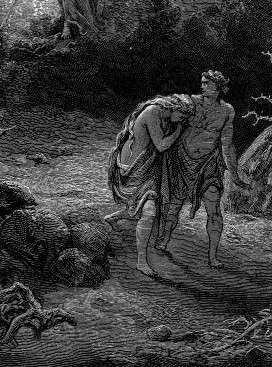
The Westminster Standards put forth a two-covenant paradigm for Scripture: a Covenant of Works in Adam and a Covenant of Grace in Christ. The former covenant describes man’s original righteousness and subsequent fall into sin and misery; the latter Covenant relates God’s redemptive program that will stretch through the remainder of Scripture, centering on the Lord Jesus Christ and culminating with His bodily return to execute the Final Judgment. Although the term Covenant of Life or Covenant of Works is not present in Scripture, the concept is present. The Covenant of Life shows man in a vassal relationship with the suzerain God, shows man as God’s vice-regent, representing God to creation in dominion and creation back to God in worship. Man had blessed communion with God his Creator. The covenant at this stage sets the foundation of man’s relationship to God, characterized by faith in God’s promises and fidelity in obedience to God’s commands. The clearest exegetical support for such a Covenant of Life is based on the parallelism the Apostle Paul presents between Adam (the “First Adam”) and Christ Jesus (the “Second Adam”) in Romans 5:12-20. That this period of God’s relationship with Adam prior to the Fall was understood in covenantal terms was a valid historical interpretation can be seen in the reference to it as such in Hosea 6:7. Beyond this, the narrative structure of Gen. 2:4-6:8 reinforces the understanding that Adam’s relationship with God was covenantal, since narratively, God’s warning that disobedience would lead to death—a covenantal sanctions—begins with the expulsion and death of Adam and Eve from the Garden and culminates in the destruction of mankind, save Noah’s family, through God’s judgment in the Flood.
The Fall marks not only a radical break in God’s covenantal dealings with mankind but is the seminal break. God’s redemptive work begins in earnest after the Flood. The rest of Scripture narrates God’s Covenant of Grace. There is some difference among covenant theologians as to when the Covenant of Grace technically begins, although most would put it in Gen. 3:15, with the promise of a Seed of Eve who will crush the head of the serpent. That said, the thoroughgoing nature of God’s judgment on mankind in the Flood is consistent with God’s warning before the Fall to Adam that disobedience would surely result in death and, except for Noah and his family, seems inconsistent with the overarching thrust of redemption characterized by the Covenant of Grace. God can and does act graciously independent of a formal covenant. It is only after the Flood that God begins codifying His redemptive program in the form of a covenant with the Noahic covenant. The significance of the Noahic Covenant, or what is termed here the Covenant of Common Grace, is that it is a necessary first step in God’s program of redemption, as it provides the gracious assurance that God will withhold such a comprehensive judgement for a time, thereby allowing His redemptive program to move forward. God’s redemptive program and work through a specific family line comes into clearer focus starting in Genesis chapter 12 with Abraham. The covenantal relationship with Abraham, beginning with the promises God makes in Gen. 12:1-3, the codification of the covenant in Gen. 15, the granting of a distinguishing covenantal sign in Gen. 17, and the confirmation of the covenantal relationship in Gen. 22, sets the basis for God’s redemption. The remainder of Genesis shows the conveyance of those covenant promises to Isaac, Jacob, and his family.
 Covenantide